

Cambodia has one of Southeast Asia’s most remarkable histories. Its story stretches from ancient communities and early kingdoms to the extraordinary Khmer Empire, the magnificent cities of Angkor, French colonial rule, independence, decades of conflict, and the rebuilding of the modern Kingdom of Cambodia.
For travelers, understanding Cambodian history adds meaning to almost every journey. A temple is not simply an old building, a traditional dance is not simply a performance, and a bustling market is not separate from the country’s past. Cambodia’s history continues to shape its architecture, religion, language, food, customs, cities, and national identity.
This guide provides a chronological overview of Cambodian history and highlights the historical periods that are most important for visitors to understand.
Quick Overview of Cambodian History
- Early civilizations: Ancient communities developed along the Mekong River and around the Tonle Sap region.
- Funan and Chenla: Early Southeast Asian states helped establish foundations for later Khmer civilization.
- Khmer Empire: From the 9th century, Khmer rulers built a powerful regional kingdom centered eventually at Angkor.
- Angkor period: Large temples, reservoirs, roads, and sophisticated urban systems were constructed between the 9th and 15th centuries.
- Post-Angkor period: Political power shifted away from Angkor and Cambodia experienced changing regional influences.
- French colonial period: Cambodia became part of French Indochina in the 19th century.
- Independence: Cambodia gained independence from France in 1953.
- War and Khmer Rouge: Cambodia experienced civil conflict and the devastating Khmer Rouge regime from 1975 to 1979.
- Peace and reconstruction: The 1991 Paris Peace Agreements and the UN transitional period helped establish a framework for peace and elections.
- Modern Cambodia: The country continues to preserve its heritage while developing as a modern Southeast Asian nation.
1. The Early History of Cambodia
The history of Cambodia began long before the famous temples of Angkor. Archaeological evidence indicates that people lived in the territory of present-day Cambodia thousands of years ago. Agriculture, including rice cultivation, became increasingly important, while communities developed around rivers, lakes, and fertile plains.
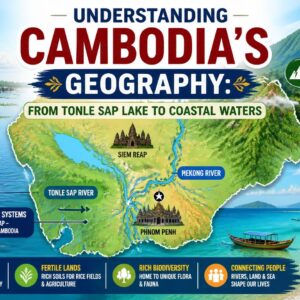
The Mekong River and Tonle Sap system played an important role in the development of early Cambodian societies. Water provided transportation, food, agricultural opportunities, and connections between communities.
By the beginning of the first millennium AD, Cambodia was part of a wider Southeast Asian world connected by trade with India, China, and neighboring regions. Indian religious and cultural traditions influenced local societies, while indigenous beliefs remained important.
2. Funan and Chenla: Foundations of Khmer Civilization
Funan
One of the earliest known complex states in the region was Funan, which flourished during the first centuries AD. Its centers were connected to important waterways and trade routes linking mainland Southeast Asia with maritime networks.
Archaeological evidence from sites such as Angkor Borei in present-day Takeo Province provides important evidence about early political and cultural development in the region. Angkor Borei is associated with the early history of Khmer civilization and has been identified as an important center of the ancient polity known as Funan.
Chenla
Later, Chenla became an important political power in mainland Southeast Asia. One of its major centers was Ishanapura, represented today by the archaeological site of Sambor Prei Kuk.
Sambor Prei Kuk is particularly significant because its architecture and artistic traditions helped establish foundations for the later Khmer architectural style seen at Angkor. The site contains hundreds of ancient brick structures and reflects the religious and political development of the period.
3. The Rise of the Khmer Empire
The Khmer Empire emerged as one of the most influential civilizations in Southeast Asia. The beginning of the empire is traditionally associated with King Jayavarman II in the early 9th century.
Jayavarman II helped unite important Khmer territories and established the foundations of a centralized kingdom. Over subsequent centuries, Khmer rulers expanded their influence across large areas of mainland Southeast Asia.
The empire’s strength was supported by agriculture, political organization, religious institutions, trade, engineering, and an extensive system of roads and waterways.
The Khmer rulers also developed a distinctive architectural tradition that combined local ideas with influences from Hinduism and Buddhism. Temples became important religious, political, and cultural centers.
4. Angkor: The Golden Age of Khmer Civilization
When people think about Cambodian history, Angkor is often the first chapter that comes to mind. For several centuries, Angkor was the political and cultural center of the Khmer Kingdom.
The Angkor region contains the remains of several capitals and enormous temple complexes. Among them, Angkor Wat is the most famous, while Angkor Thom, Bayon, Ta Prohm, Banteay Srei, and many other sites demonstrate the scale and diversity of Khmer civilization.
Angkor was much more than a collection of temples. The archaeological landscape includes reservoirs, canals, embankments, roads, settlements, and other infrastructure that supported a large population.
UNESCO describes Angkor as one of the most important archaeological sites in Southeast Asia. The archaeological park covers approximately 400 square kilometers and preserves the remains of Khmer capitals dating from the 9th to the 15th centuries.
Jayavarman VII and the Expansion of Angkor
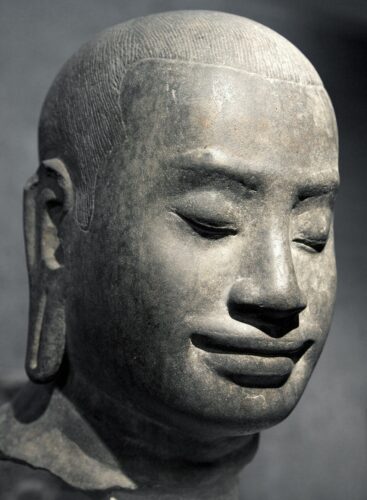
King Jayavarman VII was one of the most influential rulers of the Angkor period. His reign is associated with major construction projects and the expansion of Buddhist architecture.
Angkor Thom and the Bayon are especially associated with his period. His reign also saw the construction of roads, reservoirs, temples, hospitals, and other public infrastructure.
Angkor Wat and Khmer Identity
Angkor Wat was originally constructed as a Hindu temple associated with Vishnu and later became an important Buddhist site. Today, it is one of Cambodia’s most recognizable national symbols.
The Angkor monuments are not only archaeological attractions. They are an important part of Cambodia’s cultural heritage and continue to influence Cambodian art, architecture, religion, tourism, and national identity.
5. Koh Ker and Other Important Khmer Capitals
Angkor was not the only important capital of the Khmer Empire. Koh Ker, located northeast of Angkor, briefly became a major royal center during the 10th century.
UNESCO identifies Koh Ker as the capital of the Khmer Empire from 921 to 944 CE. Its monuments are notable for their large-scale stone construction and distinctive architectural style.
Other important archaeological centers include Sambor Prei Kuk, Preah Vihear, Banteay Chhmar, and numerous temple complexes throughout Cambodia. Together, these sites demonstrate that Khmer civilization was much broader than Angkor Wat alone.
6. The Post-Angkor Period
From around the 15th century, the political center of Cambodia gradually shifted away from Angkor. Historians have proposed several interconnected explanations for the transformation of Angkor, including political changes, regional conflicts, environmental pressures, changes in trade networks, and the evolving management of water systems.
Cambodia entered a different historical period in which political centers developed farther south. Phnom Penh eventually became an increasingly important center because of its strategic position near the Mekong, Tonle Sap, and Bassac rivers.
During the centuries after Angkor, Cambodia existed between powerful neighboring kingdoms and faced changing political circumstances. Despite these challenges, Khmer language, Theravada Buddhism, traditions, arts, and cultural identity continued to develop.
7. Cambodia Under French Colonial Rule
In the 19th century, Cambodia came under increasing French influence. In 1863, King Norodom signed an agreement establishing a French protectorate over Cambodia.
Cambodia subsequently became part of French Indochina, together with neighboring territories under French colonial administration. French influence affected Cambodia’s administration, education, architecture, infrastructure, and urban development.
Phnom Penh changed considerably during this period, and examples of French colonial architecture can still be seen in parts of the capital and other Cambodian towns.
The colonial period also influenced the preservation and study of Cambodia’s ancient monuments. European scholars and archaeologists increasingly documented Angkor and other archaeological sites.
8. Cambodian Independence in 1953
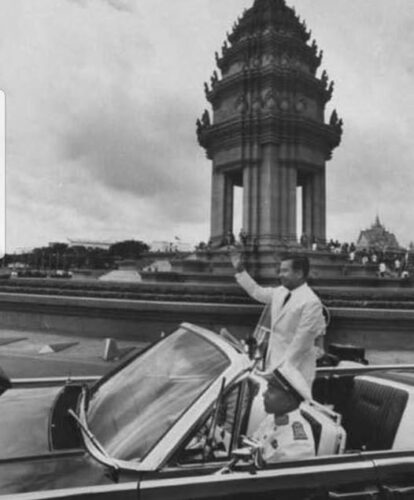
Cambodia gained independence from France in 1953 under King Norodom Sihanouk. The achievement marked a major turning point in the country’s modern history.
The years following independence were associated with efforts to develop Cambodia as an independent state. Prince Norodom Sihanouk played a central role in Cambodian politics during the period that followed independence.
Cambodia became a member of the United Nations in 1955, establishing its place as an independent state in the international community.
9. War, Political Upheaval, and the Khmer Republic
Cambodia’s position during the Cold War became increasingly difficult. Regional conflict connected to the wider war in Indochina affected the country, while political tensions grew inside Cambodia.
In 1970, a coup removed Prince Norodom Sihanouk from power and established the Khmer Republic under Lon Nol. The country subsequently became deeply involved in civil conflict.
The conflict created severe instability and helped create conditions in which the Khmer Rouge movement expanded its influence.
10. The Khmer Rouge Era, 1975–1979
On 17 April 1975, Khmer Rouge forces captured Phnom Penh. Cambodia was renamed Democratic Kampuchea and underwent one of the most devastating periods in its modern history.
The Khmer Rouge regime attempted to transform Cambodian society through radical policies. Cities were emptied, families were separated, religious and cultural institutions were severely affected, and large numbers of people were subjected to forced labor, starvation, imprisonment, torture, and execution.
The period lasted from 1975 until January 1979. The United Nations has described the Khmer Rouge period as a major humanitarian catastrophe, with an estimated 1.7 million Cambodians dying through execution, starvation, exhaustion, and related causes.
Today, sites such as the Tuol Sleng Genocide Museum and Choeung Ek provide places for remembrance and education about this difficult chapter of Cambodian history.
Learning about this period should be approached with respect for survivors and victims. It is an essential part of understanding modern Cambodia and the resilience of its people.
11. Cambodia After 1979
The Khmer Rouge regime was overthrown in January 1979, but peace did not immediately return to Cambodia. Conflict continued for many years, and the country faced enormous challenges in rebuilding its institutions, economy, education system, infrastructure, and social life.
The 1980s were marked by continued political conflict and humanitarian challenges. International humanitarian organizations provided assistance to displaced Cambodians, including communities near the Thai-Cambodian border.
For ordinary Cambodian families, this was a period of rebuilding after years of war and upheaval.
12. The Paris Peace Agreements and UNTAC
A major turning point came on 23 October 1991, when the Cambodian parties and international partners signed the Paris Peace Agreements.
The agreements established a framework for ending the conflict and creating conditions for a political settlement. The United Nations Transitional Authority in Cambodia, commonly known as UNTAC, subsequently operated in Cambodia from 1992 to 1993.
UNTAC helped organize and support the country’s transition toward elections and the restoration of national institutions. In September 1993, the Constitution for the Kingdom of Cambodia was promulgated and a new Royal Government was inaugurated.
13. Cambodia’s Modern Era
Since the 1990s, Cambodia has continued the long process of rebuilding and development. Cities have expanded, infrastructure has improved, and tourism has become an important part of the national economy.
At the same time, Cambodia has continued to preserve its cultural heritage. Ancient temples, traditional performing arts, religious practices, handicrafts, historic urban areas, and archaeological landscapes remain important parts of Cambodian identity.
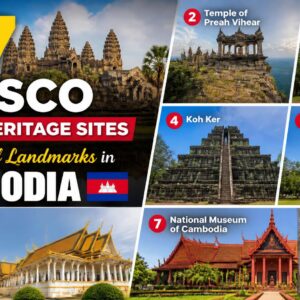
UNESCO’s World Heritage listings illustrate the breadth of Cambodia’s heritage. The country’s listed properties include Angkor, the Temple of Preah Vihear, Sambor Prei Kuk, Koh Ker, and Cambodian Memorial Sites.
For visitors, this means Cambodia offers much more than one famous destination. Its history can be explored through ancient archaeological sites, colonial architecture, museums, memorial sites, traditional communities, religious monuments, and living cultural traditions.
14. Why Cambodian History Matters to Travelers
Understanding Cambodian history can transform the way you experience the country.
- At Angkor: You can understand why temples were built, how they relate to Khmer kings, and why water management was so important.
- In Phnom Penh: Colonial buildings, royal institutions, museums, and memorial sites represent different chapters of Cambodia’s modern history.
- At Sambor Prei Kuk: You can explore an important pre-Angkorian center that helped shape later Khmer architecture.
- At Koh Ker: You can see evidence of a different Khmer imperial capital and artistic tradition.
- At Preah Vihear: You can experience a major Khmer temple situated dramatically on a mountain landscape.
- At Cambodia’s museums and memorial sites: You can learn about the country’s more recent history and the experiences of Cambodian people during periods of conflict.
Practical Tips for Exploring Cambodia’s History
Travel Tips
- Give Angkor enough time: Do not treat Angkor Wat as the only temple worth visiting. The wider archaeological park contains many different sites.
- Learn before visiting memorial sites: Reading a short historical overview can make visits to museums and memorial locations more meaningful.
- Visit museums: Museums in Phnom Penh and Siem Reap can provide historical context that is difficult to understand from monuments alone.
- Respect sacred places: Dress appropriately and behave respectfully when visiting temples and active Buddhist sites.
- Look beyond Angkor: Cambodia’s history extends across many provinces, including Takeo, Kampong Thom, Preah Vihear, Oddar Meanchey, and other regions.
- Consider a knowledgeable guide: A good local guide can explain historical details, religious symbolism, architecture, and local traditions that visitors may otherwise miss.
Frequently Asked Questions About Cambodia’s History
What is Cambodia most famous for historically?
Cambodia is especially famous for the Khmer Empire and the Angkor civilization. Angkor Wat and the wider Angkor archaeological complex are among the country’s most important historical and cultural landmarks.
When was the Khmer Empire?
The Khmer Empire emerged in the early 9th century and remained a major regional power for several centuries. Angkor was its principal political and cultural center for much of this period.
What was Cambodia called before?
The name of the country changed during different historical periods. In the modern era, Cambodia was known as the Khmer Republic from 1970 to 1975 and Democratic Kampuchea during the Khmer Rouge period from 1975 to 1979. The country has also used other official names during different periods of its modern history.
When did Cambodia gain independence?
Cambodia gained independence from France in 1953 under King Norodom Sihanouk.
What happened in Cambodia between 1975 and 1979?
From 1975 to 1979, Cambodia was governed by the Khmer Rouge regime under Democratic Kampuchea. The regime’s policies caused mass death, displacement, forced labor, starvation, imprisonment, torture, and execution.
Why is Angkor important to Cambodia?
Angkor represents one of the greatest achievements of Khmer civilization. Its temples, urban remains, reservoirs, canals, roads, and sculptures provide evidence of the political, religious, artistic, and technological development of the Khmer Empire.
Is Cambodian history only about Angkor?
No. Angkor is an important part of Cambodian history, but the country’s heritage includes prehistoric communities, Funan and Chenla, other Khmer capitals such as Koh Ker, the post-Angkor period, French colonial history, independence, the Khmer Rouge period, and the country’s modern development.
Sources & References
This article was researched using information from established institutional and heritage sources. These references are provided to help readers explore Cambodia’s history in greater depth.
- UNESCO World Heritage Centre: Angkor and Cambodia’s World Heritage sites.
- UNESCO: Sambor Prei Kuk, Koh Ker, and other Cambodian heritage sites.
- United Nations in Cambodia: Cambodia’s modern political history, peace process, UNTAC, and post-conflict development.
- United Nations Treaty Collection: Paris Agreement on the comprehensive political settlement of the Cambodia conflict.
- Tourism Cambodia: Historical overview of Cambodia and early Cambodian civilization.
Conclusion
The history of Cambodia is a story of remarkable achievements, cultural continuity, hardship, resilience, and renewal. From the early kingdoms of Funan and Chenla to the extraordinary Khmer Empire, from the monumental cities of Angkor to independence and the painful experience of the Khmer Rouge era, each period has contributed to the Cambodia that travelers see today.
Exploring Cambodia with an understanding of its history makes the country’s temples, cities, landscapes, museums, and traditions much more meaningful. Whether you are visiting Angkor Wat for the first time, walking through Phnom Penh, exploring ancient sites beyond Siem Reap, or discovering Cambodia’s quieter provinces, the country’s past is always close to the surface.
Planning a trip to Cambodia? Explore more GoToKH guides to discover Cambodia’s destinations, culture, food, heritage, and practical travel information.