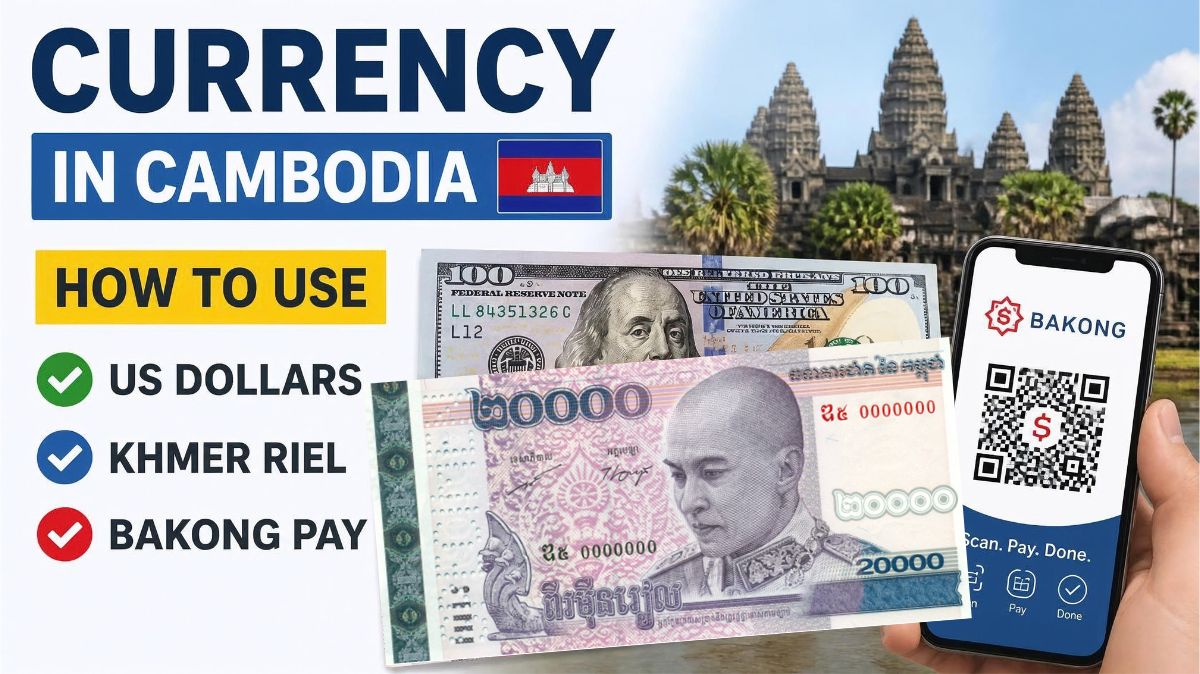
Currency in Cambodia: How to Use US Dollars, Khmer Riel, and Bakong Pay

Understanding money in Cambodia is relatively simple once you know how the country’s two commonly used currencies work together. The Khmer riel (KHR) is Cambodia’s national currency, while the US dollar (USD) remains widely used for many everyday payments, particularly in urban areas and the tourism sector.
At the same time, Cambodia has developed a modern digital payment system centered around Bakong and KHQR. Travelers may now see QR codes at restaurants, cafés, hotels, shops, markets, and other businesses, making digital payments increasingly common.
The National Bank of Cambodia (NBC) describes Cambodia as a highly dollarized economy, with payment instruments commonly operating in both US dollars and Khmer riel. The NBC also notes that US-dollar transactions have historically represented a larger share of payment activity, while the riel remains especially important for smaller transactions and in rural areas.
This Cambodia currency guide explains how to use US dollars and Khmer riel, how to handle change, where to exchange money, how cards and ATMs work, and how international visitors can use Bakong Pay and KHQR during their trip.
Quick Summary: Money in Cambodia
- Official currency: Cambodian riel (KHR)
- US dollar: Widely used, especially in cities and tourist areas
- Common reference rate: Around 4,000 KHR to US$1, although actual exchange rates change
- Small purchases: Khmer riel is particularly useful
- Large tourist payments: US dollars are still commonly accepted
- Digital payments: KHQR and Bakong-supported payments are increasingly widespread
- Cards: Commonly accepted at hotels, larger restaurants, supermarkets, and established businesses
- Cash: Still important, particularly outside major tourist centers
1. What Is the Currency of Cambodia?
The official currency of Cambodia is the Khmer riel, abbreviated as KHR and commonly written with the symbol ៛.
Riel banknotes are issued in several denominations, including 500, 1,000, 2,000, 5,000, 10,000, 20,000, 50,000, 100,000 and 200,000 riel notes. The National Bank of Cambodia maintains an official list of banknotes currently in circulation.
However, visitors will quickly notice that Cambodia also uses US dollars extensively. Prices in hotels, tour companies, restaurants, transportation services and other businesses may be displayed in dollars, particularly in major tourist destinations.
This means travelers do not necessarily need to exchange all their money into riel before arriving. A combination of US dollars, Khmer riel and digital payment options can be practical.
2. Why Are US Dollars Used in Cambodia?
The widespread use of US dollars in Cambodia has historical and economic roots.
According to the National Bank of Cambodia, dollarization increased significantly during the 1990s, particularly during the period of the United Nations Transitional Authority in Cambodia (UNTAC), when large amounts of US dollars entered the Cambodian economy. As Cambodia became more open to international trade, tourism and investment, the US dollar became widely used for business and commercial transactions.
Today, the two currencies coexist. The US dollar is particularly common for larger transactions and in urban areas, while Khmer riel is widely used for smaller purchases and remains important throughout the country.
For tourists, this dual-currency system can actually be convenient once you understand how prices and change are handled.
3. Should Tourists Use US Dollars or Khmer Riel?
For most travelers, the easiest answer is: use both.
US dollars can be convenient for hotels, tours, higher-value restaurant bills and other tourist expenses. Khmer riel is particularly useful for small purchases such as local food, drinks, markets, small transportation fares and everyday items.
For example, if a small purchase costs 8,000 riel, paying in riel is straightforward. If a hotel bill is quoted in US dollars, paying in dollars may be simpler.
You do not need to treat one currency as a replacement for the other. Think of them as two commonly used forms of payment within the same economy.
A Simple Example
| Purchase | Possible Price | Convenient Payment |
|---|---|---|
| Bottled water | US$0.50–$1 | Riel or USD |
| Local meal | Several thousand riel | Riel or digital payment |
| Tuk-tuk ride | Usually quoted in USD or riel | USD, riel, or app payment |
| Hotel | Often quoted in USD | USD or card |
| Market shopping | Varies | Riel or USD |
Prices are examples only and vary significantly by location, business, season and product.
4. Understanding the Cambodia Exchange Rate
The exchange rate between the US dollar and Khmer riel changes over time. The National Bank of Cambodia publishes official exchange-rate information on working days. Recent NBC official rates in 2026 have been around the 4,000 riel-per-US-dollar level.
For everyday travel calculations, many visitors use approximately:
US$1 ≈ 4,000 KHR
This is useful as a mental calculation rather than a guaranteed rate.
Easy Mental Conversions
- US$1 ≈ 4,000 KHR
- US$5 ≈ 20,000 KHR
- US$10 ≈ 40,000 KHR
- US$20 ≈ 80,000 KHR
- US$50 ≈ 200,000 KHR
- US$100 ≈ 400,000 KHR
When paying in cash, however, always check the actual exchange rate being used by the business if the price is converted between currencies.
5. How Does Change Work in Cambodia?
This is one of the most useful things for first-time visitors to understand.
If you pay a US-dollar price with a dollar bill, you may receive part of your change in Khmer riel, particularly for smaller amounts.
For example, imagine a purchase costs US$3 and you give the seller US$5. The seller may return US$2, or may use a combination of US dollars and Khmer riel depending on the business and the exchange rate being used.
Always check the amount of change before leaving the counter.
Keep Small Notes
Large US-dollar banknotes can sometimes be inconvenient for very small purchases. Carrying smaller denominations such as US$1, US$5 and US$10 can make everyday transactions easier.
For small local purchases, having Khmer riel is often even more convenient.
6. US Dollar Banknotes: What Should Travelers Know?
When carrying US dollars in Cambodia, travelers should pay attention to the physical condition of their notes.
Very old, damaged, heavily marked, torn or otherwise questionable US-dollar notes may be refused by some businesses or money changers. Acceptance policies can vary from one business to another.
For this reason, travelers should try to carry clean, undamaged US-dollar notes, particularly when bringing cash from abroad.
For everyday spending, smaller clean notes are usually easier to use than a wallet full of large denominations.
7. Where Can You Exchange Money in Cambodia?
Travelers can exchange foreign currency at banks, licensed or established money-changing businesses, airports, hotels, and other authorized locations.
Exchange rates and fees can differ, so compare the rate before exchanging a large amount of money.
Practical Currency-Exchange Tips
- Check the exchange rate before handing over your money.
- Count the cash before leaving the counter.
- Avoid exchanging large amounts at the airport unless necessary.
- Use established financial institutions or reputable money changers.
- Keep your receipt when appropriate.
- Do not exchange money with strangers offering unusually attractive rates.
For longer stays, travelers may find it more convenient to withdraw riel from an ATM or use digital payment methods instead of repeatedly exchanging cash.
8. Using ATMs in Cambodia
ATMs are widely available in major Cambodian cities and tourist destinations. International visitors can commonly find ATMs near airports, banks, shopping areas, hotels and busy commercial districts.
Depending on the bank and ATM, you may be able to withdraw US dollars, Khmer riel, or choose between available currencies.
Before using an ATM, check the screen carefully for transaction fees and the exchange-rate information provided by your card issuer or the ATM operator.
ATM Safety Tips
- Prefer ATMs located at banks or established commercial locations.
- Check for unusual devices or signs of tampering.
- Shield your PIN when entering it.
- Take your card and cash before leaving the ATM.
- Keep emergency payment options separate from your main wallet.
9. Can You Use Credit Cards in Cambodia?
Credit and debit cards are increasingly accepted in Cambodia, especially at international hotels, larger restaurants, supermarkets, shopping centers, travel companies and established businesses.
However, card acceptance is not universal.
Small restaurants, street-food sellers, local markets, small guesthouses and rural businesses may still prefer cash or QR payments.
For this reason, international travelers should not rely exclusively on a credit card. A practical approach is to carry a card, some US dollars, and some Khmer riel.
10. What Is Bakong Pay?
Bakong is Cambodia’s national payment system developed under the National Bank of Cambodia. It supports digital payments and transfers using Cambodian banking infrastructure.
Bakong is closely associated with KHQR, Cambodia’s standardized QR payment system. A KHQR code can allow customers to make payments using participating banking and payment applications.
The National Bank of Cambodia’s Bakong system supports transactions in both KHR and USD. The official Bakong platform also lists participating banks and financial institutions.
11. What Is KHQR?
KHQR is Cambodia’s standardized QR code payment format. Travelers will increasingly see KHQR signs or QR codes displayed at Cambodian businesses.
Instead of handing over cash, a customer can scan the merchant’s QR code using a supported payment application and authorize the payment.
The National Bank of Cambodia’s KHQR guidance describes KHQR as a payment method that can be used with the Bakong application and participating bank applications.
Why KHQR Is Useful for Travelers
- Reduces the need to carry large amounts of cash.
- Can be used for many small and large purchases.
- Payments can be made in KHR or USD depending on the service and account.
- Provides an electronic transaction record.
- Is increasingly visible at Cambodian businesses.
12. Bakong Tourists: A Digital Payment Option for Visitors
For international visitors, the Bakong Tourists service is particularly relevant.
The official Bakong Tourists documentation describes a system designed for visitors that can support payments, transfers, deposits, QR payments and currency exchange between US dollars and Khmer riel.
Current official information also explains that visitors can link supported Visa or Mastercard cards and use the Bakong Tourists application to scan KHQR codes for payment.
How Bakong Tourists Works
- Download the official Bakong Tourists application.
- Register according to the current visitor requirements.
- Link a supported Visa or Mastercard where applicable.
- Top up the wallet using the supported card functionality.
- Scan a merchant’s KHQR code.
- Check the payment amount and currency.
- Confirm the payment.
- Keep the transaction record in the application.
Features and eligibility can change, so travelers should check the latest official Bakong Tourists instructions before relying on the application for an entire trip.
13. Should Tourists Use Bakong or Cash?
You do not necessarily have to choose one.
A combination of digital payment and cash is usually more practical.
| Situation | Useful Payment Method |
|---|---|
| Hotel | Card, USD, or supported digital payment |
| Large restaurant | Card, USD, KHR, or KHQR |
| Street food | KHR, USD, or KHQR where available |
| Local market | KHR or USD |
| Tuk-tuk | Cash or ride-hailing app |
| Small café | KHR, USD, or KHQR |
| Remote rural area | Cash |
14. How Much Money Should You Bring to Cambodia?
There is no single correct amount because travel budgets vary significantly.
A backpacker staying in inexpensive accommodation and eating local food may spend considerably less than a traveler staying at a luxury resort and taking private tours.
Instead of carrying your entire travel budget in cash, consider dividing your money between several payment methods.
A Practical Money Strategy
- Carry a small amount of Khmer riel for everyday purchases.
- Keep some clean US-dollar notes for businesses that quote prices in USD.
- Carry at least one international debit or credit card.
- Use ATMs when necessary rather than carrying a very large amount of cash.
- Consider Bakong Tourists or another supported digital payment option if suitable for your trip.
- Keep emergency cash separate from your everyday wallet.
15. Cambodia Money Tips for Travelers
Smart Money Tips for Cambodia
- Carry both currencies: A mixture of KHR and USD is practical.
- Use riel for small purchases: It can make everyday transactions easier.
- Carry small USD notes: They are useful when prices are quoted in dollars.
- Check your change: Especially when paying with USD.
- Protect your cash: Avoid displaying large amounts of money in public.
- Keep cards secure: Use normal precautions when paying or withdrawing money.
- Check exchange rates: Especially before exchanging larger amounts.
- Do not rely only on cards: Cash remains useful throughout Cambodia.
- Try KHQR: Digital payments can be very convenient where supported.
- Keep an emergency payment method: Carry a backup card or cash separately.
16. Common Money Mistakes to Avoid in Cambodia
- Assuming every business accepts credit cards.
- Carrying only large US-dollar notes.
- Accepting an unclear exchange rate without checking it.
- Failing to count change.
- Exchanging money with unknown individuals.
- Keeping all your cash and cards together.
- Assuming a QR code automatically means your foreign banking app can pay it.
- Relying completely on internet-based payments without carrying a backup.
- Confusing the official exchange rate with the rate offered by a particular bank, ATM, hotel, or money changer.
17. Frequently Asked Questions About Money in Cambodia
What currency is used in Cambodia?
The official currency is the Cambodian riel (KHR). US dollars are also widely used, especially in urban areas, tourism, and larger commercial transactions.
Can I use US dollars in Cambodia?
Yes. US dollars are widely used in Cambodia, particularly in cities and tourist areas. However, Khmer riel is also widely used and is especially useful for smaller transactions.
Should I exchange US dollars into Khmer riel before traveling?
You do not necessarily need to exchange all your money in advance. Cambodia uses both currencies extensively, and travelers can obtain riel locally through ATMs, banks, money changers, and other legitimate channels.
How much is US$1 in Cambodian riel?
The exchange rate changes over time. For quick travel calculations, many visitors use approximately US$1 = 4,000 KHR. Check the latest official or transaction-specific rate before making larger exchanges.
Can I pay by credit card in Cambodia?
Yes, cards are accepted at many hotels, larger restaurants, supermarkets, shopping centers and established businesses. Cash remains important, particularly at smaller businesses and in rural areas.
Can tourists use KHQR in Cambodia?
Digital QR payments are increasingly common in Cambodia. Visitors with a supported payment application or the official Bakong Tourists service may be able to scan KHQR and pay participating merchants.
What is Bakong Tourists?
Bakong Tourists is a service from Cambodia’s National Bank designed to help international visitors make digital payments and use KHQR. Official documentation describes features including QR payments in USD and KHR, transfers, deposits, and currency exchange.
Do I need to carry Cambodian riel?
It is strongly practical to have some riel available. Small purchases and transactions outside major tourist businesses are often easier to handle in Khmer riel.
Are US-dollar banknotes accepted everywhere?
No. Acceptance varies, and businesses may refuse damaged or questionable notes. Carry clean, undamaged notes and keep smaller denominations available.
Sources & References
- National Bank of Cambodia (NBC): Official information on Cambodia’s dual-currency payment environment, US-dollar usage, Khmer riel, exchange rates, and financial services.
- National Bank of Cambodia — Banknotes in Circulation: Official information on current Khmer riel banknote denominations.
- Bakong — National Bank of Cambodia: Official information on Bakong, participating financial institutions and KHR/USD accounts.
- Bakong Tourists: Official user documentation covering QR payments, USD/KHR transactions, currency exchange and card-based top-up functions.
- KHQR — National Bank of Cambodia: Official guidance on KHQR as a payment method.
Information about exchange rates, payment services, participating institutions, fees and digital-payment features can change. Travelers should check the latest information from the National Bank of Cambodia and relevant payment providers before departure.
Conclusion: Bring a Mix of Cash and Digital Payment Options
Money in Cambodia may look complicated at first because both US dollars and Khmer riel are widely used. In practice, it is easy to manage once you understand the basic system.
Keep some Khmer riel for small everyday purchases, carry clean US-dollar notes for businesses that use USD pricing, and keep a debit or credit card available for hotels and larger businesses. Where supported, KHQR and Bakong can provide another convenient way to pay without carrying large amounts of cash.
The most useful strategy for international travelers is not to rely on a single payment method. A combination of KHR + USD + card + digital payment gives you flexibility in cities, tourist areas and smaller destinations across Cambodia.
Planning your Cambodia trip? Explore more GoToKH travel guides for information about visas, transportation, destinations, accommodation, food, culture and practical travel planning.