
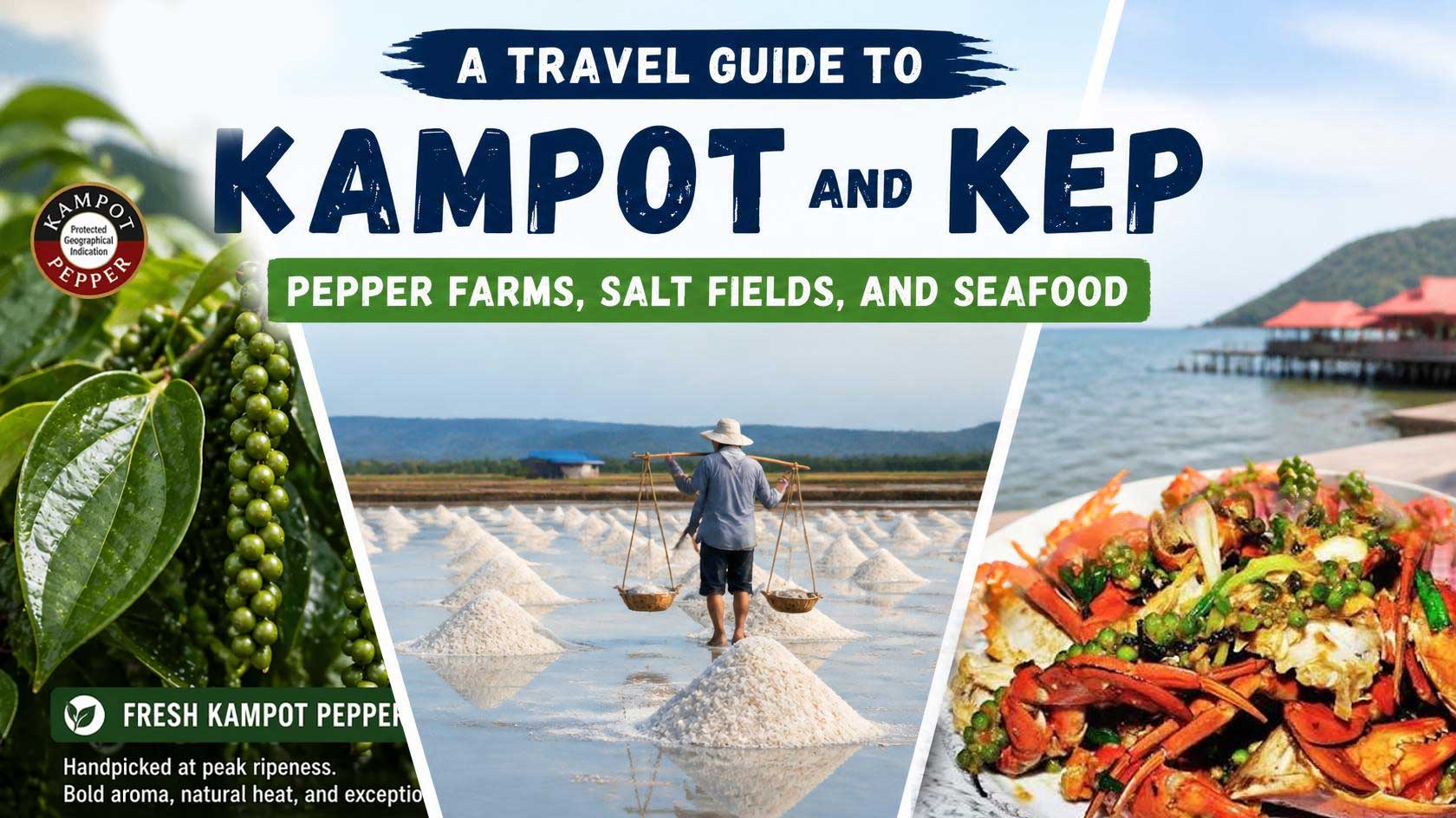
A Travel Guide to Kampot and Kep: Pepper Farms, Salt Fields, and Seafood

Southern Cambodia offers a slower and more atmospheric travel experience than the country’s major cities and temple destinations. The neighboring destinations of Kampot and Kep combine countryside landscapes, rivers, mountains, salt fields, pepper plantations, beaches, islands, and some of Cambodia’s most famous seafood.
Kampot is best known for its internationally recognized pepper, peaceful riverside setting, colonial-era architecture, countryside, and access to Bokor and the coast. Kep, meanwhile, is a small seaside destination famous for its crab, seafood restaurants, beaches, national park, and nearby islands.
For food lovers, the two destinations form a particularly attractive combination. You can visit a pepper plantation in the morning, see salt fields in the afternoon, watch the sunset over the coast, and finish the day with fresh crab cooked with Kampot Pepper.
This guide explains what to see, where the famous local products come from, how to plan a Kampot-Kep itinerary, and what international travelers should know before visiting.
Quick Overview: Kampot vs. Kep
| Destination | Best Known For | Best Experiences | Ideal Stay |
|---|---|---|---|
| Kampot | Pepper, countryside, river, colonial town | Pepper farms, salt fields, Bokor, river, caves | 2–3 nights |
| Kep | Crab, seafood, beaches, islands | Crab Market, Kep Beach, Rabbit Island, National Park | 1–2 nights |
| Kampot + Kep | Food and coastal countryside | Pepper, salt, seafood, beaches, islands | 3–4 nights |
Kampot and Kep are close enough to combine easily in one trip. Tourism Cambodia describes the paved road between the two towns as a convenient connection, while the two destinations offer distinctly different landscapes and experiences.
1. Why Visit Kampot and Kep?
Kampot and Kep are ideal for travelers who want to experience a different side of Cambodia.
Instead of concentrating on major archaeological monuments, a trip here revolves around agriculture, food, nature, coastal scenery, local markets, and relaxed outdoor experiences.
Kampot sits on the Tuk Chhou River near the foothills of the Elephant Mountains. The province is known for fruits, sea salt, and Kampot Pepper, while the surrounding countryside offers plantations, caves, waterfalls, rivers, and rural landscapes.
Kep is smaller and more coastal. The province faces the Gulf of Thailand and is known for its seafood, beaches, islands, national park, salt production, and connections with the Kampot pepper-growing region.
Together, they create a destination that works especially well for travelers interested in food tourism, nature, photography, slow travel, and authentic rural experiences.
2. Visit a Kampot Pepper Farm
For many visitors, a pepper plantation is the highlight of a Kampot trip.
Kampot Pepper is not simply a generic name for pepper grown somewhere in southern Cambodia. It is a protected geographical indication (GI) product with defined production areas and specifications.
According to Cambodia’s Department of Intellectual Property, the official geographical area for Kampot Pepper includes designated districts and cities in both Kampot and Kep provinces. Producers must meet specific requirements and participate in a traceability system to market pepper under the protected Kampot Pepper name.
The Kampot Pepper Promotion Association (KPPA) is responsible for promoting and protecting the product, supporting producers, maintaining quality requirements, and helping ensure the authenticity and origin of Kampot Pepper.
What Will You See at a Pepper Farm?
A farm visit gives travelers a chance to see the pepper vines growing on support poles and learn how the crop is cultivated and processed.
Depending on the plantation and season, visitors may learn about:
- Pepper vine cultivation
- Soil and drainage requirements
- Organic or traditional farming techniques
- Harvesting
- Sorting and processing
- The differences between green, black, red, and white pepper
- How pepper is dried and prepared
- How Kampot Pepper is used in Cambodian cuisine
One well-known example is La Plantation, an agrotourism site that offers guided tours and pepper and spice tastings. Its current farm information says visitors can tour the plantation and fruit garden, learn about its farming methods, and taste different peppers and spices.
When Is the Best Time to Visit a Pepper Farm?
Pepper plantations look different throughout the year. During the growing period, you can see green pepper berries developing on the vines. During harvest season, visitors may have a chance to see more of the traditional harvesting and processing work.
Because farm activities are seasonal, travelers interested specifically in harvesting should check directly with their chosen plantation before visiting.
3. Understand the Four Colors of Kampot Pepper
One of the most interesting parts of a pepper plantation visit is discovering that different pepper colors can come from the same species and crop but are harvested and processed differently.
Green Pepper
Green pepper is harvested before the berries fully mature. It has a fresh, bright flavor and is particularly popular in Cambodian cooking.
Black Pepper
Black pepper is harvested at a later stage and dried, producing the familiar dark appearance and a stronger, more pungent flavor.
Red Pepper
Red pepper comes from fully mature pepper berries. It tends to have a more complex and naturally sweeter aroma than standard black pepper.
White Pepper
White pepper is processed from mature pepper berries after the outer skin is removed. It has a different appearance and flavor profile from black pepper.
When purchasing Kampot Pepper, travelers should look for appropriate GI labeling and traceability information rather than assuming that every product sold as “Kampot pepper” has the protected GI status. Cambodia’s GI system is specifically designed to protect the geographical name and product characteristics.
4. Explore Kampot’s Famous Salt Fields
After pepper, salt is another important product associated with the Kampot-Kep coastal region.
Salt fields can be found in the low-lying coastal areas around Kampot and Kep. Traditional salt production uses seawater, evaporation, sunlight, and carefully prepared ponds to produce crystals of sea salt.
Tourism Cambodia identifies salt production as an important local activity and notes that much of Cambodia’s salt is produced in the coastal area around Kampot.
The Cambodian Department of Intellectual Property also lists Kampot-Kep Salt among Cambodia’s geographical indication products.
How Salt Farming Works
Salt farming is closely connected to Cambodia’s tropical climate and coastal geography.
- Seawater is brought into prepared salt fields.
- The water moves through shallow ponds.
- Sun and wind gradually evaporate the water.
- Salt crystals begin to form.
- Farmers collect and dry the salt.
- The finished salt is sorted and prepared for use or sale.
Weather plays an important role in salt production. The dry season is particularly important because strong sunlight and lower rainfall help evaporation.
For travelers, the salt fields provide a fascinating contrast to the green pepper plantations. One landscape is agricultural and tropical; the other is wide, flat, and shaped by seawater and sunlight.
5. Visit Kep Crab Market
If Kampot is famous for pepper, Kep is famous for crab.
The Kep Crab Market is one of the most recognizable food destinations on Cambodia’s southern coast. The market and surrounding waterfront restaurants allow visitors to see and eat locally sourced seafood while enjoying views toward the Gulf of Thailand.
Tourism Cambodia describes the Crab Market as a popular place for fresh seafood, with restaurants along the shore where visitors can watch fishermen bring in their catch. Crab, prawns, squid, fish, and other seafood are available.
What Should You Eat at Kep Crab Market?
The most famous dish to order is naturally Kampot Pepper Crab.
Fresh crab is cooked with Kampot Pepper, creating a dish that combines the sweetness of seafood with the distinctive aroma and heat of the region’s famous spice.
Other seafood commonly available around Kep includes:
- Grilled squid
- Fresh prawns
- Fish
- Clams and other shellfish
- Grilled or fried seafood
- Crab dishes
- Seafood soups
For the freshest experience, visit around late afternoon or early evening, when the seafood market and waterfront become especially lively.
How to Order Seafood
If you are buying seafood directly from vendors, establish the quantity and price before the food is prepared. This is particularly useful when buying seafood by weight.
Tourism Cambodia specifically recommends confirming how much seafood you want and the price before preparation.
6. Relax at Kep Beach
Kep Beach is a small coastal beach near the center of Kep. It is convenient for travelers who want a short swim, a sunset walk, or an easy place to relax after visiting the Crab Market.
The beach is not comparable in scale to Cambodia’s larger island beaches, but its location makes it easy to combine with seafood, the waterfront, and a drive around the Kep peninsula.
Tourism Cambodia describes Kep Beach as a roughly one-kilometer crescent of sand and notes that the surrounding waterfront has dining platforms and seafood vendors.
Weekends can be considerably busier because Kep is also a popular destination for domestic Cambodian travelers.
7. Take a Boat to Rabbit Island
For a more relaxed island experience, take a boat from Kep to Koh Tonsay, commonly known as Rabbit Island.
The island is located a short boat ride from Kep and is known for its beaches, tropical vegetation, and relatively simple atmosphere. Tourism Cambodia describes it as a small island with beaches, basic accommodation, and simple beach restaurants.
Rabbit Island is better suited to travelers who want a simple coastal escape than those looking for luxury resort facilities.
Things to Do on Rabbit Island
- Relax on the beach
- Swim when sea conditions are suitable
- Walk around the island
- Enjoy a simple seafood lunch
- Read or relax in a hammock
- Stay overnight in basic accommodation
- Enjoy a slower, less developed island environment
Bring essentials with you, particularly drinking water, sunscreen, insect repellent, and cash, because facilities are more limited than in Kep town.
8. Explore Kep National Park
If you enjoy walking and nature, Kep National Park provides a welcome change from beaches and seafood.
The park covers forested hills on the Kep peninsula and provides walking routes through a green natural landscape. The elevated terrain also provides viewpoints toward Kep, the Gulf of Thailand, and surrounding countryside.
Kep’s combination of forest, coast, and mountains is one of the reasons the destination feels different from Cambodia’s larger beach resorts.
Wear comfortable shoes and bring water if you plan to hike. During or after heavy rain, trails can become muddy and slippery.
9. Discover Kampot’s Countryside
Kampot is more than a base for pepper farms. The surrounding countryside contains a mixture of rice fields, fruit plantations, limestone formations, waterways, and rural communities.
Tourism Cambodia lists attractions around Kampot including caves, waterfalls, river areas, plantations, beaches, and rural destinations.
Teuk Chhou
Teuk Chhou is a popular natural area north of Kampot where cool water flows through a rocky river environment near the Elephant Mountains.
It can be combined with a countryside trip, particularly if you want a break from sightseeing in town.
Phnom Chhngok Cave
For travelers interested in history and geology, the limestone caves around Kampot offer a completely different experience from the coastal landscape.
Phnom Chhngok contains an ancient brick structure inside a limestone cave and is associated with the early history of the region. Tourism Cambodia describes the site as a pre-Angkorian ruin dating to the 4th–5th centuries.
10. Enjoy Kampot’s Riverside and Colonial Character
After exploring plantations and countryside, return to Kampot town for a slower evening.
The town sits along the Tuk Chhou River and retains historic Sino-colonial and French-influenced architecture. Some old buildings have been adapted into cafés, restaurants, guesthouses, shops, and small businesses.
A riverside walk around sunset is one of the simplest ways to enjoy Kampot. You can watch boats move along the river, see the surrounding mountains, and stop for dinner or a drink.
The atmosphere is generally more relaxed than Phnom Penh or Cambodia’s major resort areas, making Kampot particularly attractive for travelers who prefer slow travel.
11. Kampot and Kep Food You Should Try
A trip to these destinations is incomplete without exploring their food culture.
| Food | Where to Try It | Why It Matters |
|---|---|---|
| Kampot Pepper Crab | Kep | Combines local crab with famous Kampot Pepper |
| Green Pepper Seafood | Kampot / Kep | Fresh green pepper pairs naturally with seafood |
| Fish Amok | Kampot / Kep | Classic Cambodian dish |
| Lok Lak | Kampot / Kep | Popular Cambodian beef dish |
| Fresh Grilled Seafood | Kep | Simple coastal dining |
| Kampot Pepper | Kampot farms and shops | Signature local agricultural product |
| Fresh Fruit | Kampot countryside and markets | Kampot is known for tropical fruit |
La Plantation’s current restaurant menu, for example, includes Khmer dishes using its farm spices as well as Kep crab and shrimp with fresh green pepper, illustrating how local agricultural products and coastal seafood are closely connected in the regional cuisine.
12. A 3-Day Kampot and Kep Itinerary
Day 1: Kampot Town and Pepper Country
- Arrive in Kampot
- Explore the historic town
- Visit a Kampot Pepper plantation
- Taste different pepper varieties
- Explore the countryside
- Return to town for a riverside sunset
- Enjoy a Khmer dinner
Day 2: Salt Fields, Kep and Seafood
- Visit coastal salt fields
- Continue to Kep
- Explore Kep Beach
- Visit the Crab Market
- Enjoy fresh Kep crab with Kampot Pepper
- Watch the sunset over the Gulf of Thailand
Day 3: Rabbit Island and Nature
- Take a morning boat to Rabbit Island
- Relax on the beach
- Have a simple island lunch
- Return to Kep
- Explore Kep National Park or another local attraction
- Return to Kampot or continue your journey
13. A 4-Day Slow Travel Itinerary
If you have four days, you can slow the itinerary down and spend more time in the countryside.
Day 1 — Kampot Town
Explore the old town, riverside, cafés, markets, and local restaurants.
Day 2 — Pepper, Countryside and Bokor
Visit a pepper plantation in the morning and explore the Bokor area or surrounding countryside later in the day.
Day 3 — Salt and Kep
Visit salt fields, travel to Kep, explore the beach and Crab Market, and enjoy a seafood dinner.
Day 4 — Rabbit Island or Kep National Park
Choose between a relaxing island trip and a nature-focused day in Kep.
14. Best Time to Visit Kampot and Kep
Cambodia has a tropical climate, with a generally drier period from around November to April and a wetter period from around May to October.
For outdoor activities such as pepper farm visits, salt-field photography, hiking, and island trips, weather conditions can influence the experience considerably.
The salt harvest is especially dependent on dry weather because traditional salt production relies on evaporation. Historical industry reporting has shown how heavy rain can significantly disrupt salt harvesting.
November to February is often comfortable for exploring the countryside and coast, while March to April can be hotter. The wet season can bring lush landscapes but also heavier rainfall and less predictable conditions for outdoor activities.
15. How to Travel Between Kampot and Kep
Kampot and Kep are close neighbors, making it easy to visit both on the same trip.
The road between the two towns is approximately 25 kilometers, and the journey can be made by tuk-tuk, taxi, private vehicle, or other local transportation. Tourism Cambodia notes that the road connection is straightforward and that organized day trips between the destinations are also available.
For a more flexible trip, hiring a private tuk-tuk or driver for the day can be useful if you plan to visit several countryside attractions.
Practical Tips for Visiting Kampot and Kep
Travel Smart in Southern Cambodia
- Bring cash: Small rural attractions and local vendors may not accept cards.
- Carry water: Especially for pepper farms, salt fields, hiking, and island trips.
- Use sun protection: Salt fields and beaches offer little shade.
- Wear comfortable shoes: Rural paths and plantation grounds can be uneven.
- Check weather conditions: Rain can affect countryside roads and boat trips.
- Confirm seafood prices: Ask about quantity and price before ordering from market vendors.
- Buy authentic pepper: Look for appropriate GI information when purchasing Kampot Pepper.
- Respect farmers: Do not enter plantation areas without permission.
- Protect nature: Avoid littering on beaches, islands, trails, and in the countryside.
- Allow extra time: Kampot and Kep are best experienced slowly rather than rushed.
Frequently Asked Questions
How many days do I need for Kampot and Kep?
Three to four days is a comfortable amount of time for most travelers. Three days allows you to cover the main highlights, while four days provides more time for countryside exploration, a pepper farm, Rabbit Island, or Kep National Park.
What is Kampot famous for?
Kampot is particularly famous for Kampot Pepper and sea salt, as well as its riverside setting, countryside, colonial architecture, fruits, caves, waterfalls, and access to Bokor.
What is Kep famous for?
Kep is best known for fresh seafood, particularly crab, as well as its beach, islands, national park, coastal scenery, and relaxed atmosphere.
Where can I eat the famous Kampot Pepper Crab?
The Crab Market and surrounding waterfront restaurants in Kep are among the most popular places to try fresh crab prepared with Kampot Pepper.
Can I visit a pepper farm without booking?
It depends on the plantation and season. For example, La Plantation currently states that from April to October its regular visits do not require advance time-slot booking, while arrangements differ during other months and for certain activities. Travelers should check directly with the farm before visiting.
Is Kampot Pepper really protected?
Yes. Kampot Pepper is a protected geographical indication product. Cambodia’s GI specifications define its production area and requirements, while the Kampot Pepper Promotion Association helps protect the name, quality, and origin of the product.
When is the best time to see salt fields?
The dry season is generally more suitable for observing traditional salt production because the process depends heavily on evaporation. However, actual field activity varies with weather and the annual production cycle.
Is Rabbit Island worth visiting?
Rabbit Island is a good choice for travelers looking for a simple beach escape and a slower island atmosphere. It is less developed than Cambodia’s major resort islands, so expectations should be adjusted accordingly.
Can Kampot and Kep be visited as a day trip from Phnom Penh?
It is possible, but a day trip would involve a long travel day and would leave limited time for exploring. Staying at least two nights is more comfortable if your schedule allows.
Sources & References
- Tourism Cambodia – Official tourism information on Kampot, Kep, pepper plantations, salt production, Kep Beach, Rabbit Island, seafood, and local attractions.
- Cambodia Intellectual Property Department – Official geographical indication information and product specifications for Kampot Pepper and Kampot-Kep Salt.
- Kampot Pepper Promotion Association (KPPA) – Information on Kampot Pepper producers, GI protection, quality control, traceability, and the pepper industry.
- La Plantation – Current official information on pepper farm visits, agricultural tourism, tastings, processing, restaurant experiences, and visitor arrangements.
- Ministry of Commerce / Cambodian GI information – Official information on Cambodia’s geographical indication products and protection system.
Farm opening arrangements, tour schedules, road conditions, boat services, restaurant hours, and weather conditions can change. Travelers should confirm current information directly with farms, accommodation providers, transport operators, and local authorities before traveling.
Conclusion: Discover the Flavors and Coast of Southern Cambodia
Kampot and Kep offer one of Cambodia’s most rewarding combinations of food, countryside, agriculture, and coastal scenery.
In Kampot, you can walk through a pepper plantation, learn how one of Cambodia’s best-known agricultural products is grown, see traditional salt fields, explore the countryside, and relax beside the river. In Kep, the experience shifts toward the sea, with fresh crab, seafood markets, beaches, islands, and coastal landscapes.
The real attraction is the connection between these experiences. Kampot Pepper grown in the countryside can appear on a seafood plate in Kep. Salt produced along the coast becomes part of everyday Cambodian cooking. Local farmers, fishermen, restaurants, and tourism businesses all contribute to the food culture that makes this region distinctive.
For travelers who want to slow down and experience Cambodia through its landscapes and flavors, Kampot and Kep deserve a place on the itinerary.
Come for the pepper, stay for the countryside, and leave with the taste of Kampot and Kep.