
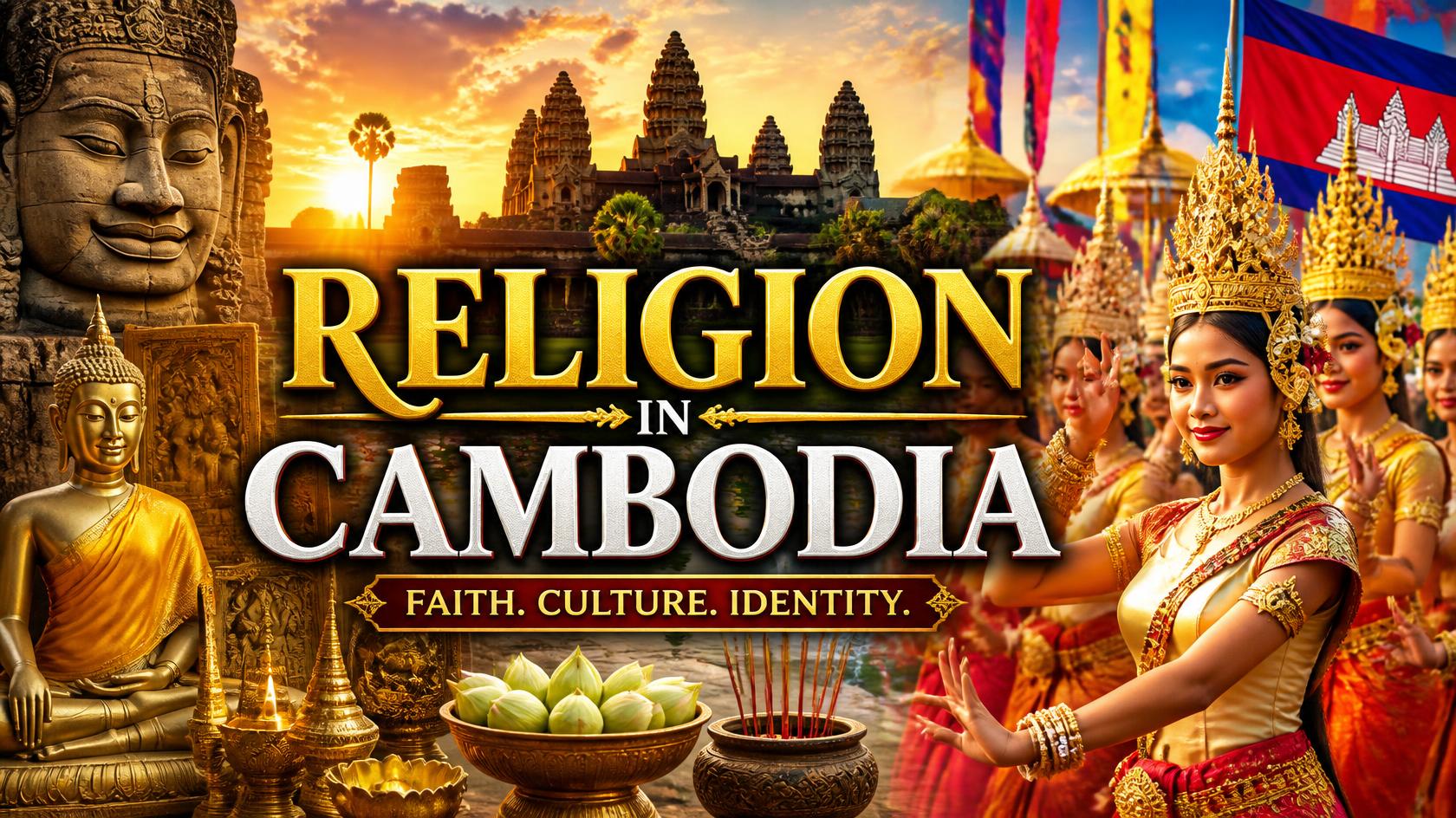

Religion is one of the most important parts of Cambodian culture and identity. From Buddhist pagodas in modern cities and villages to the Hindu and Buddhist monuments of Angkor, Cambodia’s religious traditions have developed over many centuries and continue to influence everyday life.
Theravada Buddhism is Cambodia’s state religion and the dominant faith. However, Cambodian religious culture is broader than Buddhism alone. Hindu traditions, Islam, Christianity, Chinese religious practices, and Indigenous beliefs have all contributed to the country’s cultural landscape.
For travelers, understanding religion in Cambodia can make a visit more meaningful. It helps explain why pagodas are important community spaces, why Buddhist monks receive special respect, and why temples such as Angkor Wat contain layers of Hindu and Buddhist history.
Quick Overview: Religion in Cambodia
| Religion or Tradition | Role in Cambodia |
|---|---|
| Theravada Buddhism | State religion and the dominant religious tradition |
| Islam | Important minority religion, particularly among Cham communities |
| Christianity | Smaller religious community including Catholic and Protestant traditions |
| Hindu traditions | Historically central to Khmer civilization and strongly represented in ancient temples |
| Indigenous beliefs | Traditional spiritual practices continue among some Indigenous communities |
| Chinese traditions | Some Chinese-Cambodian communities maintain Taoist, Confucian, Buddhist, and folk traditions |
What Is the Main Religion in Cambodia?
Theravada Buddhism is the main religion in Cambodia. The Cambodian Constitution establishes Buddhism as the state religion while also guaranteeing freedom of religious belief and worship, subject to public order and security.
The country’s 2019 General Population Census recorded approximately 97.1% of the population as Buddhist. The same census recorded approximately 2.0% Muslim, 0.3% Christian, and 0.5% belonging to other religious categories.
These figures come from the 2019 census and should not be treated as a precise measurement of Cambodia’s religious population in 2026. Nevertheless, they provide the country’s most detailed official census picture of religious affiliation.
Theravada Buddhism in Cambodia
Theravada Buddhism has a deep influence on Cambodian society. It shapes religious ceremonies, family traditions, festivals, architecture, art, education, and ideas about merit and moral conduct.
In Theravada Buddhist tradition, people seek to follow the teachings of the Buddha and develop good karma through ethical behavior, generosity, meditation, and other forms of religious practice.
One of the most visible expressions of Buddhism in Cambodia is the pagoda, or Buddhist temple complex. Pagodas are not simply places of worship. They can also serve as community spaces where people gather for ceremonies, festivals, funerals, charitable activities, and important family occasions.
The Role of Buddhist Monks
Buddhist monks, known in Khmer as ព្រះសង្ឃ, hold an important position in Cambodian religious and cultural life.
Monks traditionally live according to a disciplined religious code and devote themselves to Buddhist practice, study, teaching, and community activities.
Many Cambodian families have connections with their local pagoda, particularly during religious festivals, funerals, memorial ceremonies, and merit-making activities.
Making Merit
Merit-making is an important part of Cambodian Buddhist life. People may make offerings of food, money, flowers, candles, or other useful items to monks and temples.
For many Cambodian families, religious merit is closely connected with compassion, generosity, respect for parents and elders, and remembering deceased relatives.
The Religious History of Cambodia
Cambodia’s religious history is much older and more diverse than its modern Buddhist identity suggests.
Ancient Khmer civilization developed through interaction with religious and cultural ideas from South Asia while also retaining local spiritual traditions.
UNESCO’s documentation of Sambor Prei Kuk, the ancient capital of Ishanapura, describes a religious landscape that included Hindu traditions alongside animist and Buddhist elements. These traditions contributed to the artistic and architectural development that later became characteristic of the Angkorian period.
Hinduism Before and During the Angkor Era
Hinduism played a major role in the development of early Khmer state culture and architecture.
Ancient Khmer rulers associated themselves with Hindu deities and established temples dedicated to gods such as Shiva and Vishnu. UNESCO’s historical documentation of Angkor describes early Khmer state temples and royal religious institutions dedicated to Hindu divinities, particularly Shiva.
This Hindu heritage remains visible today in the architecture, sculpture, inscriptions, mythology, and symbolism found throughout Cambodia.
Buddhism and the Angkor Empire
Buddhism also became an important part of the Angkorian religious landscape. Different rulers supported different religious traditions, and Hindu and Buddhist beliefs sometimes existed side by side.
King Jayavarman VII, one of the most famous rulers of Angkor, strongly promoted Mahayana Buddhism. The Bayon at the center of Angkor Thom was constructed during his reign and became one of the most recognizable Buddhist monuments of the Khmer Empire. UNESCO describes Jayavarman VII as a ruler who established Mahayana Buddhism as the state religion of the Khmer Empire.
Yet Angkorian religious history was not simply a transition from Hinduism to Buddhism. Religious imagery and institutions changed over time, and Hindu and Buddhist elements continued to coexist in many places.
Angkor Wat and the Mixture of Hindu and Buddhist Heritage
Angkor Wat is perhaps the clearest example of Cambodia’s complex religious history.
The monument was constructed during the reign of King Suryavarman II in the early 12th century and was originally associated with the Hindu god Vishnu. Over time, the temple became an important Buddhist religious site.
Today, visitors can see both Hindu and Buddhist elements within the wider Angkor landscape.
UNESCO describes Angkor as a vast archaeological site containing temples, reservoirs, urban structures, and monuments representing the religious and symbolic traditions of the Khmer Empire.
Travel insight: When visiting Angkor, remember that the temples are not simply ancient buildings. They are part of a living cultural landscape with continuing religious significance.
Islam in Cambodia
Islam is an important minority religion in Cambodia. The Muslim population is particularly associated with the Cham people, although not every Cham person is Muslim.
The 2019 Cambodian census recorded approximately 2.0% of the population as Muslim.
Cambodian Muslim communities can be found in different parts of the country, including areas around the Mekong and Tonle Sap waterways and in several urban and rural communities.
Most Cambodian Muslims belong to Sunni Islam, while different traditions and practices can be found among Muslim communities. Cham Muslim culture has developed its own history and identity within Cambodia.
Visitors may encounter mosques, halal restaurants, Muslim communities, and Islamic cultural practices while traveling through Cambodia.
Christianity in Cambodia
Christianity is practiced by a smaller proportion of Cambodia’s population. Catholic and Protestant communities are present in Phnom Penh and other parts of the country.
The 2019 census recorded approximately 0.3% of the population as Christian.
Christian communities in Cambodia include both Cambodian converts and people from ethnic minority or foreign backgrounds.
Christian organizations have also contributed to areas such as education, healthcare, social services, and community development.
Indigenous Spiritual Traditions in Cambodia
Not all Cambodian religious traditions fit neatly into the categories of Buddhism, Islam, Christianity, or Hinduism.
Some Indigenous communities maintain traditional spiritual beliefs connected with forests, mountains, rivers, ancestors, animals, and other elements of the natural world.
These traditions can include respect for sacred forests, ancestral spirits, local guardian spirits, and rituals connected with community life.
For visitors traveling in Indigenous areas, it is important to understand that a forest, mountain, tree, or other natural place may have cultural or spiritual significance beyond its physical appearance.
Chinese Religious Traditions in Cambodia
Cambodia’s Chinese-Cambodian communities have also contributed to the country’s religious landscape.
Depending on the family and community, Chinese religious traditions may include elements of Taoism, Confucianism, Buddhism, and Chinese folk religion.
These traditions can be seen in family shrines, temples, ancestor worship, festivals, offerings, and traditional ceremonies.
Chinese religious and cultural influences are particularly visible in some commercial areas and historic communities in Phnom Penh and other Cambodian cities.
How Religion Shapes Cambodian Culture
Religion in Cambodia is closely connected with everyday culture. Even people who do not actively practice religion may participate in cultural traditions influenced by Buddhism and older beliefs.
Family and Respect for Elders
Respect for parents, grandparents, monks, teachers, and elders is an important part of Cambodian social culture.
Religious traditions reinforce ideas of generosity, compassion, gratitude, and responsibility toward family and community.
Funerals and Ancestor Remembrance
Buddhist ceremonies play an important role in Cambodian funerals and remembrance practices.
Families may invite monks to chant prayers, make offerings, and conduct ceremonies intended to honor the deceased and support the family during mourning.
Festivals
Many of Cambodia’s most important public and family celebrations have religious or spiritual connections.
Major Buddhist celebrations include:
- Khmer New Year (Chaul Chnam Thmey)
- Pchum Ben
- Visak Bochea
- Meak Bochea
- Kathina
During these occasions, people may visit pagodas, make offerings, listen to monks’ teachings, participate in ceremonies, and spend time with family.
Religion and Cambodian Architecture
Religion has shaped Cambodian architecture for centuries.
Ancient temples were designed not only as places for religious worship but also as expressions of cosmology, political authority, sacred geography, and artistic achievement.
The temple-mountain concept, for example, reflected ideas associated with Mount Meru, a sacred cosmic mountain in Hindu and Buddhist traditions.
At Angkor, this symbolism can be seen in monuments such as Angkor Wat and the Bayon. UNESCO notes that the architecture and layout of Angkor’s successive capitals contain strong religious and symbolic significance.
Modern Buddhist pagodas continue this architectural tradition in a different form, combining religious spaces with community facilities, stupas, statues, murals, and ceremonial buildings.
What Should Travelers Know About Religion in Cambodia?
Visitors do not need to be Buddhist to enjoy or explore Cambodia’s religious heritage. However, showing respect is important when entering temples, pagodas, mosques, or other sacred places.
Dress Respectfully
When visiting an active pagoda or religious monument, wear clothing that covers the shoulders and knees where appropriate.
Some major tourist temples may have specific visitor rules, particularly around sacred areas.
Remove Your Shoes When Required
If you are entering a religious building where visitors are expected to remove their shoes, follow the local practice.
Respect Buddha Images
Buddha statues and religious images should be treated respectfully. Avoid climbing on statues, sitting on religious structures, touching sacred objects unnecessarily, or posing in ways that could be considered disrespectful.
Official Cambodian visitor information specifically asks travelers to treat Buddha statues and images with respect.
Be Careful When Photographing Monks
Always ask permission before taking a close-up photograph of a monk or someone participating in a religious ceremony.
At major tourist attractions, photography may be allowed, but individual areas can have restrictions.
Keep Your Voice Low
Religious buildings are places of worship, not simply tourist attractions. Speak quietly and avoid disturbing people who are praying or participating in ceremonies.
Religion in Cambodia: A Simple Historical Timeline
| Period | Religious Development |
|---|---|
| Early centuries CE | Indian religious and cultural influences interacted with local spiritual traditions. |
| Funan and Chenla periods | Hindu, Buddhist, and Indigenous elements existed within the developing Khmer cultural landscape. |
| Early Angkor period | Hindu traditions played a major role in royal and temple culture. |
| 12th–13th centuries | Mahayana Buddhism became especially prominent under Jayavarman VII. |
| Post-Angkor period | Theravada Buddhism became increasingly dominant in Cambodian religious life. |
| Modern Cambodia | Theravada Buddhism remains the state religion alongside Muslim, Christian, Indigenous, and other religious communities. |
Religion and Cambodian Identity
Religion is closely connected with the way Cambodia understands its national and cultural identity.
The country’s national motto is commonly expressed through the three concepts of Nation, Religion, King, and the Cambodian flag itself features an image of Angkor Wat.
This connection between religion, history, monarchy, architecture, and national culture helps explain why Buddhist temples and ancient religious monuments are so important to Cambodian identity.
At the same time, Cambodia’s identity is not limited to one religious tradition. The country’s history shows centuries of interaction between Buddhism, Hinduism, Islam, Christianity, Indigenous spiritual traditions, and Chinese religious practices.
Practical Tips for Visiting Religious Sites in Cambodia
🙏 Respectful Travel Checklist
- Dress modestly when visiting pagodas and religious sites.
- Remove your shoes when requested.
- Never climb on Buddha statues or sacred structures.
- Ask permission before photographing monks or religious ceremonies.
- Keep your voice low inside places of worship.
- Do not touch religious objects unless you are invited to do so.
- Follow signs and instructions from temple staff.
- Remember that many temples are active places of worship.
- Respect Muslim, Christian, Indigenous, and other religious communities as you would Buddhist communities.
Frequently Asked Questions About Religion in Cambodia
What is the main religion in Cambodia?
Theravada Buddhism is the dominant religion in Cambodia and is established as the country’s state religion under the Constitution. The 2019 census recorded 97.1% of the population as Buddhist.
Is Buddhism the official religion of Cambodia?
Yes. Article 43 of the Cambodian Constitution states that Buddhism is the religion of the State while also guaranteeing freedom of religious belief and worship under the conditions established by law.
Are there Muslims in Cambodia?
Yes. Cambodia has an established Muslim minority, with many Cambodian Muslims belonging to Cham communities. The 2019 census recorded approximately 2.0% of the population as Muslim.
Are there Christians in Cambodia?
Yes. Catholic and Protestant communities are present in Cambodia. The 2019 census recorded approximately 0.3% of the population as Christian.
Was Angkor Wat originally a Buddhist temple?
No. Angkor Wat was originally associated with Hindu worship, particularly Vishnu, before becoming an important Buddhist site. This is one reason the monument contains a mixture of religious and artistic traditions.
Was the Khmer Empire Buddhist or Hindu?
Both Hinduism and Buddhism were important at different periods and under different rulers. Some Khmer kings strongly supported Hindu traditions, while others promoted Buddhism. The monuments of Angkor preserve evidence of this changing religious landscape.
Can tourists enter Buddhist pagodas?
Generally, visitors can enter many pagodas if they behave respectfully and follow local rules. Some areas may be restricted during ceremonies or for religious reasons.
Do I need to be Buddhist to visit Cambodian temples?
No. Cambodia welcomes visitors of different religions. The important thing is to respect the religious and cultural significance of the places you visit.
What should I wear when visiting a Cambodian temple?
Modest clothing that covers the shoulders and knees is a good general choice, especially when visiting active pagodas or particularly sacred areas.
Sources & References
- National Institute of Statistics of Cambodia — General Population Census of Cambodia 2019, including national religious affiliation data.
- Constitution of the Kingdom of Cambodia — Article 43 on freedom of religious belief and Buddhism as the state religion.
- Tourism Cambodia — Official information on Buddhism, religion, beliefs, and Cambodian cultural traditions.
- UNESCO World Heritage Centre — Documentation on Angkor, Sambor Prei Kuk, and the religious history of Khmer monuments.
- UNESCO — Research and conservation information on the Bayon and its Buddhist and Hindu heritage.
- U.S. Department of State — International Religious Freedom reporting on Cambodia’s religious communities and legal framework.
Conclusion
Religion in Cambodia is much more than a single faith. Theravada Buddhism is the dominant and state religion, but Cambodia’s cultural identity has been shaped by centuries of interaction between Buddhism, Hinduism, Islam, Christianity, Indigenous spiritual traditions, and Chinese religious practices.
For travelers, this religious heritage can be seen everywhere—from village pagodas and Buddhist festivals to the Hindu and Buddhist symbolism of Angkor Wat and the Bayon.
Understanding these traditions allows visitors to see Cambodia beyond its temples and monuments. Religion remains part of everyday life, family traditions, community celebrations, architecture, art, and the country’s sense of cultural identity.
Planning your Cambodia trip? Explore more GoToKH guides to discover Cambodia’s culture, history, temples, festivals, food, and local traditions.


