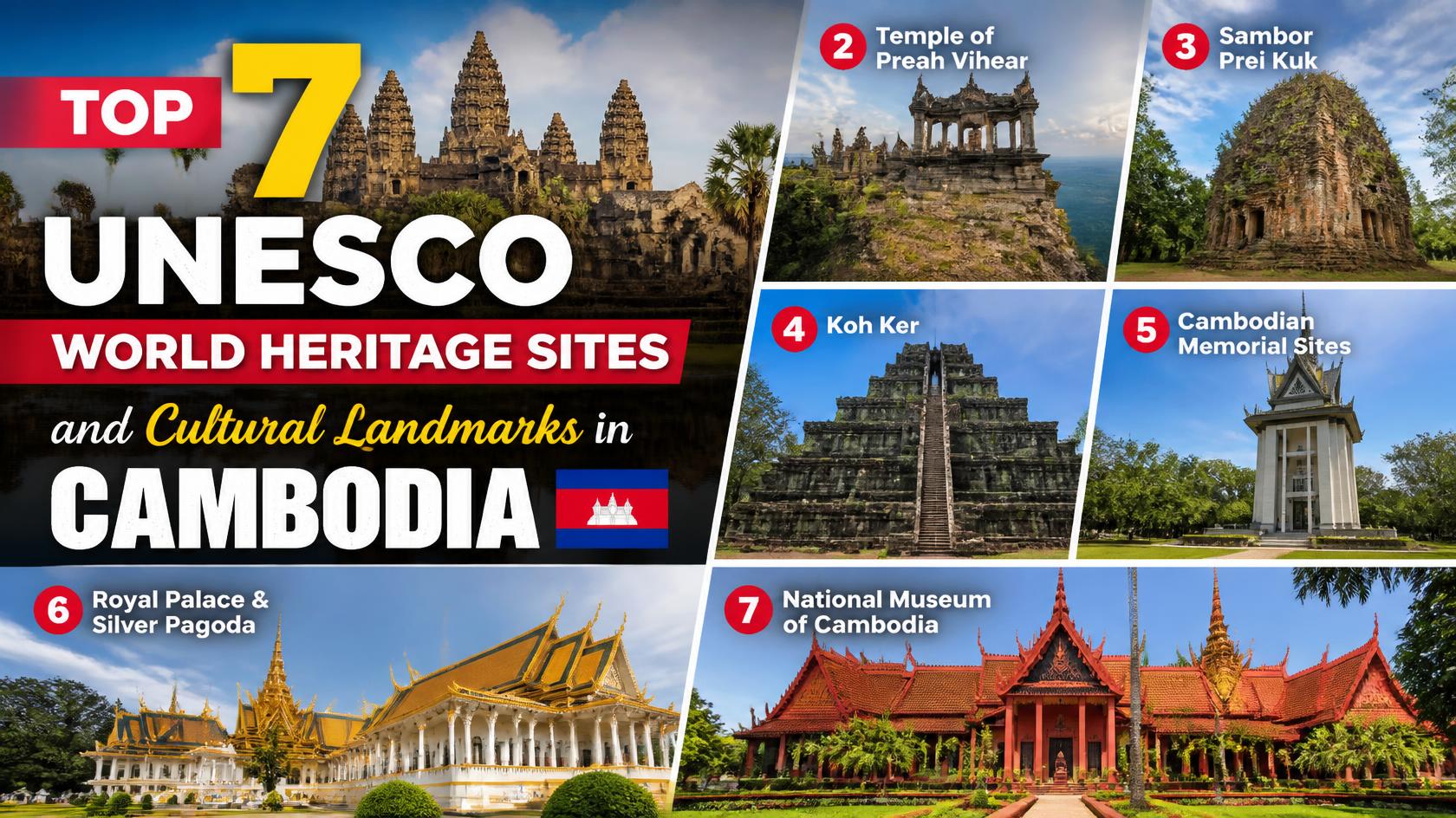

Cambodia is a country where ancient history and living culture exist side by side. From the monumental temples of Angkor to royal architecture in Phnom Penh and archaeological sites hidden in the countryside, Cambodia offers an extraordinary range of cultural heritage for travelers to explore.
UNESCO currently lists five properties in Cambodia on the World Heritage List: Angkor, the Temple of Preah Vihear, the Temple Zone of Sambor Prei Kuk, Koh Ker, and the Cambodian Memorial Sites. The fifth property, the Cambodian Memorial Sites, was inscribed in 2025 and represents an important new chapter in the international recognition of Cambodia’s modern historical heritage.
Beyond these UNESCO World Heritage properties, Cambodia also has important cultural landmarks such as the Royal Palace and Silver Pagoda and the National Museum of Cambodia. Together, these places help explain the country’s ancient civilization, royal traditions, religion, art, architecture, and modern history.
In this guide, GoToKH explores seven important heritage destinations that can help travelers understand Cambodia beyond simply visiting Angkor Wat.
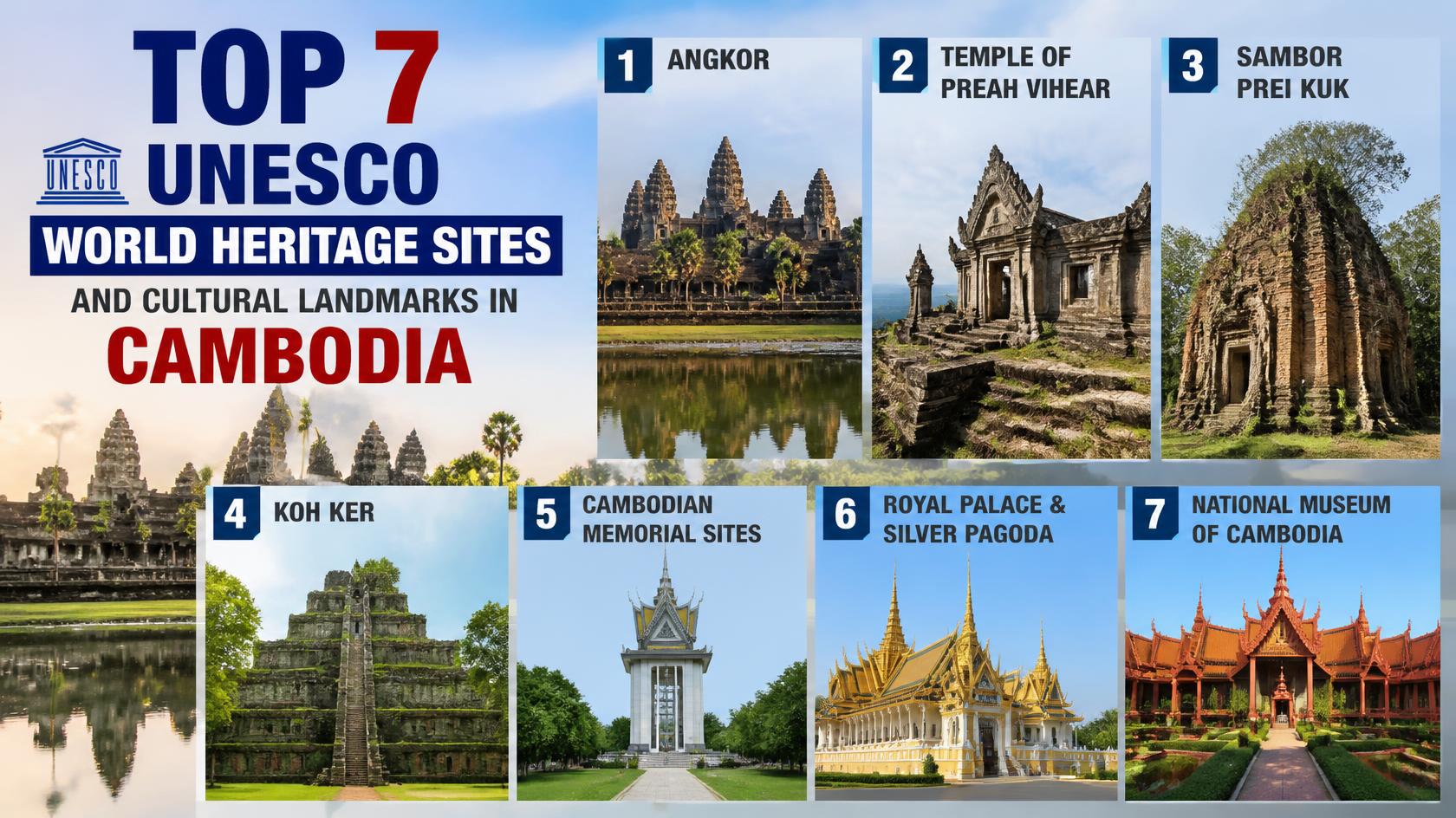
Quick Summary: 7 Cambodian Heritage Sites to Know
- Angkor – The monumental heart of the Khmer Empire.
- Temple of Preah Vihear – A spectacular Khmer temple on a mountain plateau.
- Sambor Prei Kuk – An important pre-Angkorian capital of Chenla.
- Koh Ker – A former Khmer imperial capital known for its distinctive architecture.
- Cambodian Memorial Sites – UNESCO-recognized places of remembrance connected to the Khmer Rouge period.
- Royal Palace & Silver Pagoda – A living symbol of Cambodia’s monarchy and religious heritage.
- National Museum of Cambodia – A major collection of Khmer art and archaeological treasures.
1. Angkor – The Heart of the Khmer Empire
Location: Siem Reap Province
UNESCO inscription: 1992
Angkor is Cambodia’s most internationally recognized heritage site and one of the most important archaeological landscapes in Southeast Asia. Located near Siem Reap, the Angkor Archaeological Park covers approximately 400 square kilometers and contains the remains of several capitals of the Khmer Empire dating from the 9th to the 15th centuries.
The site is much larger than Angkor Wat alone. Its archaeological landscape includes temples, reservoirs, canals, roads, ancient urban areas, and numerous monuments. Major temples include Angkor Wat, Bayon, Ta Prohm, Preah Khan, Banteay Srei, Baphuon, and Pre Rup.
Why Angkor is important
Angkor demonstrates the remarkable architectural, artistic, religious, and engineering achievements of Khmer civilization. The city’s extensive water-management system, including reservoirs, canals, and hydraulic structures, was closely connected to the development of the ancient urban landscape.
Angkor Wat, built in the 12th century, is the best-known monument and remains one of the world’s most recognizable religious structures. The Bayon, famous for its monumental carved faces, and Ta Prohm, where trees and ruins have become visually intertwined, offer very different experiences within the same archaeological complex.
Travel tip
If you have enough time, do not limit your visit to Angkor Wat. Exploring several temples helps reveal the diversity of Khmer architecture and the scale of the ancient Angkorian urban landscape.
2. Temple of Preah Vihear – Khmer Architecture on a Mountain
Location: Preah Vihear Province
UNESCO inscription: 2008
The Temple of Preah Vihear is one of Cambodia’s most dramatic ancient monuments. Located on the edge of a plateau overlooking the Cambodian plain, the temple is dedicated to Shiva and is particularly notable for the way its architecture follows the natural landscape.
UNESCO describes the temple as a remarkable Khmer architectural complex consisting of a series of sanctuaries connected by pavements and staircases along an approximately 800-meter-long axis. Its history can be traced back to the 9th century, while much of the surviving architectural complex dates from the first half of the 11th century.
What makes Preah Vihear special?
Unlike Angkor’s relatively expansive temple complexes, Preah Vihear follows a long ceremonial route leading toward the summit. The combination of stone architecture, carved decoration, elevated terrain, and wide views across the surrounding landscape creates a distinctive experience.
The temple is also important for understanding the geographical reach and architectural diversity of the Khmer Empire.
Travel tip
Preah Vihear is considerably farther from the main Siem Reap tourist circuit than Angkor. Travelers should plan transportation and visiting conditions in advance, particularly during hot weather or the rainy season.
3. Sambor Prei Kuk – A Window into Pre-Angkorian Cambodia
Location: Kampong Thom Province
UNESCO inscription: 2017
Before Angkor became the center of the Khmer Empire, important Khmer civilization had already developed elsewhere. Sambor Prei Kuk provides an opportunity to explore this earlier period.
The site has been identified with Ishanapura, the capital of the Chenla Empire, which flourished during the late 6th and early 7th centuries. UNESCO recognizes the site for its architectural and artistic importance and notes that its artistic traditions helped lay foundations for the later Khmer style associated with Angkor.
What can travelers see?
Sambor Prei Kuk contains a large collection of brick temples surrounded by forest. Some structures feature distinctive octagonal designs, while sandstone lintels, pediments, columns, and other decorative elements demonstrate the sophistication of early Khmer architecture.
The atmosphere is also different from Angkor. Rather than encountering enormous crowds around Cambodia’s most famous monument, visitors can experience an archaeological environment where ancient structures are integrated into a quieter forest landscape.
Why visit Sambor Prei Kuk?
For travelers interested in Cambodian history, Sambor Prei Kuk provides an important missing chapter between early Khmer civilization and the great Angkorian period.
4. Koh Ker – The Forgotten Capital of the Khmer Empire
Location: Preah Vihear Province
UNESCO inscription: 2023
Koh Ker is one of Cambodia’s newer UNESCO World Heritage properties. Hidden within a forested landscape northeast of Angkor, the site was a major Khmer capital during the 10th century.
UNESCO identifies Koh Ker as a capital of the Khmer Empire from approximately 921 to 944 CE. It was established by King Jayavarman IV and became the sole capital of the empire from 928 to 944 before political power returned to Angkor.
The distinctive architecture of Koh Ker
Koh Ker is particularly famous for its massive pyramid-shaped temple, Prasat Thom, but the wider archaeological site contains numerous temples, sanctuaries, sculptures, inscriptions, and hydraulic structures.
The architecture and sculpture of Koh Ker are distinctive enough to be recognized as the Koh Ker Style. UNESCO notes the site’s unusual urban planning and its innovative use of very large monolithic stone blocks.
Why Koh Ker is worth visiting
Koh Ker helps visitors understand that the Khmer Empire did not develop around one permanent capital from the beginning. Political centers changed, architectural styles evolved, and different kings left their own mark on Khmer civilization.
Its relatively remote setting can also make a visit feel very different from the busy central temples of Angkor.
5. Cambodian Memorial Sites – Remembering the Khmer Rouge Era
Location: Phnom Penh and related historical locations
UNESCO inscription: 2025
Cambodia’s heritage is not limited to ancient temples. Its modern history is also part of the country’s cultural memory.
In 2025, UNESCO inscribed the Cambodian Memorial Sites: From centres of repression to places of peace and reflection on the World Heritage List. The property consists of three locations connected to the Khmer Rouge period: the former M-13 prison, Tuol Sleng Genocide Museum, and Choeung Ek Genocidal Center.
Tuol Sleng Genocide Museum
Located in Phnom Penh, Tuol Sleng was formerly the S-21 prison. Today, the site serves as a museum and memorial documenting the experiences of people imprisoned there during the Khmer Rouge period.
Choeung Ek
Choeung Ek is a former execution site associated with S-21 and is now preserved as a memorial and place of remembrance.
Why these sites matter
These memorial sites represent a very different part of Cambodian history from the temples of Angkor. Visiting them requires sensitivity and respect, but they provide an important opportunity to learn about Cambodia’s recent past, remember victims, and understand the country’s long journey toward peace and reconciliation.
UNESCO describes the property as places of memorialization, reflection, and learning intended to encourage peaceful coexistence and a commitment to preventing similar atrocities in the future.
6. Royal Palace and Silver Pagoda – Cambodia’s Living Royal Heritage
Location: Phnom Penh
Type: Cultural landmark
The Royal Palace and Silver Pagoda are among the most recognizable cultural landmarks in Phnom Penh. Unlike archaeological sites such as Angkor or Koh Ker, this complex represents Cambodia’s more recent royal and religious heritage.
The Royal Palace was established in Phnom Penh in 1866 during the reign of King Norodom. The complex includes important buildings associated with the Cambodian monarchy, including the Throne Hall and other ceremonial structures.
The Silver Pagoda
Located within the Royal Palace complex, the Silver Pagoda is officially known as Wat Preah Keo Morakot. It is associated with royal Buddhist ceremonies and contains important religious and artistic objects.
The pagoda is famous internationally for its silver-tiled floor and its collection of valuable Buddhist images and royal treasures. The surrounding gallery also contains murals depicting scenes from the Khmer version of the Ramayana, known as the Ream Ke.
Travel tip
The Royal Palace is an active royal and religious site, so visitors should dress respectfully. More formal clothing covering the shoulders and knees is appropriate, particularly when visiting the Silver Pagoda.
7. National Museum of Cambodia – A Journey Through Khmer Art
Location: Phnom Penh
Type: Cultural landmark and museum
The National Museum of Cambodia is an excellent place to visit before or after exploring the country’s archaeological sites. Located near the Royal Palace in central Phnom Penh, the museum houses an extensive collection of Khmer cultural material.
Its collections cover prehistoric, pre-Angkorian, Angkorian, and post-Angkorian periods. Visitors can see sculptures, ceramics, bronzes, religious objects, and other examples of Cambodian artistic heritage.
Why the museum is important
One of the biggest challenges when visiting ancient temples is understanding what the sculptures and architectural details represent. The National Museum provides useful historical and artistic context.
The collection includes important works associated with different periods of Cambodian history, including Funan, Chenla, the Angkorian period, and later Khmer history.
The museum building itself is also notable. Constructed in the early 20th century in a traditional Khmer-inspired architectural style, it forms an important part of Phnom Penh’s historic cultural landscape.
Are All Seven Sites UNESCO World Heritage Sites?
No. This distinction is important.
As of 2026, Cambodia has five properties inscribed on the UNESCO World Heritage List: Angkor, Temple of Preah Vihear, Temple Zone of Sambor Prei Kuk, Koh Ker, and Cambodian Memorial Sites.
The Royal Palace & Silver Pagoda and National Museum of Cambodia are included in this guide as major cultural landmarks, not as separate UNESCO World Heritage properties.
Cambodia also has important UNESCO Intangible Cultural Heritage. These include the Royal Ballet of Cambodia, Sbek Thom Khmer shadow theatre, Kun Lbokator, and traditional practices associated with the krama textile.
How to Plan a Cambodian Heritage Journey
You do not need to visit all seven places on one trip. The best itinerary depends on how much time you have and which period of Cambodian history interests you most.
For a first trip to Cambodia
Start with Angkor in Siem Reap and combine it with the National Museum in Phnom Penh. This gives you both the monumental experience of the temples and useful historical context.
For ancient Khmer history
Consider adding Sambor Prei Kuk, Koh Ker, and Preah Vihear. These sites reveal different stages and expressions of Khmer civilization beyond the main Angkor complex.
For Cambodia’s modern history
Spend time in Phnom Penh and visit the Cambodian Memorial Sites. Pairing these with the Royal Palace and National Museum provides a broader view of Cambodia’s transition from ancient kingdoms through the modern era.
For travelers interested in architecture
Angkor offers the greatest variety, while Preah Vihear demonstrates how Khmer architecture interacts with dramatic natural terrain. Koh Ker and Sambor Prei Kuk provide further examples of how Khmer architectural styles developed over time.
Practical Tips for Visiting Cambodia’s Heritage Sites
Heritage Travel Tips
- Dress respectfully: Wear appropriate clothing when visiting temples, pagodas, royal sites, and religious monuments.
- Start early: Ancient temples are often more comfortable to explore during the cooler morning hours.
- Use a knowledgeable guide: Historical details, religious symbolism, and architectural features are much easier to understand with local context.
- Do not touch carvings: Avoid climbing or touching fragile sculptures and architectural details unless specifically permitted.
- Respect memorial sites: Places connected to the Khmer Rouge period should be visited thoughtfully and respectfully.
- Explore beyond Angkor: Cambodia’s heritage extends across many provinces, not just Siem Reap.
- Check current access information: Opening arrangements, conservation work, road conditions, and visitor rules can change.
Frequently Asked Questions About Cambodia’s Heritage Sites
How many UNESCO World Heritage Sites does Cambodia have?
As of 2026, Cambodia has five properties on the UNESCO World Heritage List: Angkor, Temple of Preah Vihear, Temple Zone of Sambor Prei Kuk, Koh Ker, and Cambodian Memorial Sites.
Is Angkor Wat the same as Angkor?
No. Angkor Wat is one temple within the much larger Angkor archaeological complex. The UNESCO World Heritage property known as Angkor includes numerous temples, ancient urban areas, reservoirs, canals, and other archaeological remains.
Which Cambodian UNESCO site was added most recently?
The Cambodian Memorial Sites were inscribed on the UNESCO World Heritage List in 2025, making them Cambodia’s most recent World Heritage property as of 2026.
Is Koh Ker part of Angkor?
No. Koh Ker is a separate UNESCO World Heritage property. It served as a Khmer imperial capital during the 10th century before the political center returned to Angkor.
Why is Sambor Prei Kuk important?
Sambor Prei Kuk is important because it represents the ancient city of Ishanapura, associated with the Chenla Empire. Its architecture and artistic traditions helped establish foundations for later Khmer architecture.
Can tourists visit the Royal Palace in Phnom Penh?
Parts of the Royal Palace complex are open to visitors, although access can vary because it remains a functioning royal complex. Visitors should follow current visitor rules and dress respectfully.
What is the best heritage site in Cambodia?
There is no single answer for every traveler. Angkor is central to understanding the Khmer Empire, Preah Vihear offers dramatic architecture and landscape, Sambor Prei Kuk represents the pre-Angkorian period, Koh Ker reveals another Khmer capital, and the Cambodian Memorial Sites provide insight into Cambodia’s modern history.
Sources & References
This article was researched and fact-checked using official and established sources, with UNESCO used as the primary reference for World Heritage status.
- UNESCO World Heritage Centre: Cambodia’s World Heritage properties and official site descriptions.
- UNESCO: Angkor World Heritage property.
- UNESCO: Temple of Preah Vihear.
- UNESCO: Temple Zone of Sambor Prei Kuk.
- UNESCO: Koh Ker Archaeological Site.
- UNESCO: Cambodian Memorial Sites, inscribed in 2025.
- UNESCO Intangible Cultural Heritage: Cambodian traditional cultural heritage.
- Tourism Cambodia: Royal Palace, Silver Pagoda, National Museum, and Cambodian cultural attractions.
Conclusion
Cambodia’s cultural heritage is much broader than Angkor Wat. The country’s five UNESCO World Heritage properties reveal different chapters of its history, from the pre-Angkorian civilization of Sambor Prei Kuk and the great Khmer capitals of Angkor and Koh Ker to Preah Vihear and the memorial sites of Cambodia’s modern history.
Meanwhile, landmarks such as the Royal Palace, Silver Pagoda, and National Museum show that Cambodian heritage is not confined to archaeological ruins. It remains part of the country’s living religious, royal, artistic, and cultural traditions.
For travelers who want to understand Cambodia more deeply, visiting several different heritage sites is one of the best ways to see how the country’s history developed across centuries.
Planning your Cambodia trip? Explore more GoToKH guides to discover Cambodia’s temples, cities, culture, food, heritage, and destinations beyond the usual tourist route.