

























Essential Cambodian Etiquette: Do’s and Don’ts for International Travelers

Traveling in Cambodia is not only about discovering ancient temples, beautiful landscapes, delicious food, and welcoming communities. It is also an opportunity to experience a culture shaped by Buddhism, Khmer traditions, family values, and centuries of history.
Most Cambodian people understand that international visitors may not know every local custom. You do not need to be an expert in Khmer culture to travel respectfully. A little awareness, patience, and consideration can prevent misunderstandings and make your interactions with local people more enjoyable.
From using a respectful greeting and dressing appropriately at temples to understanding why you should not point with your feet or touch someone’s head, these simple customs can make a meaningful difference during your trip.
This guide explains the most useful Cambodian etiquette rules for international travelers, including what to do, what to avoid, and how to behave respectfully in temples, homes, restaurants, markets, and everyday situations.
Quick Summary: Cambodian Etiquette at a Glance
- Do greet people politely and consider using the traditional sampeah.
- Do dress modestly when visiting temples, pagodas, and the Royal Palace.
- Do remove your shoes when required before entering homes or religious buildings.
- Do ask permission before photographing people, especially monks.
- Do use calm and friendly communication, even when something goes wrong.
- Do respect Buddhist monks, religious objects, and sacred spaces.
- Don’t touch another person’s head.
- Don’t point at people or religious objects with your feet.
- Don’t shout or display anger in public.
- Don’t assume that every Cambodian custom is the same as customs in your home country.
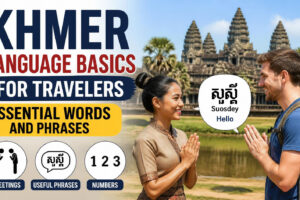
1. Learn the Cambodian Greeting: The Sampeah
One of the easiest ways to show respect in Cambodia is to understand the traditional Khmer greeting known as the sampeah.
The sampeah involves bringing the palms together in front of the body and slightly bowing the head or upper body. The height of the hands and degree of the bow can vary depending on the age and social status of the person being greeted.
You will also hear the polite greeting “Chum Reap Suor”, particularly in more formal situations.
Handshakes are also common, particularly in modern business and international settings. When meeting someone for the first time, following the other person’s lead is often the easiest approach.
Tourism Cambodia specifically recommends the sampeah as a respectful traditional greeting for visitors.
Simple rule for travelers
If you are unsure how to greet someone, smile, make eye contact appropriately, and follow their greeting. A respectful attitude is more important than performing the gesture perfectly.
2. Dress Respectfully at Temples and Religious Sites
Cambodia is predominantly Buddhist, and temples and pagodas remain important places of worship. Visitors should therefore dress more conservatively when entering religious sites.
At temples and pagodas, it is appropriate to cover the shoulders and knees. Some specific locations may have stricter requirements. For example, visitors to the upper level of Angkor Wat must follow the site’s dress requirements, including covered shoulders and legs extending at least to the knees.
The Royal Palace and Silver Pagoda in Phnom Penh also require more formal clothing than you might wear at a beach or resort. Tourism Cambodia advises visitors to wear long trousers or long skirts and keep their shoulders covered when visiting the Silver Pagoda.
What to pack
A lightweight scarf, loose trousers, or a long skirt can be very useful. Cambodia’s climate is hot and humid, so lightweight clothing that provides adequate coverage is practical for temple visits.
3. Remove Your Shoes When Appropriate
Removing shoes is a normal part of entering many Cambodian homes and religious buildings.
When you see shoes lined up outside a house, pagoda, or building, this is usually a clear indication that you should remove yours as well.
At Buddhist pagodas, shoes are generally removed before entering the main religious buildings. Visitors should also follow any instructions provided by the temple or site staff.
Don’t assume every building has the same rule
Some tourist sites, restaurants, shops, and businesses may not require shoes to be removed. Look for signs or observe what local people are doing rather than removing your shoes automatically everywhere.
4. Never Touch Someone’s Head
One of the most important Cambodian etiquette rules for visitors is to avoid touching another person’s head.
In Cambodian Buddhist and cultural traditions, the head is regarded as the highest or most sacred part of the body. Touching someone’s head can therefore be considered disrespectful, even if your intention is friendly.
This is particularly important when interacting with children. A visitor may naturally want to pat a child’s head as a friendly gesture, but it is better to avoid doing so.
Tourism Cambodia specifically advises visitors not to touch or pat another person’s head, including children.
5. Be Careful With Your Feet
In Cambodian culture, the feet are considered the lowest part of the body. Because of this, pointing your feet toward people, monks, Buddha images, or important objects can be considered disrespectful.
Avoid using your foot to point at something or someone. You should also avoid putting your feet on furniture in a way that points the soles toward another person.
When sitting in a pagoda, try to position your feet away from Buddha images and other people. If you are sitting on the floor, keeping your feet tucked behind you is a respectful option.
Remember this simple rule
Head = respect. Feet = keep them out of the way.
This simple principle will help you avoid one of the most common cultural mistakes made by unfamiliar visitors.
6. Show Respect to Buddhist Monks
Buddhist monks are highly respected in Cambodian society. Visitors should behave calmly and respectfully around monks, particularly inside pagodas.
Do not touch a monk without a clear cultural or practical reason. Women should be especially careful because Buddhist monastic rules restrict physical contact between monks and women. Tourism Cambodia specifically advises that women should not touch a monk’s body or robe.
If you want to photograph a monk, it is courteous to ask permission first rather than photographing them at close range without warning.
When a monk is walking, sitting, eating, praying, or participating in a religious ceremony, give them appropriate space and avoid interrupting them.
7. Ask Before Taking People’s Photos
Cambodia is a visually rich country, and travelers naturally want to photograph markets, villages, temples, monks, farmers, street scenes, and everyday life.
However, a person’s image is personal. Before taking a close-up photograph of someone, especially a monk, elderly person, child, or someone engaged in a private activity, ask permission whenever practical.
A simple smile and gesture toward your camera followed by a questioning look is often enough when there is a language barrier.
Tourism Cambodia recommends asking permission before photographing people, while UK government travel guidance also advises travelers to ask permission before photographing people, particularly monks and other religious figures.
8. Keep Your Voice Calm in Public
Raising your voice, shouting, or showing visible anger in public can create an uncomfortable situation in Cambodia.
Tourism Cambodia advises visitors to avoid shouting and excessive noise in public areas, including pagodas and public buildings. Its general cultural guidance also notes that displays of anger and raised voices are considered ill-mannered.
If you have a disagreement with a hotel, restaurant, driver, shopkeeper, or another person, try to remain calm and explain the problem clearly.
A polite conversation is usually much more effective than confrontation.
9. Understand Public Displays of Affection
Cambodian society is generally more conservative about public displays of affection than many Western societies.
Holding hands may be seen in modern urban settings, particularly among younger people, but more intimate behavior such as prolonged kissing or sexual displays in public can be considered inappropriate.
Tourism Cambodia advises visitors to avoid public displays of affection such as kissing and intimate hugging.
At temples, pagodas, memorial sites, and other culturally significant places, visitors should be particularly discreet and respectful.
10. Be Respectful When Visiting a Cambodian Home
If you are invited into a Cambodian home, consider it a sign of hospitality and friendship.
Observe whether the household removes shoes at the entrance and follow the family’s example. Tourism Cambodia specifically recommends leaving shoes at the entrance when entering someone’s home.
If you are offered food or a drink, accepting at least a small amount when appropriate can be a friendly gesture of appreciation. If you cannot accept something because of dietary, religious, or health reasons, explain politely rather than simply rejecting it.
When meeting older family members, use a particularly respectful tone. Cambodian society traditionally places significant importance on age and family relationships.
11. Dining Etiquette in Cambodia
Cambodian meals are often social experiences, with dishes shared among several people. Rice, soups, vegetables, meat, fish, and other dishes may be placed in the center of the table for everyone to share.
When eating with Cambodian friends or a host family, take a reasonable portion rather than filling your plate immediately. Sharing food is an important part of hospitality.
Tourism Cambodia also advises visitors to use the right hand when handling food in situations where food is eaten by hand.
Don’t worry about perfect table manners
Food culture varies between families, restaurants, and regions. The most important rule is to observe your hosts and follow their example.
12. Market Etiquette: Bargain With a Smile
Markets are one of the best places to experience everyday Cambodian life. In traditional markets and some tourist markets, bargaining may be part of the shopping experience.
If bargaining is appropriate, keep it friendly. A smile, polite conversation, and reasonable negotiation are better than becoming angry over a small price difference.
Not every shop uses the same pricing system. Some stores have fixed prices, supermarkets use marked prices, and many modern businesses do not expect customers to negotiate.
Lonely Planet notes that bargaining is common in Cambodian markets and some forms of locally arranged transportation, while emphasizing a friendly approach.
13. Tipping in Cambodia: What Should Travelers Know?
Tipping practices in Cambodia are less standardized than in some Western countries.
Tourism Cambodia states that tipping is not traditionally mandatory in Cambodia and that some hotels and restaurants may include a service charge.
However, travelers may choose to leave a tip when they receive particularly good service, especially from guides, drivers, hotel staff, restaurant workers, or other service providers.
The important point is that a tip should not be treated as an automatic obligation in every situation. Check the bill first to see whether a service charge has already been included.
14. Respect Cambodian Religion and Sacred Objects
Buddhist temples are active places of worship, not simply tourist attractions.
When visiting a pagoda or temple, speak quietly, follow signs, stay within areas open to visitors, and avoid climbing on statues or religious structures.
Do not sit on Buddha images, touch sacred objects without permission, or treat religious statues as props for humorous photographs.
At Angkor and other archaeological temples, visitors should also stay on designated paths and respect barriers and restricted areas. The official Angkor code of conduct emphasizes appropriate clothing and respect for the sanctity of the temples and Cambodian culture.
15. Be Sensitive When Discussing Cambodia’s History
Cambodia has experienced profound historical trauma, particularly during the Khmer Rouge period from 1975 to 1979.
Visitors may encounter museums and memorial sites such as Tuol Sleng Genocide Museum and Choeung Ek. These are places of remembrance and education, not entertainment attractions.
When visiting such sites, avoid making jokes, posing disrespectfully, or treating painful historical events as casual photo opportunities.
Listen to guides and museum information, respect other visitors, and remember that Cambodian families continue to carry personal memories connected to this period.
16. Learn a Few Khmer Words
You do not need to speak fluent Khmer to make a positive impression. Learning a few simple expressions can show genuine interest in Cambodian culture.
- Chum Reap Suor – Hello / formal greeting
- Orkun – Thank you
- Som toh – Sorry / excuse me
- Ba – Yes / polite response commonly used by men
- Cha – Yes / polite response commonly used by women
Pronunciation may vary depending on the speaker and context, so do not worry about sounding perfect. A sincere attempt is generally appreciated.
17. What International Travelers Should Avoid
Important Don’ts in Cambodia
- Don’t touch someone’s head, including a child’s head.
- Don’t point at people or objects with your feet.
- Don’t point the soles of your feet toward Buddha images or monks.
- Don’t touch monks or their robes, particularly if you are a woman.
- Don’t enter temples wearing revealing clothing.
- Don’t take close-up photographs of people without permission.
- Don’t shout or lose your temper in public.
- Don’t climb on ancient temple structures where climbing is prohibited.
- Don’t treat Buddhist statues or sacred objects as photo props.
- Don’t make jokes at memorial sites connected with Cambodia’s recent history.
- Don’t assume every shop or market uses the same bargaining rules.
- Don’t expect Cambodian customs to be identical to those in your home country.
18. The Most Important Rule: Observe and Adapt
Perhaps the most useful etiquette rule for international travelers is simply to observe what local people do and adapt respectfully.
Cambodia is changing rapidly, particularly in Phnom Penh, Siem Reap, Sihanoukville, and other tourist and urban areas. Younger Cambodians may be comfortable with international customs, while older generations or people in rural communities may follow more traditional practices.
There is therefore no single rule that perfectly describes every Cambodian person or every situation.
If you are uncertain, watch what people around you are doing, ask politely, and use common sense. A respectful attitude will take you a long way.
Frequently Asked Questions About Cambodian Etiquette
What should tourists not do in Cambodia?
Visitors should avoid touching people’s heads, pointing with their feet, disrespecting Buddhist monks or religious objects, wearing inappropriate clothing at sacred sites, photographing people without permission, shouting in public, and behaving disrespectfully at memorial sites.
Can tourists wear shorts in Cambodia?
Yes, shorts are commonly worn by travelers in everyday tourist settings. However, clothing requirements are stricter at religious sites. At Angkor Wat, visitors entering the highest level must cover their shoulders and legs to at least the knees. The Royal Palace and Silver Pagoda also require more conservative dress.
Is it rude to touch someone’s head in Cambodia?
Yes. The head is traditionally regarded as the highest or most sacred part of the body, so visitors should avoid touching or patting another person’s head, including children.
Can women touch Buddhist monks in Cambodia?
Women should not touch Buddhist monks or their robes. Visitors should also avoid handing objects directly to monks when doing so would require physical contact. If you need to give something to a monk, follow the local practice or ask another person for guidance.
Should I ask before taking photos in Cambodia?
Yes, particularly for close-up photographs of people, monks, children, or private activities. Asking permission is a simple way to show respect.
Do I need to remove my shoes in Cambodia?
Often, yes, when entering homes and many Buddhist religious buildings. Look for shoes outside the entrance or follow the behavior of local people and site instructions.
Is bargaining rude in Cambodia?
Bargaining is not necessarily rude when it is customary, particularly in some traditional markets. The key is to negotiate politely and accept the seller’s final price if you decide not to buy. Fixed-price shops and modern businesses generally do not expect bargaining.
Is tipping required in Cambodia?
Tipping is not traditionally mandatory. Some establishments may include a service charge, while travelers may choose to give additional tips for particularly good service. Check your bill before tipping.
What is the traditional Cambodian greeting?
The traditional Khmer greeting is called the sampeah, which involves placing the palms together and making a slight bow. “Chum Reap Suor” is a formal Khmer greeting.
Sources & References
This article was researched using official Cambodian tourism guidance and established international travel information sources. Cultural recommendations can vary by location, age group, religious setting, and individual family, so travelers should also follow instructions at the specific place they are visiting.
- Tourism Cambodia: Do’s and Don’ts in the Kingdom of Cambodia.
- Tourism Cambodia: Health, clothing, temple, and visitor advice.
- Tourism Cambodia: Cambodian cultural etiquette and frequently asked questions.
- Tourism Cambodia: Angkor Code of Conduct.
- UK Foreign, Commonwealth & Development Office: Cambodia travel advice and Angkor visitor guidance.
- Lonely Planet: Cambodia travel and cultural etiquette guidance.
Conclusion
Good etiquette in Cambodia does not require travelers to know every Khmer custom. The most important principles are simple: dress appropriately at sacred places, greet people respectfully, keep your voice calm, ask before taking photographs, respect Buddhist monks and religious objects, and be mindful of how you use your hands, feet, and body language.
Most importantly, approach Cambodia with curiosity rather than judgment. Cultural differences are part of what makes international travel rewarding. When you take the time to observe local customs and show genuine respect, everyday interactions—from ordering food at a market to visiting a centuries-old temple—can become a more meaningful part of your Cambodian journey.
Planning your trip to Cambodia? Explore more GoToKH guides for practical travel advice, Cambodian culture, history, food, destinations, and experiences across the Kingdom.