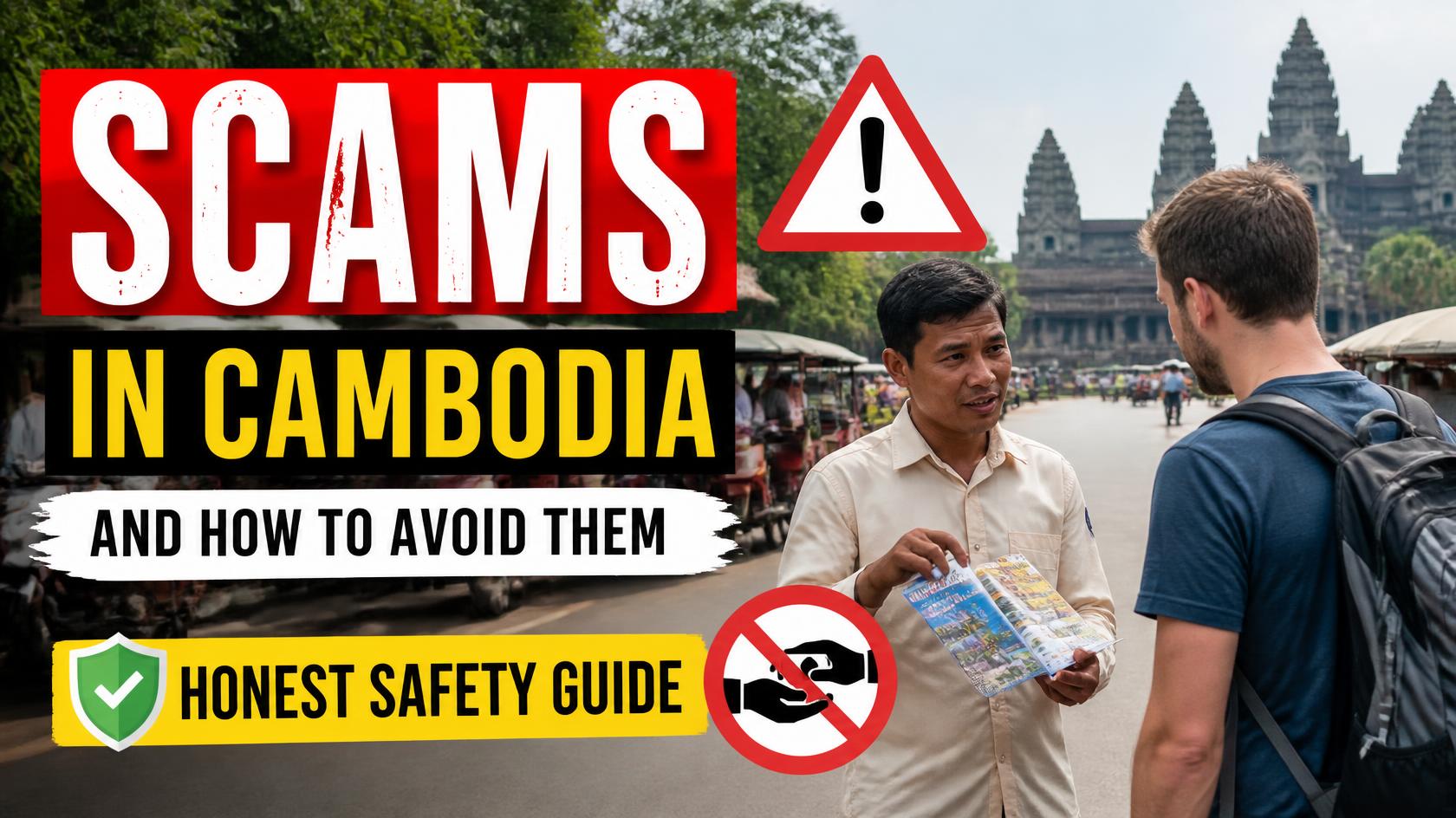
Scams in Cambodia and How to Avoid Them: Honest Safety Guide

Cambodia is a welcoming destination with famous temples, beautiful islands, excellent food, and friendly people. Millions of travelers visit each year without experiencing serious problems. However, like many popular tourist destinations, Cambodia has scams and petty crimes that visitors should understand before arriving.
The good news is that most common tourist scams are relatively easy to avoid when you know the warning signs. The biggest risks usually come from situations involving unexpected requests for money, fake opportunities, dishonest prices, suspicious online relationships, card and ATM fraud, or strangers trying to move you into a private location.
This guide focuses on practical, realistic precautions rather than making Cambodia sound dangerous. The goal is simple: enjoy your trip, protect your money and documents, and know when to walk away.
Quick Summary: Common Scams in Cambodia
| Scam or Risk | Common Warning Sign | Best Response |
|---|---|---|
| Fake or damaged US dollars | Suspicious notes or unusual change | Check money before accepting it |
| ATM/card fraud | Suspicious ATM or unexpected transaction | Use reputable bank ATMs and monitor your account |
| Tuk-tuk/taxi overcharging | No agreed price before the ride | Use a reputable ride-hailing app or agree on price first |
| Gambling/card-game scam | Friendly stranger invites you to a private home | Decline and leave |
| Fake job offer | Very high salary and vague job details | Verify the employer independently |
| Romance scam | Online contact asks for money or urgent help | Never send money to someone you have not met |
| Fake visa or border fee | Unofficial fee request | Check official visa fees in advance |
| Bag or phone snatching | Motorbike approaches from behind | Keep valuables away from the road |
1. Is Cambodia Full of Scams?
No. It would be misleading to describe Cambodia as a country where tourists are constantly being scammed.
Most visitors have normal, positive experiences. However, travelers should recognize that scams and street crime do occur, particularly in busy tourist areas and situations involving cash, transportation, nightlife, online relationships, and informal services.
The Australian government currently advises travelers to exercise a high degree of caution in Cambodia and specifically warns about scams involving friendly strangers, gambling, forced ATM withdrawals, online relationships, employment offers, and card or ATM fraud.
The U.S. State Department also currently warns about financial scams, romance scams, fake emergencies, work scams and other fraud targeting foreigners.
The important lesson is not to become paranoid. Instead, understand the common patterns and make decisions based on warning signs.
2. Fake or Damaged US Dollar Notes
US dollars remain widely used in Cambodia, particularly in tourism and larger transactions. This makes cash-related scams an important issue for travelers.
Travelers have reported receiving fake US-dollar notes as change. UK travel advice specifically warns visitors to check dollar notes received as change and notes that damaged or torn bills can also cause problems when trying to use them.
How to Protect Yourself
- Check large US-dollar notes when you receive them.
- Do not accept badly damaged or torn notes if you can avoid it.
- Count your change before leaving the shop, restaurant, or taxi.
- Be particularly careful when receiving change from informal businesses.
- Use established businesses for large cash transactions.
If someone gives you a suspicious banknote, do not immediately accuse them of deliberately scamming you. Politely ask for another note or use another payment method.
3. ATM and Credit Card Scams
ATMs are widely available in Cambodian cities and tourist destinations, but travelers should still take normal precautions.
Card and ATM fraud, including card skimming, has been reported in Cambodia. Australia’s Smartraveller specifically warns travelers about credit-card and ATM fraud and recommends checking ATMs for skimming devices and monitoring transaction statements.
Safer ATM Habits
- Use ATMs operated by established banks.
- Prefer ATMs located inside or directly beside bank branches or secure commercial locations.
- Cover the keypad while entering your PIN.
- Check the card slot and keypad for anything suspicious.
- Do not allow strangers to help you use an ATM.
- Keep your phone notifications enabled for banking transactions.
- Check your account regularly while travelling.
- Contact your bank immediately if you see an unfamiliar transaction.
Never give your PIN, card password, online banking password, or one-time security code to another person.
4. Tuk-Tuk and Taxi Overcharging
Transportation scams are usually less dramatic than organized fraud, but they can still make a trip unnecessarily expensive.
A driver may quote one price before a journey and later claim that the price was per person, that the destination was different, or that additional charges apply.
This is not unique to Cambodia, but tourists can reduce the risk by confirming the price before getting into a vehicle.
How to Avoid Transportation Problems
- Agree on the price before starting the journey.
- Confirm whether the price is total or per passenger.
- Use reputable ride-hailing services when available.
- Check the destination shown in the app.
- Avoid accepting unexpected shopping stops from drivers.
- Keep your phone and wallet secure while travelling.
Australia’s current travel advice notes that ridesharing services are common in Phnom Penh, Siem Reap, Sihanoukville and Kampot and can be safer and cheaper than negotiating with a taxi, motorbike or tuk-tuk on the street.
5. The Friendly Stranger and Gambling Scam
This is one of the more important scams for visitors to understand.
A stranger may approach you in a friendly way and start a conversation. They may say they want to practice English, show you around, introduce you to friends, or invite you to their home.
Eventually, you may be introduced to a card game or gambling activity where you are encouraged to put money into the game. Some victims have been pressured into withdrawing money from an ATM.
Australia’s Smartraveller specifically warns about criminals approaching travelers with friendly stories, inviting them to private homes, and involving them in card games where victims can lose large amounts of money. It also reports cases where victims were forced to withdraw money from ATMs.
Red Flags
- A stranger becomes unusually friendly very quickly.
- They insist on taking you somewhere private.
- They introduce you to people you do not know.
- They suggest a card game or gambling activity.
- They say you can easily make money.
- They pressure you to withdraw cash.
Best response: politely say no, do not follow them, and leave the situation.
6. Fake Job Offers and Employment Scams
This is one area where travelers should take the risk particularly seriously.
Criminal organizations have used attractive job advertisements to lure foreigners to Cambodia and other parts of Southeast Asia. Some victims have reportedly been trafficked and forced to work in illegal online scam operations.
The U.S. State Department warns that people, including English teachers, can be lured by offers of well-paid jobs that turn out to involve illegal scam centers.
Australian authorities also warn about employment offers with unusually high salaries, vague job descriptions, secretive communication, questionable visa promises, and pressure to travel quickly.
Warning Signs of a Fake Job
- Extremely high salary for little experience.
- No proper interview.
- Vague company information.
- Pressure to travel immediately.
- Employer refuses to provide a verifiable office address.
- Someone else controls your visa or passport arrangements.
- They tell you not to discuss the job with others.
- They ask you to pay large recruitment fees.
- The actual job is different from the advertised position.
Never hand over your passport permanently to an employer or recruiter. Verify the company independently before travelling for employment.
7. Online Romance and Dating Scams
Romance scams can begin anywhere, including dating apps, social media, messaging platforms, and online communities.
A person may develop a relationship with you online and then suddenly claim to have an emergency. They may need money for medical treatment, travel, a legal problem, a family emergency, or another urgent situation.
The U.S. State Department specifically warns about romance and online dating scams in Cambodia, including requests for money and situations where criminals use dating platforms to target foreigners.
Protect Yourself
- Never send money to someone you only know online.
- Do not share banking information.
- Be suspicious of urgent emergencies.
- Do a video call before meeting someone you met online.
- Meet in a busy public location.
- Tell a friend where you are going.
- Do not invite a stranger directly to your hotel room.
If someone you met online asks for money, expensive gifts, cryptocurrency, or financial assistance, treat it as a serious warning sign.
8. Fake Visa Fees and Border Scams
Travelers crossing international borders should know the official visa requirements and fees before reaching the checkpoint.
UK travel advice warns that local officials or tour operators at remote land crossings can sometimes request unofficial fees or inflate visa prices.
This is one reason travelers should research their visa before travelling and keep a record of the official fee.
How to Reduce the Risk
- Know whether you need a visa.
- Know the official visa fee before travelling.
- Use the official Cambodian e-Visa system when applying online.
- Ask for a receipt for official payments.
- Do not hand over money to random intermediaries.
- Be particularly careful at unfamiliar land crossings.
Do not assume that every person wearing a uniform or offering assistance is authorized to collect money from you.
9. Fake Tour, Hotel and Activity Deals
Tourists can also encounter misleading offers for tours, hotels, transportation, excursions, and other activities.
A very cheap offer may initially look attractive but later involve additional charges, compulsory shopping stops, poor-quality services, or conditions that were not clearly explained.
Before Paying for a Tour
- Check recent reviews from multiple sources.
- Confirm exactly what is included.
- Ask whether entrance tickets are included.
- Ask about transportation.
- Confirm cancellation conditions.
- Get the final price in writing when possible.
- Be cautious of deals that are dramatically cheaper than comparable offers.
For expensive activities, paying through an established company with clear contact information and a verifiable location is usually safer than handing cash to a stranger on the street.
10. The “Donation” or Fake Charity Scam
Some travelers may encounter people asking for money for charities, schools, children, hospitals, or other causes.
Not every request is fraudulent, but tourists should be careful when someone puts them under immediate emotional pressure to donate cash.
If you genuinely want to support a cause, consider donating through an established organization that publishes information about its programs and finances.
Do not feel guilty about saying no. A simple “Sorry, I can’t help” is enough.
11. Fake Police or Authority Scams
Scammers may sometimes claim to be police officers, government officials, immigration personnel, or other authorities and demand immediate payment.
If someone claims you have committed an immigration or legal violation and demands cash immediately, stay calm and ask for official identification and documentation.
Do not hand over your passport, bank card, or large amounts of cash simply because someone is wearing a uniform.
If you are genuinely concerned, contact the relevant authority through an independently verified official number.
12. Bag and Phone Snatching
Not every tourist problem is technically a scam. Bag and phone snatching is a genuine street-crime risk and is one of the most important practical safety issues for visitors.
UK travel advice reports that thieves often ride past on motorbikes and snatch bags or phones from people walking, travelling in tuk-tuks, or riding motorbikes.
The U.S. State Department similarly warns that phone and bag snatching occurs frequently in areas of Phnom Penh where foreigners gather.
How to Reduce Your Risk
- Do not hold your phone loosely while walking beside a road.
- Keep bags away from the traffic side of the street.
- Avoid displaying expensive jewelry or electronics.
- Use a secure crossbody bag.
- Keep your passport in a secure location.
- Use a hotel safe for valuables when appropriate.
- Be especially alert at night and in crowded tourist areas.
If someone attempts to snatch your belongings, do not physically fight over the bag or phone. Your safety is more important than the value of the item. The U.S. State Department specifically advises against physically resisting robbery.
13. Drink Spiking and Nightlife Scams
Travelers should also be careful with drinks in nightlife areas.
Authorities have reported cases of drink spiking in bars frequented by foreign visitors. UK travel advice also warns about drink spiking and methanol poisoning associated with alcoholic drinks.
Simple Nightlife Rules
- Do not leave your drink unattended.
- Do not accept drinks from strangers.
- Watch your drink being prepared when possible.
- Stay with people you trust.
- Be cautious about accepting invitations to private locations.
- Arrange your transportation before drinking heavily.
If you suddenly feel much more intoxicated than expected, seek help from trusted people and move to a safe location.
14. Common Scams in Tourist Areas
Scams and petty crime can be more noticeable in places with large numbers of international visitors.
Travelers should use extra awareness around:
- Busy markets
- Nightlife districts
- Major tourist attractions
- Transport hubs
- Popular beaches
- ATM locations
- Large festivals and crowded events
This does not mean these places are unsafe or should be avoided. It simply means that crowded environments create more opportunities for distraction and theft.
15. How to Recognize a Scam Before You Lose Money
Most scams share a few common psychological patterns.
Pressure
You are told that you must pay or decide immediately.
Urgency
Someone claims that something terrible will happen if you do not send money immediately.
Secrecy
You are told not to tell your friends, family, hotel, employer, or authorities.
Too-Good-to-Be-True Offers
You are promised easy money, an unusually cheap service, a fantastic job, or a guaranteed investment.
Isolation
Someone tries to move you away from public places into a private home, hotel room, vehicle, or isolated location.
Emotional Manipulation
The person tries to make you feel guilty, frightened, romantic, or responsible for their problem.
Simple rule: If someone is trying to make you act quickly before you have time to think, slow down.
16. What to Do If You Think You Are Being Scammed
You do not need to argue with a scammer.
The safest response is often to stop the transaction and leave.
- Stop giving money.
- Do not provide your PIN or passwords.
- Move to a public place.
- Contact your bank if financial information was exposed.
- Block suspicious online contacts.
- Save screenshots, receipts, messages, and transaction records.
- Report serious incidents to the police.
- Contact your travel insurer if appropriate.
- Contact your embassy or consulate if you need consular assistance.
17. What to Do If Your Card or Money Is Stolen
If your bank card is stolen, contact your bank immediately and ask them to block the card.
If your phone is stolen, use your bank’s security system to protect your accounts and remotely lock the device if that feature is available.
If your passport is stolen, contact your embassy or consulate for instructions on obtaining replacement travel documentation.
For serious crimes in Cambodia, the emergency police number is 117. Fire services can be reached at 118 and ambulance services at 119.
18. Scams vs. Normal Cambodian Bargaining
One important cultural distinction is that bargaining is not automatically a scam.
At some markets and informal businesses, prices may be negotiable. A seller giving a tourist a higher opening price is not necessarily committing fraud.
The difference is whether the price is clearly communicated and whether you are free to accept or decline it.
If you do not like the price, simply say no and walk away.
19. Is It Safe to Use Cash in Cambodia?
Yes, but use normal precautions.
Cambodia’s widespread use of both US dollars and Khmer riel means travelers often carry cash. However, carrying your entire travel budget in one wallet creates unnecessary risk.
A better strategy is to divide your money between your wallet, secure luggage, hotel safe where appropriate, and payment cards.
Carry only the amount you expect to need for the day.
20. Current 2026 Safety Reminder for Travelers
Scams are only one part of Cambodia’s current travel-safety picture.
As of October 2026, the U.S. State Department advises increased caution in Cambodia because of crime, unrest and unexploded ordnance, while the UK and Australian governments also publish specific warnings concerning crime, scams and border areas.
Travelers should also understand that current warnings concerning the Cambodia–Thailand border are specific to affected border areas and should not be interpreted as meaning that every tourist destination in Cambodia faces the same security conditions. The UK currently advises against all but essential travel within 20 km of the land border with Thailand, while the U.S. advises against travel within 50 km of that border.
Always check your own government’s latest travel advisory before travelling.
Practical Anti-Scam Checklist for Cambodia
- ☐ Never send money to an online stranger.
- ☐ Do not follow strangers to private homes or hotel rooms.
- ☐ Avoid gambling or card games with people you just met.
- ☐ Check US-dollar notes before accepting large amounts of change.
- ☐ Use reputable bank ATMs.
- ☐ Monitor your bank account during your trip.
- ☐ Keep your PIN and passwords private.
- ☐ Agree on transportation prices before travelling.
- ☐ Use reputable ride-hailing services when practical.
- ☐ Be suspicious of extremely attractive job offers.
- ☐ Never carry luggage or parcels for strangers.
- ☐ Keep your phone and bag away from the road.
- ☐ Do not leave drinks unattended.
- ☐ Keep emergency contact numbers available.
- ☐ Trust your instincts and walk away when something feels wrong.
Frequently Asked Questions About Scams in Cambodia
What is the most common scam in Cambodia?
There is no single scam that affects every traveler. Common concerns include transportation overcharging, fake or damaged currency, ATM and card fraud, gambling scams, fake job offers, online romance scams, and bag or phone snatching.
Are tourists commonly scammed in Cambodia?
Scams do occur, but millions of visitors travel through Cambodia without serious problems. The best protection is awareness, especially when strangers make unexpected financial offers or try to isolate you.
Is it safe to use ATMs in Cambodia?
Yes, but use reputable bank ATMs, protect your PIN, inspect the machine for suspicious devices, and monitor your account. Card and ATM fraud has been reported in Cambodia.
Should I carry US dollars in Cambodia?
US dollars remain widely used, particularly for tourist-related transactions. However, Khmer riel is Cambodia’s official currency and is useful for small everyday purchases.
How can I avoid fake US dollars?
Check large notes and inspect your change before leaving a business. Avoid accepting badly damaged notes when possible.
Is it safe to accept an invitation from a stranger?
It is better to be cautious. Current Australian travel advice specifically warns about strangers who invite travelers to private homes and later involve them in gambling or financial scams.
Are job offers in Cambodia safe?
Many legitimate jobs exist, but travelers should be extremely cautious about offers promising unusually high salaries with little experience or vague job descriptions. International authorities have warned about fraudulent job advertisements connected to illegal scam operations and trafficking.
What should I do if someone tries to rob me?
Prioritize your physical safety. Do not physically resist a robbery over a phone, wallet, or bag. Move to a safe location and report the incident to police.
What is Cambodia’s emergency police number?
The emergency police number is 117. Fire services are 118 and ambulance services are 119.
Can I report a scam or theft to the police?
Yes. Serious crimes should be reported to local police. Ask for a police report if you need documentation for travel insurance. The UK government notes that police reports should be free.
Sources & References
- Australian Government – Smartraveller: Current Cambodia travel advice covering scams, ATM fraud, employment scams, online relationships, transportation and personal safety.
- U.S. Department of State: Current Cambodia Travel Advisory and guidance on financial scams, romance scams, employment scams, street crime and emergency assistance.
- UK Foreign, Commonwealth & Development Office: Current Cambodia safety advice covering theft, fake currency, scams, drink spiking, employment scams and emergency contacts.
- UK Home Office: September 2026 cooperation with Cambodia to combat international online scam networks.
Important: Safety conditions and scam patterns can change. This guide is intended for general travel information and should not replace the latest advice from Cambodian authorities or your own government’s travel advisory.
Conclusion
Cambodia is not a destination where travelers need to spend their entire holiday worrying about scams. Most visitors have enjoyable experiences, but understanding a few common risks can make your trip significantly safer and more comfortable.
The most useful rule is simple: do not rush into financial decisions because a stranger creates pressure, urgency, fear, or excitement. Be cautious with unexpected friendships, private invitations, gambling opportunities, online relationships, unusually attractive job offers, and requests for money.
For everyday travel, protect your phone and wallet, use reputable ATMs and transportation services, check your cash, keep backup payment methods, and avoid carrying valuables unnecessarily.
If something feels wrong, you do not need to prove that it is a scam. Simply say no, leave, and choose a safer option.
With sensible precautions and a little awareness, travelers can enjoy Cambodia’s temples, beaches, food, culture, and welcoming communities with confidence.