
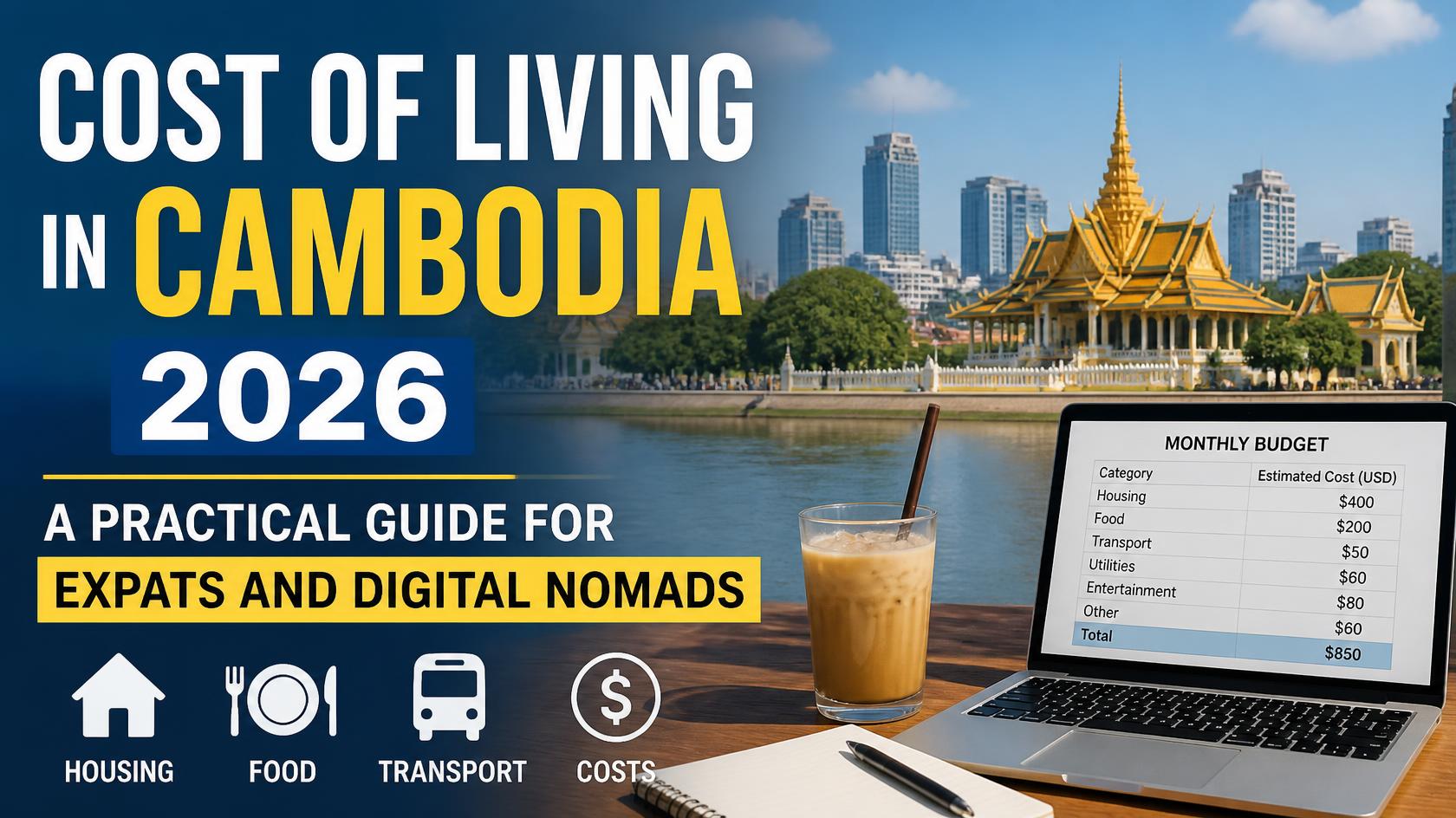
Cost of Living in Cambodia 2026 A Practical Guide for Expats and Digital Nomads

Cambodia remains an attractive destination for expats, remote workers, retirees and digital nomads who want a relatively affordable lifestyle in Southeast Asia. But the cost of living in Cambodia can vary dramatically depending on where you live, the type of accommodation you choose, how often you eat Western food, how much you use air conditioning, and how frequently you travel.
In 2026, a single person can live relatively simply in Cambodia on a modest monthly budget, while a more comfortable lifestyle with a modern apartment, frequent restaurant meals, cafés, coworking, entertainment and private transport can require considerably more.
Phnom Penh generally has the highest living costs among Cambodia’s major cities, particularly for centrally located housing. Siem Reap can offer lower accommodation costs, while cities such as Battambang and Kampot may appeal to people looking for a slower and potentially less expensive lifestyle.
This guide explains the major expenses you should consider before moving to Cambodia or staying for several months, with practical budget examples for expats and digital nomads in 2026.
Quick Answer: How Much Does It Cost to Live in Cambodia?
There is no single monthly figure that applies to everyone. Current 2026 cost-of-living sources place a simple single-person lifestyle in Phnom Penh at roughly $650–$850 per month, while a more comfortable lifestyle can reach around $1,000–$1,400 per month. A higher-end lifestyle can easily exceed $1,800–$2,500 per month.
These figures are planning ranges rather than official government cost-of-living statistics. Your actual spending can be substantially lower or higher.
| Lifestyle | Approx. Monthly Budget | Typical Lifestyle |
|---|---|---|
| Budget | $500–$750 | Simple accommodation, mostly local food, limited entertainment |
| Comfortable | $800–$1,400 | Furnished apartment, mixed local and international food, regular cafés and transport |
| Premium | $1,500–$2,500+ | Modern condo, frequent dining out, imported products, private transport and more entertainment |
Important: These are planning ranges for one person. Couples can often share housing and other costs, while families with children may face much higher expenses, particularly for international education and healthcare.
1. Rent and Accommodation in Cambodia
Housing is usually the largest monthly expense for an expat or digital nomad in Cambodia. Prices depend on the city, neighborhood, apartment size, furnishing, building age, security, swimming pool, gym, parking and whether utilities or internet are included.
Current September 2026 cost data for Phnom Penh shows a furnished studio of around 45 m² at approximately $337 per month in a normal area and around $514 in a more expensive area. These figures are useful reference points rather than guaranteed market prices.
Typical Monthly Rent Ranges
| Accommodation | Practical Planning Range |
|---|---|
| Basic local room/studio | $150–$300 |
| Furnished studio | $250–$500 |
| Comfortable 1-bedroom apartment | $350–$700 |
| Modern central condo | $600–$1,000+ |
| Luxury apartment/condo | $1,000+ |
These ranges are broad because the Cambodian rental market contains everything from basic local rooms to fully serviced luxury apartments.
Phnom Penh
Central neighborhoods such as BKK1 and Tonle Bassac are popular with foreign residents but generally command higher rents. Areas farther from the center can provide more space for the money, although transport time and convenience may change.
Current 2026 sources place many one-bedroom apartments in Phnom Penh around the $350–$650 range, with premium central properties considerably higher.
Siem Reap
Siem Reap generally offers lower accommodation costs than central Phnom Penh. Current cost comparisons show furnished accommodation in Siem Reap below comparable Phnom Penh housing in many categories.
This makes Siem Reap attractive to digital nomads who prefer a smaller city, easier access to Angkor and a more relaxed lifestyle.
Before Signing a Rental Agreement
- Ask whether electricity is charged separately.
- Confirm the electricity rate per kWh.
- Ask whether water is included.
- Check whether Wi-Fi is included.
- Ask about cleaning or building fees.
- Check the internet speed and reliability.
- Inspect the air conditioner before moving in.
- Ask about the security deposit and refund conditions.
- Clarify the minimum rental period.
- Check what furniture and appliances are included.
2. Food and Groceries
Food is one of the easiest expenses to control in Cambodia. Eating mostly Cambodian food at local restaurants and markets can keep monthly costs relatively low. Imported groceries and frequent Western restaurant meals can increase your budget quickly.
Current 2026 Phnom Penh estimates suggest that a single person who cooks regularly and buys mostly local products may spend roughly $150–$250 per month on groceries, while a heavier reliance on imported products can push grocery spending to around $250–$400 or more.
Eating Local Food
Cambodian dishes such as rice with grilled meat, noodle soups, fried rice, Lok Lak, Bai Sach Chrouk and other local meals can be relatively inexpensive compared with Western restaurants.
For someone living locally rather than eating every meal in tourist-oriented restaurants, food can remain one of the most manageable parts of the monthly budget.
Western and Imported Food
Imported cheese, wine, cereals, specialty products, international brands and some imported meats can be much more expensive than locally produced alternatives.
If you want to maintain a Western-style diet, allow a larger grocery and restaurant budget.
Example Monthly Food Budget
| Food Style | Approx. Monthly Budget |
|---|---|
| Mostly local food | $150–$250 |
| Mixed local + Western | $250–$400 |
| Frequent international dining | $400–$700+ |
3. Utilities: Electricity, Water and Gas
Utility costs can be surprisingly different between two people living in similar apartments.
The biggest variable is usually electricity consumption, particularly air-conditioning. Someone who keeps an air conditioner running for many hours every day can have a significantly higher electricity bill than someone who uses it mainly at night.
Current 2026 estimates for a typical apartment suggest roughly $30–$60 per month for electricity with relatively light usage, although heavy air-conditioning can increase the bill considerably. Utilities and internet together may reasonably require around $50–$120 per month for a single person, depending on the apartment and usage.
Ways to Reduce Electricity Costs
- Set the air conditioner to a reasonable temperature.
- Use fans when the weather allows.
- Turn off air conditioning when leaving home.
- Choose an apartment with an efficient air conditioner.
- Ask the landlord for the actual electricity rate before signing.
Always ask how electricity is calculated. Some landlords or buildings may charge a different rate from the standard public tariff.
4. Internet and Mobile Data
Reliable internet is particularly important for digital nomads. Fortunately, fixed broadband and mobile data are widely available in Cambodia’s major urban areas.
Current 2026 cost estimates place basic home internet at roughly $15–$40 per month, depending on provider, speed and package.
Many remote workers also maintain a mobile data plan as a backup connection. This can be especially useful if your income depends on uninterrupted internet access.
Recommended Digital Nomad Setup
- Home fiber internet
- Local SIM card with mobile data
- Phone hotspot as backup
- Power bank
- Optional coworking membership
Before renting an apartment, do not simply ask whether Wi-Fi is available. Test the actual connection if possible, especially if your work involves video calls, uploading large files or cloud-based applications.
5. Transportation Costs
Cambodia does not have the extensive urban rail networks found in some larger Southeast Asian cities. In Phnom Penh and other cities, daily transportation commonly involves tuk-tuks, motorcycles, ride-hailing services, taxis and private vehicles.
For a person who mainly uses tuk-tuks and ride-hailing services, a practical transportation budget might be around $40–$100 per month, depending on how frequently you travel. Current Phnom Penh planning estimates use roughly $50–$100 for regular local transportation.
Common Transportation Options
- PassApp: Useful for booking local rides.
- Grab: Convenient for ride-hailing and other services.
- Tuk-tuk: A familiar Cambodian transportation option.
- Motorcycle: Convenient but requires appropriate licensing, safety awareness and insurance.
- Bus: Available for some urban routes, particularly in Phnom Penh.
- Private car: More expensive but useful for families or frequent travel.
6. Coffee Shops and Working From Cafés
For digital nomads, coffee can become an underestimated monthly expense.
Cambodia has a large café culture, particularly in Phnom Penh and Siem Reap. A daily specialty coffee, breakfast and snack may feel inexpensive individually, but frequent café visits can add a meaningful amount to the monthly budget.
One 2026 Phnom Penh cost guide estimates that regular café visits can add approximately $100–$150 per month to spending.
If you work from cafés several days a week, consider including coffee and food as a separate category rather than hiding it inside your general food budget.
7. Coworking Spaces
Coworking is optional because many digital nomads work from apartments, cafés or hotel spaces. However, a coworking membership can be worthwhile if you need stable internet, professional meeting rooms, a quiet desk or networking opportunities.
Current Phnom Penh planning estimates put coworking costs roughly around $40–$130 per month, depending on whether you choose occasional access, hot-desk access or a more dedicated workspace.
Siem Reap also has coworking options, although the market is smaller than Phnom Penh’s.
8. Healthcare and Health Insurance
Healthcare should not be ignored when calculating the cost of living in Cambodia.
Routine local medical services can be relatively affordable, but serious illness, hospitalization, emergency treatment and international-standard care can become expensive.
For long-term residents, international or regional health insurance can therefore be an important part of the overall budget. Insurance prices vary greatly according to age, coverage, deductible, pre-existing conditions, geographic coverage and provider.
Do not compare insurance only by monthly premium. Check hospitalization coverage, emergency evacuation, exclusions, outpatient care and whether treatment in neighboring countries is covered.
9. Gym and Fitness Costs
Fitness expenses vary from inexpensive local gyms to premium fitness clubs with swimming pools, classes and modern equipment.
Current Siem Reap cost data, for example, lists a monthly gym membership around 161,397 riel, although actual prices vary considerably by facility.
A reasonable planning range for gym and basic fitness expenses is around $20–$100 per month, depending on the type of facility.
10. Entertainment and Social Life
Entertainment costs depend heavily on your lifestyle.
Someone who spends evenings walking around markets, eating local food and meeting friends in inexpensive cafés can spend relatively little. Regular cocktails, imported alcohol, upscale restaurants, concerts, private clubs and weekend trips can increase spending considerably.
For a comfortable lifestyle, setting aside approximately $100–$250 per month for entertainment and miscellaneous spending can provide a useful starting point.
11. Phnom Penh vs. Siem Reap: Which Is More Affordable?
Phnom Penh and Siem Reap offer very different lifestyles.
Current September 2026 comparison data shows that housing in Siem Reap is generally cheaper than comparable housing in Phnom Penh. For example, the listed price for a furnished 45 m² studio in a normal area was approximately 961,522 riel in Siem Reap versus 1,368,130 riel in Phnom Penh.
| Category | Phnom Penh | Siem Reap |
|---|---|---|
| Housing | Generally higher | Generally lower |
| City size | Large and busy | Smaller and more relaxed |
| Business opportunities | Broader | More tourism-focused |
| Café culture | Extensive | Strong for a smaller city |
| Nightlife | Large-city variety | Tourist-oriented |
| Tourism | Capital and business hub | Major Angkor tourism hub |
| Remote-work environment | More professional/coworking options | Quieter lifestyle |
Current cost comparisons also indicate that Phnom Penh’s housing costs can be substantially higher than Siem Reap’s, while the difference in food and everyday expenses can be smaller.
12. Cost of Living in Other Cambodian Cities
Expats do not have to choose between Phnom Penh and Siem Reap.
Battambang
Battambang offers a slower-paced provincial-city lifestyle and can appeal to people who want lower-density living and access to Cambodian culture and agriculture.
Kampot
Kampot attracts travelers, retirees and foreigners looking for a relaxed environment, riverside living, cafés and access to the southern countryside.
Kep
Kep is smaller and quieter, with a coastal lifestyle and strong connections to seafood and tourism.
Rental and lifestyle costs can vary widely in these cities, so it is better to compare actual accommodation options rather than assume that every provincial city will automatically be cheap.
13. Sample Monthly Budgets for One Person
The following examples are designed as practical planning models rather than official averages.
Budget Lifestyle: Around $600–$750
| Expense | Example Budget |
|---|---|
| Rent | $200–$300 |
| Food | $150–$200 |
| Utilities + internet | $50–$80 |
| Transport | $40–$60 |
| Mobile | $5–$15 |
| Entertainment/misc. | $50–$80 |
This lifestyle is possible if you choose modest accommodation, eat mostly local food, limit nightlife and avoid expensive imported products.
Comfortable Lifestyle: Around $1,000–$1,400
| Expense | Example Budget |
|---|---|
| Rent | $400–$600 |
| Food + groceries | $250–$350 |
| Utilities + internet | $60–$100 |
| Transport | $60–$100 |
| Coworking/coffee | $50–$100 |
| Entertainment/misc. | $100–$150 |
This budget provides a comfortable lifestyle for many single expats or digital nomads, particularly outside the most expensive central neighborhoods.
Premium Lifestyle: $1,800–$2,500+
A premium lifestyle may include a modern central apartment, frequent international dining, imported groceries, regular cafés, private transportation, fitness memberships, entertainment and weekend travel.
There is effectively no fixed upper limit because luxury apartments, international schools, private healthcare, premium vehicles and frequent international travel can dramatically increase monthly expenses.
14. What Can Make Cambodia More Expensive?
Cambodia can be affordable, but certain lifestyle choices quickly increase costs.
- Living in a premium central condo
- Eating mostly imported or Western food
- Frequent restaurant dining
- Daily specialty coffee
- Heavy air-conditioning use
- Private drivers or frequent taxis
- Imported alcohol
- International schools
- Private healthcare and premium insurance
- Frequent domestic and international travel
15. How to Reduce Your Monthly Expenses
💰 Practical Money-Saving Tips for Living in Cambodia
- Choose your neighborhood carefully: Moving slightly outside the most expensive areas can reduce rent significantly.
- Eat local regularly: Cambodian food is generally much cheaper than imported Western meals.
- Cook some meals: Combine local markets with occasional restaurant meals.
- Control air-conditioning: Electricity can become one of the largest variable expenses.
- Compare internet plans: Choose a package based on your actual work requirements.
- Use ride-hailing apps: Check fares before accepting a trip.
- Work from home or cafés selectively: Daily café spending can add up.
- Shop at local markets: Fresh local produce is often more economical than imported products.
- Negotiate long-term rent carefully: Longer stays may provide better rental terms, but always understand the contract.
- Track expenses: A simple monthly spreadsheet can quickly reveal where your money is going.
16. Is Cambodia Cheap for Digital Nomads?
Cambodia can be relatively affordable for digital nomads earning income in stronger foreign currencies, but “cheap” depends on the lifestyle you want.
A person who rents a modest apartment, eats local food and works from home can spend substantially less than someone who lives in a premium condo, eats international food every day and travels frequently.
Current 2026 Phnom Penh estimates illustrate this difference clearly: a lean lifestyle may fall around $650–$850 per month, while a balanced lifestyle can be around $1,000–$1,400 and a premium lifestyle can exceed $1,800.
17. What About Families?
Families should create a different budget from solo digital nomads.
Housing becomes more expensive because larger apartments or houses are required. Food costs increase, transportation may become more complicated, and education can become the largest expense if children attend international schools.
Current 2026 Phnom Penh estimates suggest that a family of four may spend around $1,500–$2,500 per month using local schools and mid-range housing, but international education can push costs much higher.
Families should therefore research school fees, healthcare, housing and childcare before making a relocation decision.
18. Cambodia Cost of Living: What You Should Budget Before Moving
Monthly living expenses are only part of the financial picture.
Before relocating, also consider:
- Visa and immigration expenses
- International health insurance
- Security deposit for accommodation
- Initial furniture or household purchases
- Transportation or vehicle purchase
- Flights to and from Cambodia
- Emergency savings
- Business or work-related expenses
- Travel outside Cambodia
A sensible approach is to arrive with enough savings to cover several months of living expenses rather than relying entirely on expected future income.
19. Should You Live in Phnom Penh or Siem Reap?
The answer depends on your priorities rather than simply the price.
Choose Phnom Penh if you want a larger city, broader business opportunities, more professional services, extensive restaurant and café choices, and a larger professional network.
Choose Siem Reap if you prefer a smaller city, lower housing costs in many cases, easier access to Angkor, a strong tourism economy and a more relaxed daily rhythm. Current 2026 data supports a lower housing cost in Siem Reap compared with Phnom Penh.
Consider Kampot or Battambang if your priority is a slower pace and a more provincial Cambodian lifestyle.
Frequently Asked Questions About the Cost of Living in Cambodia
How much money do I need to live comfortably in Cambodia in 2026?
For one person, a practical comfortable budget is around $800–$1,400 per month, depending heavily on housing and lifestyle. Phnom Penh generally requires more than smaller cities. Current Phnom Penh planning guides commonly place a balanced lifestyle around $1,000–$1,400.
Can I live in Cambodia on $500 a month?
It may be possible for a single person with very modest accommodation, mostly local food, limited transportation and little entertainment, particularly outside expensive central areas. However, $500 provides little room for emergencies, international insurance, travel or unexpected expenses.
How much is rent in Cambodia?
Rent varies enormously. A basic room may cost around $150–$300, while furnished studios and one-bedroom apartments commonly fall into the $250–$700 range depending on location and quality. Premium apartments can cost considerably more.
Is Phnom Penh expensive compared with Siem Reap?
Phnom Penh generally has higher housing costs. Current 2026 comparison data shows furnished accommodation in Siem Reap is generally cheaper than comparable accommodation in Phnom Penh.
How much does food cost in Cambodia?
A person who mainly eats local Cambodian food can keep food spending relatively low. A practical planning range is approximately $150–$250 per month for groceries and local meals, while a diet involving imported products and frequent international restaurants can reach $400–$700 or more.
Is internet good enough for digital nomads in Cambodia?
Fixed broadband and mobile data are widely available in Cambodia’s major cities, and many remote workers use home fiber plus a mobile-data backup. Test the actual connection before committing to an apartment if reliable video calls are essential to your work.
How much does electricity cost in Cambodia?
Electricity depends strongly on air-conditioning and apartment size. Current 2026 Phnom Penh estimates suggest roughly $30–$60 per month for lighter usage, with heavier air-conditioning potentially increasing the bill substantially.
Is Cambodia a good country for digital nomads?
Cambodia offers a combination of affordable local food, a growing café culture, relatively accessible accommodation, widespread internet services and several cities with different lifestyles. Digital nomads should nevertheless consider visa arrangements, health insurance, internet reliability and long-term housing before relocating.
What is the cheapest city to live in Cambodia?
There is no reliable single answer because rental and lifestyle costs vary by neighborhood and personal habits. Smaller cities such as Battambang and Kampot can offer lower-cost options, while Siem Reap often has lower housing costs than Phnom Penh. Actual accommodation should be compared before making a decision.
Sources & References
This article uses current 2026 cost-of-living data and travel/expat references. Prices are estimates and can change by neighborhood, season, exchange rate, property quality, consumption and personal lifestyle.
- Cambodianess – 2026 Phnom Penh cost-of-living research covering housing, food, utilities, transportation and lifestyle.
- Expatistan – September 2026 Cambodia, Phnom Penh and Siem Reap price comparisons.
- Start Digital Nomad – September 2026 Phnom Penh budget estimates for digital nomads.
- Expat Life – 2026 Phnom Penh rent and monthly expense estimates.
- NomadRanker – 2026 Siem Reap digital-nomad cost estimates.
- Official Cambodian government and relevant service-provider information should be checked separately for immigration, taxation, utilities and other regulated matters.
Conclusion: How Much Does It Really Cost to Live in Cambodia?
Cambodia can accommodate a wide range of lifestyles. A single person who lives simply and eats mostly local food can keep monthly expenses relatively low, while a comfortable expat lifestyle with modern housing, restaurants, cafés, entertainment and travel requires a considerably larger budget.
For many people, $800–$1,400 per month provides a useful starting point for planning a comfortable single-person lifestyle, while budget-focused residents may spend less and premium lifestyles can easily exceed $2,000 per month.
The biggest decision is usually housing. After that, food habits, air-conditioning, transportation, café spending and entertainment can determine how quickly your monthly budget grows.
Before moving, research the neighborhood, inspect apartments in person, ask about utility charges, test internet service, calculate healthcare and insurance costs, and keep an emergency fund.
Cambodia is not simply “cheap”—it is flexible. Your monthly cost depends largely on how you choose to live.
Explore more Cambodia travel, food, lifestyle and expat guides with GoToKH.