
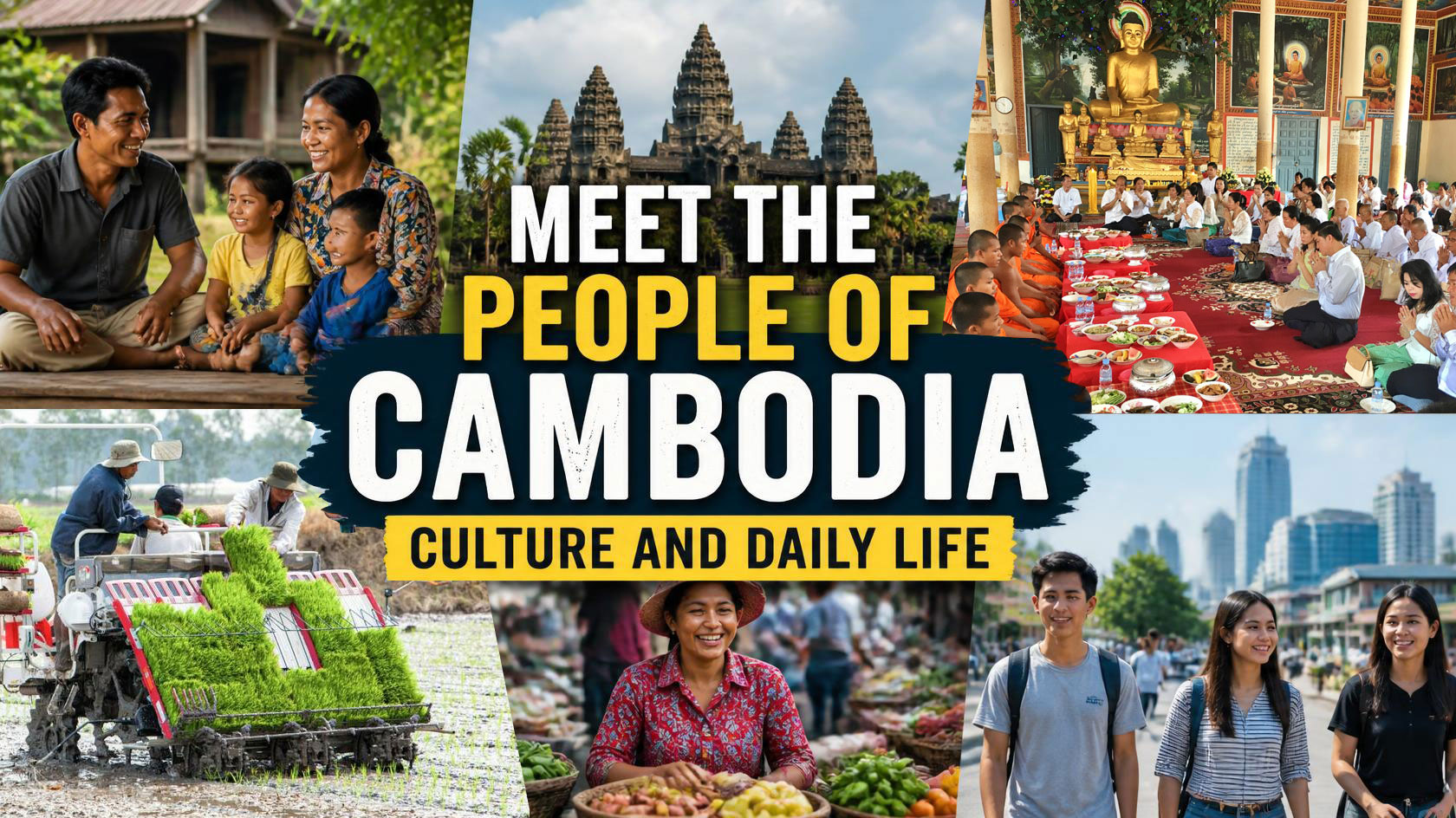

To understand Cambodia, look beyond its ancient temples and beautiful landscapes. The heart of the country is its people. From farmers working rice fields in the countryside to young professionals building careers in Phnom Penh, Cambodian life is shaped by family, community, religion, work, food, and a strong sense of social connection.
Cambodia is home to a predominantly Khmer-speaking population, but its society also includes ethnic and cultural communities with their own languages, traditions, and histories. At the same time, Cambodian society is changing quickly. Urbanization, education, technology, migration, tourism, and new employment opportunities are transforming how people live while many traditional values remain important.
For travelers, learning about Cambodian people is one of the best ways to experience the country respectfully. A smile, a polite greeting, patience, and an understanding of local customs can turn an ordinary trip into a much more meaningful cultural experience.
Who Are the People of Cambodia?
The majority of Cambodia’s population is Khmer, and Khmer is the predominant mother tongue. According to Cambodia’s 2019 General Population Census, Khmer was reported as the mother tongue of about 95.8% of the population. The census also recorded people speaking Vietnamese, Chinese, Cham, and a range of indigenous and minority languages.
This means that although Cambodia is often described simply as a Khmer country, its population is more diverse than that description suggests. Communities such as the Cham, Chinese Cambodians, Vietnamese Cambodians, and Indigenous peoples contribute to the country’s social and cultural landscape.
Indigenous communities are particularly important in several northeastern provinces, including Mondulkiri and Ratanakiri, where groups such as the Bunong and other Indigenous peoples maintain distinctive languages, customs, and relationships with the land.
Modern Cambodia is also increasingly connected to the wider world. Cambodians study and work abroad, international communities live in Cambodian cities, and tourism has created regular contact between local people and visitors from many countries.
Family Is at the Center of Cambodian Life
Family remains one of the most important parts of Cambodian society. Many Cambodians maintain close relationships with parents, grandparents, siblings, cousins, and other relatives. Even when family members live in different places, they often stay connected through regular visits, phone calls, messaging, and financial support.
In rural areas, it is common for several generations to live relatively close to one another. Young adults may leave their hometowns to study or find employment, particularly in Phnom Penh or other growing cities, but family relationships often remain strong.
Respect for parents and older relatives is an important social value. Older family members may be consulted about important decisions, while younger relatives are generally expected to show politeness and consideration toward elders.
For many Cambodians, family is also an important economic support system. Relatives may help one another with education expenses, farming activities, housing, weddings, health costs, or starting a small business.
Daily Life in Cambodia
Daily life varies considerably depending on where people live, their occupation, income, age, and access to education and technology. Life in central Phnom Penh can look very different from life in a farming village in the countryside or a coastal community.
Morning in a Cambodian Community
In many Cambodian communities, the day begins early. Farmers may leave home around sunrise to work in rice fields, plantations, vegetable gardens, or livestock operations. In towns and cities, shop owners, market vendors, construction workers, drivers, office employees, and students also begin their day early.
Breakfast may be simple and practical. Rice-based dishes, noodles, rice porridge, bread, coffee, and other local foods are common choices. Markets and small food stalls are important parts of everyday life, particularly in towns and neighborhoods.
Work and Business
Cambodia’s economy has changed significantly over recent decades. Agriculture remains important, particularly outside major cities, while manufacturing and services have become increasingly important sources of employment.
World Bank data based on ILO modeled estimates show the continuing transition of employment between sectors. In 2025, agriculture accounted for about one-third of employment in Cambodia, while services represented more than half.
Small businesses are also a visible part of Cambodian life. Family-run restaurants, cafés, grocery shops, market stalls, repair businesses, transport services, guesthouses, farms, and other small enterprises are found throughout the country.
In rural areas, people may combine several sources of income. A household might grow rice or other crops while also raising animals, operating a small shop, working in construction, or receiving income from relatives working elsewhere.
Life in Rural Cambodia
Rural Cambodia remains an important part of the country’s identity. Villages are often surrounded by rice fields, plantations, ponds, forests, waterways, or agricultural land. The rhythm of life can be strongly influenced by the agricultural calendar and the rainy and dry seasons.
Farming communities may grow rice, cassava, maize, vegetables, fruit, rubber, cashew, pepper, or other crops depending on the region. Fishing is also important around the Tonle Sap and Mekong systems and in many coastal communities.
Village life often involves strong relationships among neighbors. People may help each other during agricultural activities, weddings, funerals, religious ceremonies, house construction, or other community events.
However, rural Cambodia should not be viewed as isolated or unchanged. Mobile phones, social media, motorcycles, improved roads, electricity, schools, and access to modern services have transformed everyday life in many villages.
Life in Cambodian Cities
Urban Cambodia offers a very different lifestyle. Phnom Penh is the country’s largest urban center and a major hub for government, business, education, finance, shopping, entertainment, and professional employment.
Other cities and provincial centers, including Siem Reap, Battambang, Sihanoukville, Kampong Cham, Kampot, and others, have their own distinct character while becoming increasingly connected to the national economy.
Cambodia’s urban population has grown substantially. The 2019 census recorded approximately 39.4% of the population living in urban areas, compared with 27.1% in 2008.
For younger Cambodians, city life can mean greater access to universities, modern workplaces, technology, cafés, shopping centers, entertainment, and international influences. At the same time, many urban residents maintain strong connections with their home provinces.
Religion and Everyday Life
Theravada Buddhism has a major influence on Cambodian society. The 2019 census identified Buddhism as the predominant religion, reported by approximately 96.9% of the population.
Religion can be seen in everyday life through pagodas, monks, religious ceremonies, charitable activities, festivals, and family traditions. Many Cambodian families maintain relationships with their local pagoda and participate in religious activities during important occasions.
At the same time, Cambodian spiritual life can include beliefs and practices that exist alongside formal Buddhist traditions. Respect for ancestors, protective spirits, sacred places, and local customs can also be part of people’s understanding of family and community life.
Food Brings People Together
Food is much more than something to eat in Cambodia. Meals are often social occasions where family members, friends, colleagues, and neighbors spend time together.
Rice is a central part of the Cambodian diet, accompanied by vegetables, fish, meat, soups, curries, fermented ingredients, herbs, and dipping sauces. In many Cambodian households, several dishes are placed in the middle of the table and shared.
Street food and local markets are also important parts of everyday life. A Cambodian market can be a place to buy fresh produce, cooked food, snacks, drinks, household goods, and ingredients while also serving as an important social meeting point.
For visitors, trying local food is one of the easiest ways to connect with everyday Cambodian life. Popular dishes such as fish amok, beef lok lak, kuy teav, num banh chok, bai sach chrouk, and a wide variety of grilled foods can be found in different parts of the country.
How Cambodians Communicate and Show Respect
Cambodian communication often places importance on politeness, respect, and maintaining harmonious relationships. The appropriate way to speak or behave can depend on age, social position, familiarity, and context.
The sampeah, performed by bringing the palms together and slightly bowing the head, is a traditional respectful greeting. Its use can vary according to the relationship between people and the social situation.
Visitors should also be aware of everyday etiquette. The Ministry of Tourism advises travelers to ask permission before photographing Cambodian people or monks, remove shoes when entering homes and religious places where appropriate, and dress respectfully when visiting temples and pagodas.
A friendly and respectful attitude is usually more important than knowing every aspect of Cambodian etiquette. Learning a few Khmer words such as susadei (hello), arkun (thank you), and som tos (sorry/excuse me) can also make interactions more pleasant.
Young Cambodians and a Changing Society
Cambodia has a young and increasingly connected population. Young people are playing an important role in the country’s changing economy and social landscape.
Smartphones and social media have become part of everyday communication. Young Cambodians use digital platforms for education, entertainment, shopping, business, communication, and discovering opportunities.
Education and employment aspirations are also changing. Many young people want careers in technology, business, tourism, finance, education, engineering, healthcare, creative industries, and other professional fields.
This does not necessarily mean that traditional values are disappearing. Instead, many young Cambodians combine modern lifestyles with traditional family responsibilities, religious practices, Cambodian food, celebrations, and respect for older generations.
Community and Helping One Another
Community relationships remain important in many parts of Cambodia. Major life events often involve extended families, friends, neighbors, and local communities.
Weddings, funerals, religious ceremonies, housewarming celebrations, and festivals can bring large numbers of people together. Guests may contribute food, money, gifts, or their time to support the family hosting an event.
This sense of community can be especially visible in rural areas, but it is also present in cities. Cambodian society continues to place considerable value on relationships and mutual assistance.
Cambodian Society Is Changing
It is important not to imagine Cambodia as a society frozen in the past. The country has experienced rapid economic and social transformation.
People are moving between rural areas and cities, working in new industries, studying at universities, using digital technology, and engaging with international markets. Employment has gradually shifted away from agriculture toward manufacturing and services, reflecting broader economic changes.
At the same time, challenges remain. Differences in income, access to quality education, employment opportunities, healthcare, and services can vary between regions and communities. Migration for work, both within Cambodia and internationally, also affects many families.
Understanding these changes helps visitors see Cambodia as a modern, developing society whose people are balancing new opportunities with long-standing cultural values.
What Travelers Should Know About Cambodian People
Visitors do not need to understand every Cambodian custom before arriving. A few simple principles can make cultural interactions much more respectful:
- Be polite: A calm and friendly manner is appreciated.
- Respect older people: Age and seniority can be important in social interactions.
- Ask before taking photographs: Especially when photographing people, monks, children, or private activities.
- Dress appropriately at religious sites: Cover shoulders and knees when visiting temples and pagodas.
- Remove your shoes when appropriate: This may be expected when entering homes and certain religious spaces.
- Respect personal space and privacy: Avoid treating local people as tourist attractions.
- Be patient: Cultural differences in communication and service can sometimes require flexibility.
- Learn a few Khmer words: Even simple greetings can create a warmer connection.
Frequently Asked Questions
What are Cambodian people like?
Cambodian people are diverse, but family relationships, community connections, politeness, hospitality, and respect for elders are important social values in many communities. Individual personalities and lifestyles naturally vary.
What is the main ethnic group in Cambodia?
The Khmer are the country’s predominant ethnic and linguistic group. Cambodia is also home to Cham, Chinese Cambodian, Vietnamese Cambodian, and Indigenous communities with their own cultural and linguistic traditions.
What language do people speak in Cambodia?
Khmer is the official language and the predominant mother tongue. English is widely encountered in tourism and business, while other languages are spoken within Cambodia’s diverse communities.
Is Cambodia mostly rural or urban?
The 2019 census recorded about 60.6% of the population in rural areas and 39.4% in urban areas. Urbanization has increased significantly since 2008.
What role does family play in Cambodia?
Family is central to Cambodian social life. Relatives commonly support one another emotionally, socially, and financially, and extended family relationships can remain important even when people move to cities or abroad.
Is Cambodia a Buddhist country?
Buddhism is the predominant religion in Cambodia. The 2019 census reported Buddhism among approximately 96.9% of the population. Other religious communities, including Muslims and Christians, are also part of Cambodian society.
Sources & References
- National Institute of Statistics of Cambodia — General Population Census of Cambodia 2019
- National Institute of Statistics of Cambodia — Population Distribution and Urbanization
- World Bank — Cambodia country data and employment indicators
- World Bank — Cambodia’s Future Jobs: Linking to the Economy of Tomorrow
- Ministry of Tourism of Cambodia — Advice for Travelers: Dos and Don’ts in Cambodia
- Ministry of Tourism of Cambodia — Customs and Tradition
Conclusion: Getting to Know Cambodia Through Its People
Cambodia is more than Angkor’s temples, tropical islands, busy markets, and beautiful landscapes. Its character is found in ordinary daily life: a family sharing breakfast, farmers working in the fields, students riding to school, vendors preparing food at a market, friends meeting at a café, monks walking through a neighborhood, and relatives gathering for an important family event.
For travelers, taking time to understand Cambodian people and daily life can make a visit more rewarding. Approach people with curiosity, patience, and respect, and Cambodia will reveal a side of the country that cannot be fully experienced from a sightseeing itinerary alone.
Planning your trip to Cambodia? Explore more GoToKH guides to discover Cambodia’s destinations, culture, food, travel tips, and everyday experiences.


