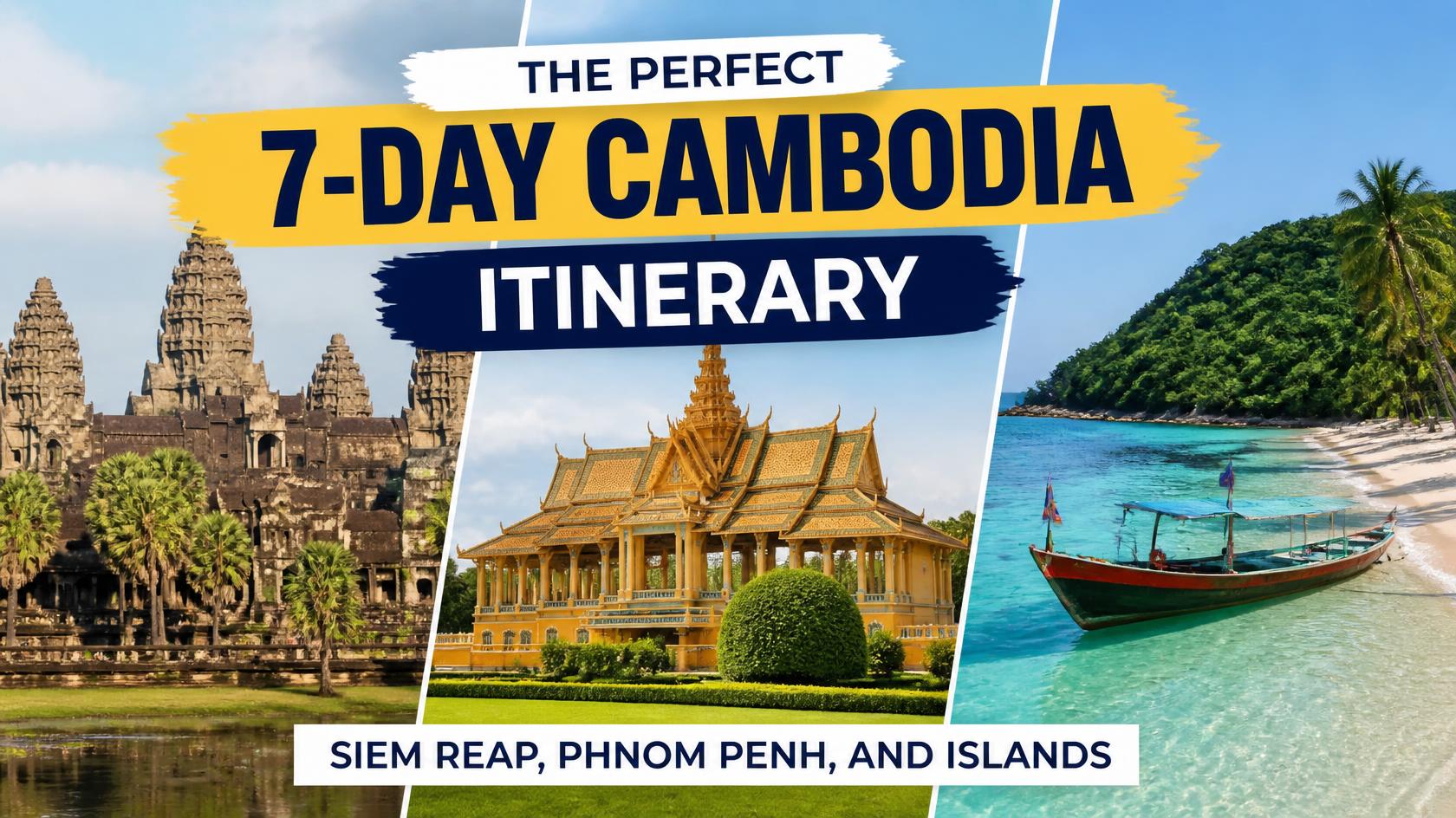

Seven days is enough to experience three very different sides of Cambodia: the ancient temples of Siem Reap, the history and energy of Phnom Penh, and the tropical beaches of Cambodia’s southern islands.
This itinerary is designed for first-time international visitors who want a balanced trip rather than spending the entire week moving between destinations. You will explore Angkor Wat and the major temples, discover Cambodia’s capital, and finish with relaxing days on Koh Rong or Koh Rong Sanloem.
The route is simple:
Siem Reap → Phnom Penh → Sihanoukville → Koh Rong / Koh Rong Sanloem
It combines Cambodia’s cultural heritage, modern city life, Khmer food, local experiences, and island beaches in one week.
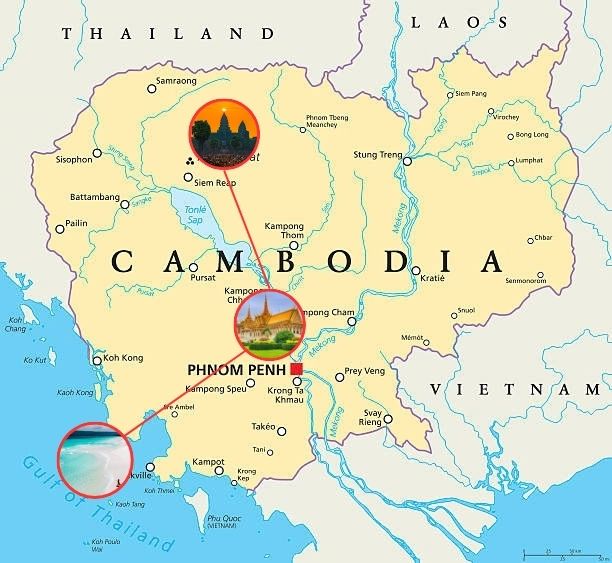
7-Day Cambodia Itinerary at a Glance
| Day | Destination | Main Experience | Overnight |
|---|---|---|---|
| Day 1 | Siem Reap | Arrival, Old Market, Pub Street, Khmer food | Siem Reap |
| Day 2 | Angkor | Angkor Wat, Angkor Thom, Bayon, Ta Prohm | Siem Reap |
| Day 3 | Siem Reap | Banteay Srei, countryside, Tonle Sap or local experiences | Siem Reap |
| Day 4 | Phnom Penh | Travel to Phnom Penh, Royal Palace, Riverside | Phnom Penh |
| Day 5 | Phnom Penh | National Museum, Tuol Sleng, Choeung Ek, markets | Phnom Penh |
| Day 6 | Koh Rong | Travel to Sihanoukville and ferry to the island | Koh Rong |
| Day 7 | Koh Rong | Beach, snorkeling, relaxation and departure | Departure |
Why This 7-Day Route Works
Cambodia is geographically compact enough that travelers can combine major cultural and beach destinations in one week, but trying to visit too many provinces can make the trip exhausting.
This itinerary therefore focuses on three major experiences:
- Siem Reap: ancient Khmer civilization and Angkor.
- Phnom Penh: Cambodian history, architecture, food and urban life.
- Koh Rong: beaches, tropical scenery and island relaxation.
Angkor is a UNESCO World Heritage property extending across approximately 400 square kilometres and containing the remains of several Khmer capitals, including Angkor Wat, Angkor Thom and the Bayon.
The southern island portion adds a completely different atmosphere. Preah Sihanouk Province is the main gateway to Cambodia’s offshore islands, including Koh Rong and Koh Rong Sanloem.
Day 1: Arrive in Siem Reap and Explore the Town
Overnight: Siem Reap
Start your Cambodia adventure in Siem Reap, the gateway to Angkor.
Depending on your arrival time, do not immediately schedule a major temple tour. Use the first day to check into your hotel, recover from your flight and explore the town at a relaxed pace.
Morning or Afternoon: Arrive and Check In
After arriving at Siem Reap Angkor International Airport, transfer to your hotel in Siem Reap.
Choose accommodation around the city center, Old Market area, Wat Bo, or the riverside if you want restaurants, cafés and evening activities within easy reach.
Late Afternoon: Explore Siem Reap
Walk around the central area and explore the Siem Reap River, local shops and markets.
If you enjoy photography, the late afternoon is a good time to explore the quieter streets around Wat Bo and the riverside.
Evening: Old Market and Pub Street
Spend your first evening around the Old Market and Pub Street area.
This is a convenient introduction to Cambodian food because you can find Khmer dishes alongside international restaurants, cafés, fresh fruit, desserts and street food.
Try a few classic Cambodian dishes such as:
- Fish Amok
- Beef Lok Lak
- Nom Banh Chok
- Bai Sach Chrouk
- Samlor Korkor
- Fresh tropical fruit
Travel tip: Keep the first evening easy. Your second day begins early for Angkor Wat.
Day 2: Angkor Wat, Angkor Thom and Ta Prohm
Overnight: Siem Reap
Day 2 is the cultural highlight of the trip.
Wake up early and spend most of the day exploring the Angkor Archaeological Park.
Sunrise at Angkor Wat
Start before sunrise and head to Angkor Wat.
Angkor Wat is one of the masterpieces within the UNESCO-listed Angkor complex. The wider archaeological site covers approximately 400 square kilometres and contains numerous temples and ancient infrastructure.
After sunrise, spend time exploring the temple’s galleries, towers, bas-reliefs and central sanctuary.
Angkor Wat Ticket Prices in 2026
| Pass | Price | Validity |
|---|---|---|
| 1-Day Pass | US$37 | 1 day |
| 3-Day Pass | US$62 | Valid within 7 days |
| 7-Day Pass | US$72 | Valid within 30 days |
Angkor Enterprise currently lists park entry from 5:00 AM to 6:30 PM. The official ticket office also states that it is the authorized place for Angkor Archaeological Park tickets, and tickets can be purchased through the official website, app, kiosk or counter.
Morning: Angkor Thom and Bayon
Continue to Angkor Thom and enter through one of its monumental gates.
Inside the ancient city, visit:
- Bayon Temple
- Terrace of the Elephants
- Terrace of the Leper King
- Baphuon
The Bayon is especially famous for its monumental towers decorated with enigmatic faces.
Lunch Break
Take a break at a local restaurant near the Angkor area or return toward Siem Reap if you prefer more restaurant choices.
Drink plenty of water because walking around the temples can be physically demanding, particularly during hot weather.
Afternoon: Ta Prohm
Continue to Ta Prohm, one of Angkor’s most recognizable temples.
The combination of ancient stone architecture and large trees growing around the ruins creates a distinctive atmosphere and makes Ta Prohm one of the most photographed temples in Cambodia.
Evening
Return to Siem Reap for dinner and an early night.
You do not need to stay out late. The next morning offers another opportunity to explore the region.
Day 3: Banteay Srei, Countryside and Tonle Sap
Overnight: Siem Reap
Day 3 gives you two choices depending on your interests: continue exploring temples or experience more of the countryside and Tonle Sap region.
Option A: Banteay Srei and the Countryside
Travel to Banteay Srei, famous for its detailed pink sandstone carvings.
The temple is farther from central Siem Reap than the main Angkor circuit, so allow several hours for the excursion.
Combine the visit with a countryside drive through villages, rice fields and rural communities.
Option B: Tonle Sap and Local Life
If you have already seen enough temples, spend the afternoon around the Tonle Sap Lake.
Depending on seasonal water conditions and current operating arrangements, visitors can explore floating or lake-edge communities and learn more about life around Cambodia’s largest lake.
Tourism Cambodia identifies Tonle Sap and nearby communities among Siem Reap’s attractions and experiences.
Evening: Khmer Food and Night Market
Return to Siem Reap and enjoy your final evening in the city.
This is a good opportunity to try Cambodian desserts, grilled food, fresh fruit and local coffee before leaving for Phnom Penh.
Day 4: Siem Reap to Phnom Penh
Overnight: Phnom Penh
After breakfast, travel from Siem Reap to Phnom Penh.
You can travel by:
- Domestic flight
- Air-conditioned bus
- Minivan
- Private car
For a seven-day itinerary, flying can save road time when a suitable schedule is available. Overland travel is another practical option and allows you to see more of the Cambodian countryside.
Tourism Cambodia lists regular bus and van connections between the two cities, while domestic air connections can also be used depending on the current schedule.
Afternoon: Royal Palace and Silver Pagoda
After checking into your Phnom Penh hotel, visit the Royal Palace and Silver Pagoda.
The Royal Palace complex remains the official royal residence, while visitors can explore the public ceremonial areas and gardens.
Dress modestly by covering your shoulders and knees, and remember that some areas may be closed during official ceremonies.
Late Afternoon: Riverside
Walk along Sisowath Quay and enjoy the riverside atmosphere.
The area is particularly pleasant around sunset, with restaurants, cafés, shops and river views.
Evening: Cambodian Dinner
For dinner, consider trying:
- Kampot Pepper dishes
- Khmer curry
- Fish Amok
- Fresh seafood
- Beef Lok Lak
Stay near Daun Penh, the riverside, BKK1 or another central neighborhood to reduce transportation time.
Day 5: Phnom Penh History, Culture and Markets
Overnight: Phnom Penh
Your second full day in Phnom Penh focuses on Cambodian history and culture.
Morning: National Museum of Cambodia
Start at the National Museum of Cambodia.
The museum contains more than 14,000 objects, including Khmer sculpture, ceramics, bronzes and ethnographic materials covering different periods of Cambodian history.
This visit can help you understand the artistic traditions you saw at Angkor.
Late Morning: Tuol Sleng Genocide Museum
Continue to the Tuol Sleng Genocide Museum, also known as S-21.
This is an important but emotionally difficult site connected with Cambodia’s Khmer Rouge period.
Allow enough time to visit respectfully and avoid scheduling too many activities immediately afterward.
Afternoon: Choeung Ek
If you want to learn more about Cambodia’s modern history, continue to Choeung Ek, commonly known as the Killing Fields.
For travelers who find historical memorial sites emotionally difficult, it is also reasonable to choose a lighter afternoon instead.
Alternative Afternoon: Markets and Cafés
Instead of visiting both historical sites, spend the afternoon exploring:
- Central Market
- Russian Market
- Local cafés
- Riverside neighborhoods
- Independent Cambodian restaurants
Phnom Penh offers a different travel experience from Siem Reap, combining royal architecture, museums, markets, modern cafés and the meeting point of the Mekong, Tonle Sap and Bassac rivers.
Day 6: Phnom Penh to Koh Rong
Overnight: Koh Rong
Day 6 begins the beach portion of your Cambodia trip.
Travel from Phnom Penh to Sihanoukville and continue by ferry to Koh Rong.
Getting to Sihanoukville
The Phnom Penh–Sihanoukville Expressway provides the main road connection between the capital and the coast. The expressway is approximately 187 kilometres long and operates as a four-lane expressway.
Travel time depends on your departure point, traffic and transportation service, but the expressway has significantly shortened the road journey compared with older routes.
From Sihanoukville to Koh Rong
Continue to a tourist pier and board a fast ferry to Koh Rong.
Current tourism information places the fast ferry crossing at approximately 45 minutes, although the exact time depends on the vessel, sea conditions and destination pier.
Ferry schedules can change because of weather and seasonal operating conditions, so confirm your departure time shortly before traveling.
Afternoon: Check In and Beach Time
Once you arrive on Koh Rong, check into your accommodation and spend the rest of the afternoon relaxing.
Depending on where you stay, you can enjoy:
- Swimming
- Walking along the beach
- Kayaking
- Snorkeling
- Sunset photography
- Beach restaurants
Koh Rong is located off the coast of Sihanoukville in the Gulf of Thailand and is one of Cambodia’s best-known island destinations.
Day 7: Koh Rong Beach Day and Departure
Final day
Keep your final day intentionally slow.
After breakfast, enjoy the beach, swim, take a short boat excursion, or simply relax at your accommodation.
Morning: Beach and Island Activities
If the weather and sea conditions are suitable, you can choose from:
- Snorkeling
- Kayaking
- Short island boat trips
- Beach walks
- Swimming
- Relaxing under the shade
Alternative: Koh Rong Sanloem
If your travel style is quieter, consider replacing Koh Rong with Koh Rong Sanloem.
Koh Rong Sanloem is a separate island south of Koh Rong and is often associated with a more relaxed beach atmosphere.
Tourism Cambodia notes that the island can be reached by boat from Sihanoukville, with fast ferry services available.
Returning to the Mainland
Leave enough time for the ferry back to Sihanoukville.
If you have an international flight from Phnom Penh on the same day, this requires careful planning. A safer approach is to spend your final night on the mainland or schedule your international departure for the following day.
Do not build a tight island-ferry connection with a long-distance transfer and international flight unless you have substantial time available. Weather and sea conditions can affect ferry operations.
Koh Rong or Koh Rong Sanloem?
| Feature | Koh Rong | Koh Rong Sanloem |
|---|---|---|
| Atmosphere | More developed in popular areas | Generally quieter |
| Nightlife | More options in some areas | More relaxed |
| Beaches | Many beaches and bays | Beautiful beaches and quieter areas |
| Activities | Swimming, snorkeling, diving, boat trips | Swimming, snorkeling, diving, relaxation |
| Best for | Travelers wanting a mix of beach and activity | Travelers seeking a slower island experience |
Both islands can work well for this itinerary. Your choice should depend on the accommodation area, ferry schedule and the type of atmosphere you want.
How Much Does a 7-Day Cambodia Trip Cost?
Your total budget depends heavily on accommodation, transportation, food and activities.
| Travel Style | Approximate Daily Budget | 7-Day Estimate |
|---|---|---|
| Budget | US$30–$50 | US$210–$350 |
| Mid-range | US$70–$120 | US$490–$840 |
| Comfortable / Premium | US$150+ | US$1,050+ |
These are planning ranges rather than fixed prices. Flights, hotel category, island accommodation, private drivers, tours and travel season can change the final cost significantly.
Angkor entrance should be added separately. In 2026, the official Angkor Enterprise prices are US$37 for one day, US$62 for three days and US$72 for seven days.
Where Should You Stay?
Siem Reap
For a first visit, stay around:
- Old Market
- Wat Bo
- Siem Reap riverside
- Pub Street area
These areas provide convenient access to restaurants, cafés and evening activities.
Phnom Penh
Consider:
- Daun Penh for major historic attractions
- Riverside for easy access to the riverfront
- BKK1 for cafés, restaurants and modern accommodation
Koh Rong
Choose accommodation based on your preferred atmosphere rather than simply choosing the cheapest available room.
Some areas are more social and active, while others are designed for a quieter beach holiday.
What Should You Pack for This Cambodia Itinerary?
- Lightweight clothing
- Comfortable walking shoes
- Sandals
- Swimwear
- Sun protection
- Reusable water bottle
- Small backpack for temple days
- Power bank
- Passport and travel documents
- Travel insurance information
- Light rain protection during the wet season
For temple visits, wear clothing that covers your shoulders and knees and follow local visitor rules.
Best Time for This 7-Day Cambodia Itinerary
The traditional dry-season travel period from approximately November to April is convenient for combining temples, cities and islands.
The island portion deserves special attention when planning around weather. Sea conditions can become rougher during parts of the wet season, potentially affecting ferry schedules.
If your priority is beaches and reliable island crossings, check the marine weather and ferry operator information shortly before traveling.
Important Cambodia Travel Tips for First-Time Visitors
🇰🇭 Cambodia 7-Day Travel Checklist
- Check your Cambodia visa requirements before departure.
- Complete the official Cambodia e-Arrival process when required.
- Keep your passport accessible during domestic travel.
- Buy Angkor tickets only through authorized channels.
- Start your Angkor Wat day early.
- Carry water during temple tours.
- Dress respectfully at temples and religious sites.
- Keep some Cambodian riel available for small purchases.
- Use reputable transportation providers for long-distance journeys.
- Confirm island ferry schedules before leaving Phnom Penh.
- Leave flexibility between ferry travel and international flights.
- Respect local communities and avoid leaving rubbish on beaches.
Should You Fly or Travel by Bus?
For this particular seven-day itinerary, the choice depends on your priorities.
| Transport | Advantages | Considerations |
|---|---|---|
| Flight | Saves road time | Flight schedules and airport transfers add complexity |
| Bus | Usually straightforward and practical | Takes longer |
| Minivan | Frequent departures and convenient city connections | Less space than a large bus |
| Private Car | Flexible stops and direct hotel-to-hotel travel | Higher cost |
For travelers with only seven days, saving time can be valuable. However, if you enjoy seeing rural Cambodia, an overland journey can become part of the travel experience.
Can You Do This Itinerary in the Opposite Direction?
Yes.
You can start in Phnom Penh, travel to Siem Reap, and finish on the islands.
Another option is:
Phnom Penh → Koh Rong → Siem Reap
This can work particularly well if you want your final days to focus on temples rather than beaches.
Your choice should depend on your international flight schedule and the available domestic connections.
What If You Have More Than 7 Days?
If you have 10–14 days, do not simply add more attractions to the existing schedule. Add extra destinations and allow more time in each place.
Good additions include:
- Kampot — pepper plantations, countryside and riverside scenery
- Kep — seafood, beaches and Rabbit Island
- Battambang — countryside and cultural experiences
- Mondulkiri — mountains, forests and eco-tourism
- Cardamom Mountains — trekking and community-based ecotourism
Adding Kampot and Kep is especially useful if you want to combine the islands with Cambodia’s southern countryside.
Frequently Asked Questions
Is 7 days enough for Cambodia?
Yes. Seven days is enough for a focused first trip covering Siem Reap, Phnom Penh and one southern island destination. It is not enough to see every major region of Cambodia, so keeping the itinerary focused is important.
How many days should I spend in Siem Reap?
For a first visit, three nights gives you enough time for Angkor Wat, the main Angkor temples and another experience such as Banteay Srei or Tonle Sap.
How many days should I spend in Phnom Penh?
Two nights is a practical amount of time for a first visit. It allows you to explore the Royal Palace, National Museum, historical sites, markets and riverside without making the stay too rushed.
Is Koh Rong worth adding to a Cambodia itinerary?
If you enjoy beaches and want a break from temples and cities, Koh Rong adds a completely different side of Cambodia. The island is accessible from Sihanoukville by ferry.
Is Koh Rong or Koh Rong Sanloem better for a 7-day trip?
Both can fit this itinerary. Koh Rong offers a range of beaches and activities, while Koh Rong Sanloem is often chosen by travelers looking for a quieter island atmosphere.
Can I travel from Siem Reap to Phnom Penh by bus?
Yes. Bus and minivan services connect Siem Reap and Phnom Penh. Travel time varies according to the operator, road conditions and traffic.
Can I travel from Phnom Penh to Koh Rong in one day?
Yes, but start early. You need to travel from Phnom Penh to Sihanoukville and then catch a ferry to the island. Allow flexibility because ferry times can change.
How much is the Angkor Wat ticket in 2026?
The official Angkor Enterprise prices are US$37 for one day, US$62 for three days and US$72 for seven days.
Do I need Cambodia e-Arrival?
Travelers should check the current entry requirements before departure and use the official Cambodia e-Arrival system when required. The e-Arrival is an arrival procedure and is separate from the visa itself.
Can I visit Angkor Wat and Phnom Penh in the same day?
It is technically possible with very tight scheduling, but it is not recommended for this itinerary. Keeping Angkor and Phnom Penh on separate days provides a much more comfortable trip.
Sources & References
- Angkor Enterprise — Official Angkor Archaeological Park ticket prices, validity, opening hours and ticket purchasing information.
- UNESCO World Heritage Centre — Official information on the Angkor World Heritage property and its cultural significance.
- Ministry of Tourism of Cambodia — Official tourism information for Siem Reap, Phnom Penh and Preah Sihanouk Province.
- Cambodia e-Arrival — Official arrival system operated by Cambodia’s General Department of Immigration.
- Ministry of Economy and Finance / GDPPP — Phnom Penh–Sihanoukville Expressway project information.
- Official ferry operators and port information — Current island ferry schedules should be checked immediately before travel because schedules can change with weather and operating conditions.
Conclusion
A seven-day Cambodia trip does not need to feel rushed if you choose the right route.
This itinerary combines the country’s three most memorable travel experiences: the ancient temples of Siem Reap, the history and urban culture of Phnom Penh, and the tropical beaches of Koh Rong or Koh Rong Sanloem.
Spend your first three days discovering Angkor and Khmer culture, two days experiencing Phnom Penh, and your final two days slowing down on a Cambodian island.
The key is to keep transportation practical, leave flexibility around ferry connections, book important tickets in advance when appropriate, and avoid trying to visit too many destinations in one week.
Planning your first Cambodia trip? Save this seven-day itinerary and explore more GoToKH guides for Cambodia visas, e-Arrival, SIM cards, currency, transportation, Angkor Wat, Phnom Penh, Kampot, Kep, Koh Rong and other destinations across the Kingdom.