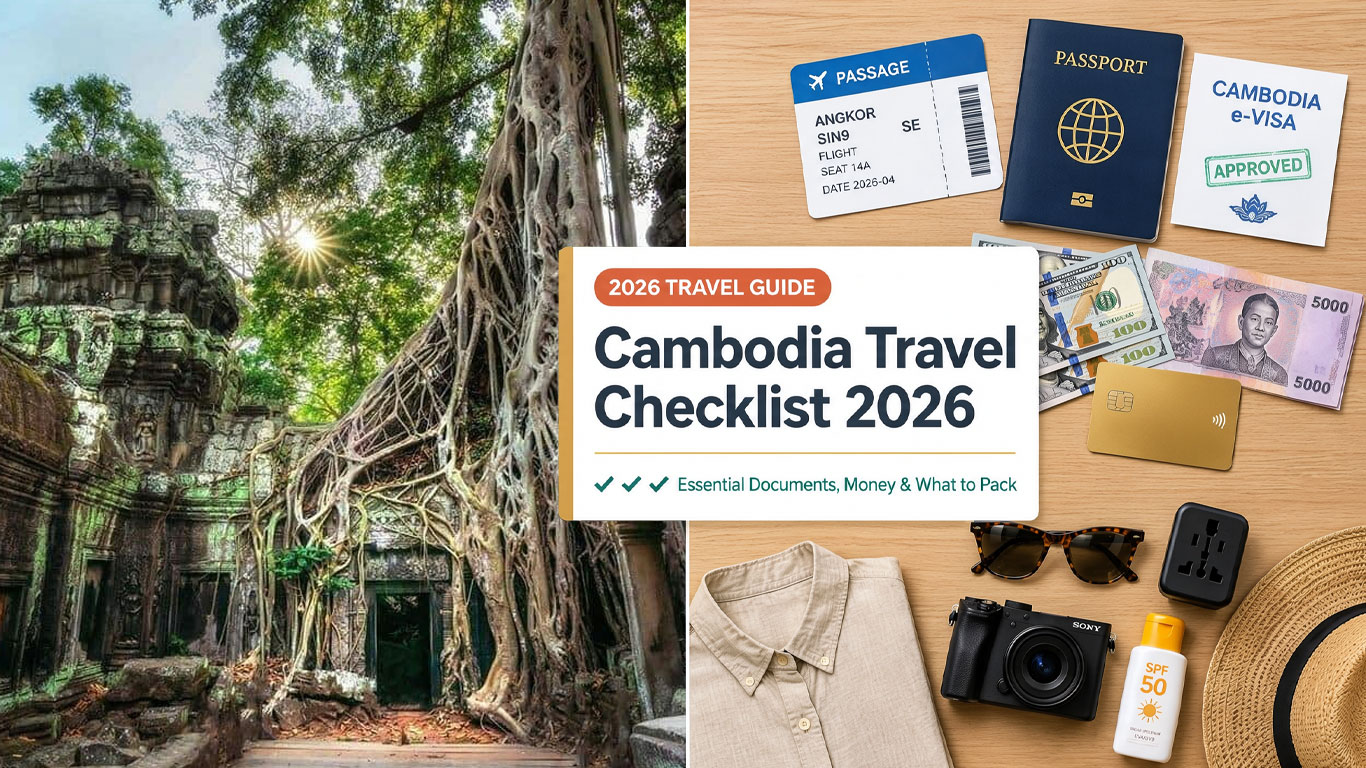
Cambodia Travel Checklist 2026: Essential Documents, Money & What to Pack

Preparing for a trip to Cambodia is easier when you organize your travel documents, money, health supplies and everyday essentials before departure. Whether you are visiting Angkor Wat, exploring Phnom Penh, relaxing on the coast or travelling through the countryside, a little preparation can help you avoid common travel problems.
This Cambodia travel checklist is designed for international visitors, including travellers from the United States, United Kingdom, Australia and other countries. Use it before booking, during the final week before departure and again on your travel day.
Cambodia Travel Essentials at a Glance
| Travel detail | What to prepare |
|---|---|
| Passport | Check validity; e-Visa applicants need more than 6 months remaining at entry. |
| Visa | Check whether your nationality requires a visa or qualifies for exemption. |
| e-Arrival | Free online declaration for air arrivals, submitted within 7 days before arrival. |
| Official currency | Cambodian riel (KHR); US dollars are also widely used. |
| Travel insurance | Consider medical, emergency evacuation and trip disruption coverage. |
| Mobile connection | Prepare roaming, an eSIM or a local SIM card. |
| Electricity | 230V, 50Hz; plug types A, C and G are used. |
| Emergency numbers | Police 117; Fire 118; Ambulance 119. |
1. Important Travel Documents
Travel documents should be your first priority. Check your passport and entry requirements before booking non-refundable flights or accommodation.
Passport checklist
- ☐ Passport is valid for the required period beyond your arrival date.
- ☐ Passport is undamaged and readable.
- ☐ Passport details match your airline ticket and visa application.
- ☐ You have checked any blank-page requirements applicable to your journey.
- ☐ You have a secure digital copy of your passport.
- ☐ You have a separate backup copy of important travel documents.
The Cambodian official e-Visa portal requires applicants to have more than six months of passport validity remaining at the time of entry. Always check the current requirements for your nationality and visa category.
Visa checklist
- ☐ Check whether your nationality requires a Cambodian visa.
- ☐ Confirm whether you qualify for visa exemption.
- ☐ Apply for an e-Visa if you prefer to arrange your visa before departure.
- ☐ Check the visa type, validity period, entry conditions and permitted length of stay.
- ☐ Save and print your approved visa certificate if applicable.
- ☐ Check that your planned airport or border checkpoint accepts your visa type.
For most eligible holiday visitors who need a visa, the Tourist Visa (Type T) is a common option. The official government e-Visa portal lists a fee of US$30, single entry and a stay of up to 30 days. Requirements can vary by nationality.
Read our Cambodia Visa Guide 2026 for more information.
Other travel documents
- ☐ Return or onward flight ticket, if required for your circumstances.
- ☐ Hotel or accommodation confirmation.
- ☐ Travel itinerary and transport bookings.
- ☐ Travel insurance certificate and emergency assistance number.
- ☐ Copies of prescriptions for essential medication.
- ☐ Parental consent documents when required for children travelling without a parent or guardian.
Some official travel advice also lists an onward or return ticket and proof of sufficient funds among entry conditions. Check the rules that apply to your passport before departure.
2. Complete the Cambodia e-Arrival Card
International visitors arriving by air should complete the Cambodia e-Arrival Card before their journey. It is a separate electronic arrival declaration, not a visa.
e-Arrival checklist
- ☐ Visit the official website: arrival.gov.kh.
- ☐ Submit the form within 7 days before your scheduled arrival.
- ☐ Prepare your passport and travel information.
- ☐ Enter your accommodation details accurately.
- ☐ Complete the required arrival declarations.
- ☐ Save or download your confirmation and QR code.
- ☐ Keep a screenshot or printed backup for arrival.
The official e-Arrival submission is free. Avoid unofficial websites that request payment for this government service.
Read our Cambodia e-Arrival Guide for step-by-step instructions.
3. Prepare Your Money and Payment Methods
Cambodia uses the Cambodian riel (KHR) as its official currency, while US dollars are also widely used, particularly in hotels, restaurants and tourism businesses.
Money checklist
- ☐ Carry some Cambodian riel for markets, local transport and small purchases.
- ☐ Bring or withdraw usable, undamaged US-dollar notes if you plan to use USD.
- ☐ Prepare small denominations for everyday payments.
- ☐ Bring at least one international debit or credit card.
- ☐ Check your bank’s overseas withdrawal and foreign transaction fees.
- ☐ Keep a backup payment method separate from your main wallet.
- ☐ Do not carry all your travel money in one place.
Important tips about US dollars
Damaged, torn or stained US-dollar notes may be rejected by Cambodian businesses. Check your banknotes before travelling and inspect change when paying with larger bills.
Are credit cards accepted?
Visa and Mastercard are accepted at many established hotels, larger restaurants and businesses in major tourist destinations. However, small shops, local markets and rural businesses may prefer cash.
Can tourists use QR payments?
Cambodia has a widely used QR payment network called KHQR. International visitors may also consider the National Bank of Cambodia’s Bakong Tourists application, which supports eligible international payment cards for QR transactions. Check current registration and card compatibility before relying on it.
Cash declaration
Under Cambodia’s foreign exchange law, travellers carrying means of payment equivalent to or exceeding US$10,000 must declare them to customs when entering or leaving the country. Check the applicable customs procedures, especially if you plan to take a large amount of money across the border.
For more practical information, read our Money in Cambodia: Cash, US Dollars, ATMs and QR Payments.
4. Travel Insurance and Health Preparation
Travel insurance is an important part of preparing for Cambodia, particularly if your itinerary includes remote areas, motorbike travel, island activities or adventure tourism.
Insurance checklist
- ☐ Check that your policy covers medical treatment abroad.
- ☐ Consider emergency medical evacuation coverage.
- ☐ Check coverage for trip cancellation, delays and lost baggage.
- ☐ Confirm whether motorbike or adventure activities are covered if you plan to participate.
- ☐ Save the insurer’s emergency contact number.
- ☐ Understand exclusions and any excess or deductible.
Health checklist
- ☐ Consult a travel health professional about recommended vaccinations and health precautions.
- ☐ Bring enough prescription medication for your trip, plus a reasonable delay allowance.
- ☐ Keep medication in its original packaging.
- ☐ Carry copies of prescriptions and check the legality of your medication in Cambodia.
- ☐ Pack insect repellent and sunscreen.
- ☐ Bring basic first-aid supplies and oral rehydration salts.
- ☐ Save the contact details of your insurer and suitable medical facilities.
Some medicines that are common in your home country may be restricted elsewhere. Check the rules before carrying prescription or controlled medication into Cambodia.
5. Clothing and Personal Packing Essentials
Cambodia has a tropical climate, so lightweight clothing is useful for most trips. Your packing list should also reflect the season, destinations and activities in your itinerary.
Clothing checklist
- ☐ Lightweight, breathable shirts and trousers.
- ☐ Comfortable walking shoes.
- ☐ Sandals or easy-to-remove footwear.
- ☐ Modest clothing for pagodas and religious sites.
- ☐ Swimwear for beach or island destinations.
- ☐ Light jacket or cardigan for cooler evenings or air-conditioned transport.
- ☐ Rain jacket, poncho or compact umbrella when rain is likely.
Temple clothing
When visiting religious sites such as Angkor Wat and Buddhist pagodas, dress respectfully. Clothing that covers your shoulders and knees is a practical choice. Some sites have specific visitor dress requirements, so check the rules before visiting.
Personal essentials
- ☐ Sunglasses and a sun hat.
- ☐ Sunscreen.
- ☐ Insect repellent.
- ☐ Reusable water bottle.
- ☐ Hand sanitiser and tissues.
- ☐ Small day bag or backpack.
- ☐ Personal toiletries.
- ☐ Zip-lock bags to protect small items from rain and moisture.
6. Phone, Internet and Electrical Essentials
A reliable mobile connection is useful for maps, transport bookings, communication and accessing digital travel documents.
Technology checklist
- ☐ Check that your phone is unlocked if you plan to use a local SIM.
- ☐ Check whether your phone supports eSIM if you prefer a digital plan.
- ☐ Arrange international roaming or a local SIM before travelling.
- ☐ Carry your phone charger and charging cables.
- ☐ Bring a suitable travel adapter.
- ☐ Pack a power bank for long journeys.
- ☐ Download offline maps and important travel documents.
Electricity in Cambodia
Cambodia uses a standard electricity supply of 230 volts and 50Hz. Plug types A, C and G are commonly used. A universal travel adapter is a practical choice, especially if you are travelling from the United States, United Kingdom or Australia.
Check the voltage rating printed on your electronic devices before plugging them in. A plug adapter does not convert voltage.
7. Check Your Itinerary, Transport and Accommodation
Transport and accommodation arrangements can affect how smoothly your trip begins. Cambodia’s main destinations are connected by buses, minivans, private cars, trains and domestic flights on selected routes.
Booking checklist
- ☐ Confirm your international flight details and arrival airport.
- ☐ Save your hotel or guesthouse confirmation.
- ☐ Arrange airport pickup or check local transport options.
- ☐ Confirm bus, train or private transfer departure locations.
- ☐ Book island ferries separately where necessary.
- ☐ Allow enough time for connections and possible delays.
- ☐ Check cancellation policies and baggage allowances.
- ☐ Share your itinerary with someone you trust.
For transport planning, read our Complete Guide to Getting Around Cambodia.
8. Check Current Travel Advisories and Border Conditions
Travel conditions can change, especially around international borders. Check your government’s travel advice shortly before departure and again during your trip.
Important update as of November 16, 2026: International travel advisories report continuing security risks along the Cambodia–Thailand border, and land border crossings between the two countries remain closed. Australia’s Smartraveller advises against travel within 50 kilometres of the border; the UK FCDO advises against all but essential travel within 20 kilometres. The US Department of State also advises against travel to areas along the border.
Do not plan a land journey through a closed checkpoint. Check the latest official advice and your transport operator’s information before booking or travelling.
Safety checklist
- ☐ Read your country’s latest Cambodia travel advisory.
- ☐ Check whether any planned destination has a specific security warning.
- ☐ Confirm that international border crossings on your route are open.
- ☐ Avoid restricted or unexploded-ordnance areas.
- ☐ Keep your phone and bag secure in busy streets and markets.
- ☐ Use reputable transport providers and avoid unnecessary night journeys.
- ☐ Check your travel insurance exclusions if an area is subject to an official warning.
9. Your Final 24-Hour Checklist Before Departure
Use this final checklist the day before leaving home.
- ☐ Passport and visa documents are in your carry-on bag.
- ☐ e-Arrival QR code is saved and accessible.
- ☐ Flight time, airport and terminal are confirmed.
- ☐ Hotel booking and arrival transfer details are saved.
- ☐ Travel insurance and emergency contact information are available.
- ☐ Bank cards are ready for international use.
- ☐ Some cash is available for arrival expenses.
- ☐ Phone, charger and power bank are charged.
- ☐ Essential medication is packed in your carry-on luggage.
- ☐ Weather and travel advisories have been checked.
- ☐ Someone at home has your itinerary and emergency contact details.
10. What to Do After Arriving in Cambodia
Once you arrive, complete the immigration and arrival procedures applicable to your nationality and visa. Keep your passport, visa information and e-Arrival QR code available when requested.
Arrival checklist
- ☐ Present your passport and required visa documents at immigration.
- ☐ Show your completed e-Arrival QR code when requested.
- ☐ Check the entry stamp and permitted stay date in your passport.
- ☐ Collect your luggage and check that nothing is missing.
- ☐ Use an authorised or pre-arranged airport transfer.
- ☐ Arrange local mobile data if you have not done so already.
- ☐ Confirm with your hotel or accommodation that your stay is registered in the Foreigners Present in Cambodia System (FPCS).
Under Cambodia’s foreigner registration system, hotels, guesthouses and accommodation owners are responsible for registering foreign guests. Visitors staying in their own accommodation should check the applicable self-registration requirements.
11. Useful Emergency Contacts in Cambodia
Save important emergency numbers on your phone before travelling. Cambodia’s Ministry of Tourism has publicised the following 24-hour assistance contacts:
| Service | Telephone |
|---|---|
| Police | 117 |
| Fire and rescue | 118 |
| Ambulance | 119 |
| Tourism Police Department | 016 654 736 |
| Immigration assistance | 068 386 699 / 078 386 699 / 087 386 699 |
| Rapid Response Team for Foreigners | 031 201 2345 / 031 601 2345 |
Emergency response services and English-language assistance may vary by location. Keep your travel insurer’s assistance number and your country’s embassy contact details as additional resources.
Frequently Asked Questions About Preparing for Cambodia
How many months should my passport be valid before visiting Cambodia?
The official e-Visa portal requires more than six months of passport validity remaining at entry for e-Visa applicants. Check the requirements for your nationality and visa category before travelling.
Do I need a visa to visit Cambodia?
Visa requirements depend on your nationality and travel purpose. Some nationalities qualify for visa exemption, while others need a tourist visa or another visa category. Check the official Cambodian e-Visa website or a Cambodian embassy before departure.
Do I need to complete Cambodia e-Arrival?
International visitors arriving by air must complete the electronic e-Arrival Card within seven days before arrival. The service is free and separate from a visa.
Should I bring US dollars or Cambodian riel?
Both are useful. Cambodian riel is the official currency and is particularly convenient for small purchases, while US dollars are widely used in many tourism businesses. Carry clean, undamaged US-dollar notes if you plan to use them.
Can I use my international credit card in Cambodia?
Many larger hotels, restaurants and established businesses accept international cards. However, cash is still useful, especially in markets, small shops, rural areas and some island destinations.
Do I need a travel adapter for Cambodia?
A universal adapter is recommended. Cambodia uses plug types A, C and G, with a standard supply of 230V and 50Hz. Check your device’s voltage compatibility before use.
What clothes should I pack for Cambodia?
Pack lightweight, breathable clothing, comfortable walking shoes, sun protection and rain protection when appropriate. Bring clothing that covers your shoulders and knees for religious sites.
Is travel insurance necessary for Cambodia?
Travel insurance is strongly recommended. Consider a policy covering medical treatment, emergency evacuation, trip disruption and the activities you plan to undertake.
Can I travel from Thailand to Cambodia by land?
As of November 16, 2026, international advisories report that Cambodia–Thailand land border crossings remain closed. Check current official updates before planning an overland journey.
What should I keep in my carry-on bag?
Keep your passport, visa documents, e-Arrival confirmation, payment cards, essential medication, phone, charger and other important travel documents in your carry-on luggage.
Conclusion: Prepare Before You Travel to Cambodia
A well-organised Cambodia travel checklist can make your trip easier from the moment you leave home. Start with your passport, visa and e-Arrival requirements, then prepare your money, insurance, health supplies, clothing and transport arrangements.
Before departure, check current travel advisories and border conditions, save your important documents offline and keep emergency contacts accessible. A combination of good preparation and flexibility will help you enjoy Cambodia’s temples, cities, beaches and countryside with greater confidence.
For more practical planning advice, explore our Cambodia Travel Guide for First-Time Visitors and How to Plan a Trip to Cambodia.
Official Sources and Further Information
- Cambodia Official e-Visa Portal
- Cambodia Official e-Arrival Portal
- Australian Government – Cambodia Travel Advice
- US Department of State – Cambodia Travel Advisory
- UK Foreign, Commonwealth & Development Office – Cambodia Travel Advice
- US Centers for Disease Control and Prevention – Cambodia Travel Health
- National Bank of Cambodia
- Tourism Cambodia – Time, Money and Banking