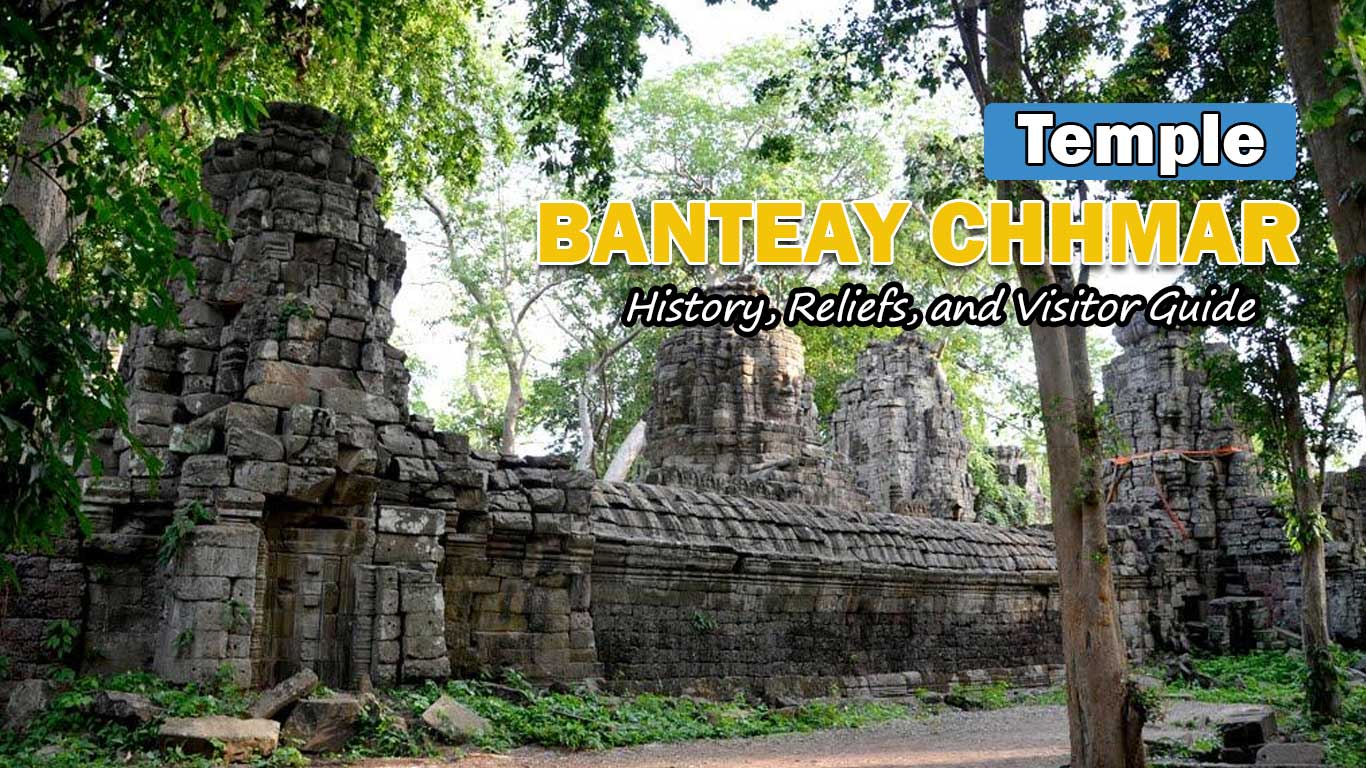

Hidden among the rural landscapes of northwestern Cambodia, Banteay Chhmar Temple is one of the most remarkable archaeological complexes from the Angkorian period. Built under King Jayavarman VII in the late 12th to early 13th centuries, this enormous Buddhist temple complex preserves monumental architecture, carved galleries, mysterious face towers, and a fascinating record of the Khmer Empire.
Unlike the heavily visited monuments around Angkor Wat, Banteay Chhmar is a remote archaeological site with a distinctive atmosphere and a strong connection to the surrounding community. Its bas-reliefs, particularly the extraordinary representations of Avalokiteshvara, make it an important destination for anyone interested in Khmer history and Buddhist art.
Banteay Chhmar Temple at a Glance
| Information | Details |
|---|---|
| Location | Banteay Chhmar Commune, Thma Puok District, Banteay Meanchey Province, Cambodia |
| Historical period | Late 12th to early 13th century |
| Associated ruler | King Jayavarman VII |
| Architectural style | Bayon style of the Angkorian period |
| Religious tradition | Primarily Mahayana Buddhist, with Hindu and local religious elements |
| Major highlights | Bas-reliefs, face towers, central sanctuaries, moat, and baray reservoir |
| Nearby heritage sites | Nine satellite temples and Banteay Torp |
| UNESCO status | On Cambodia’s UNESCO World Heritage Tentative List since 2020; not yet inscribed as a World Heritage Site |
1. History of Banteay Chhmar Temple
A Monument Built Under King Jayavarman VII
Banteay Chhmar was commissioned during the reign of King Jayavarman VII (1181–1218), one of the most influential rulers in Khmer history. His reign was marked by an extensive programme of temple construction, religious foundations, infrastructure, and public works throughout the Khmer Empire.
The temple was established as an important religious and political centre in the northwestern part of the empire. Its strategic location connected it with the wider network of royal roads and settlements that supported Khmer administration beyond the Angkor capital.
Its scale and architectural character demonstrate the ambition of Jayavarman VII to establish major religious centres outside the immediate Angkor region.
A Memorial to a Prince and His Companions
According to Cambodia’s submission to UNESCO, Banteay Chhmar was consecrated in memory of Prince Srindrakumara and four companions who had saved the prince’s life during battles against the Cham.
This memorial purpose is important for understanding the temple’s imagery. Its galleries do not contain only religious symbols; they also preserve scenes connected with warfare, royal authority, loyalty, and the commemoration of individuals who served the kingdom.
A Religious Centre of the Angkorian Empire
Banteay Chhmar reflects the religious environment of Jayavarman VII’s period. Mahayana Buddhism was especially important, while Hindu deities and local Khmer beliefs also appeared in the wider religious landscape of the temple.
The surviving inscriptions and sculptures reveal how royal authority, Buddhist ideas, and the commemoration of the dead were brought together in the design of this monumental complex.
2. Architecture and Layout of the Temple Complex
Banteay Chhmar is much larger than a single sanctuary. It was designed as an extensive religious and urban complex, with galleries, towers, courtyards, water features, and surrounding monuments.
The Main Temple Enclosure
The main temple enclosure measures approximately 770 by 690 metres. At its centre is a complex of galleries and interconnected sanctuaries measuring roughly 250 by 200 metres.
The central area includes five interconnected sanctuaries arranged along an east–west axis, together with artificial ponds, elevated platforms, and structures traditionally identified as libraries.
A broad moat, approximately 63 metres wide, surrounds the central complex. These features illustrate the importance of water management and sacred spatial planning in Angkorian architecture.
Face Towers and Bayon-Style Architecture
One of the most distinctive features of Banteay Chhmar is its face towers, which are closely associated with the architectural style of Bayon Temple.
These towers display monumental carved faces emerging from the stone structures. They create a powerful visual connection between Banteay Chhmar and other major religious foundations built under Jayavarman VII.
Only a limited number of the original face towers remain standing in the central complex, making the surviving examples especially valuable for understanding the site’s original design.
The Baray and Ancient Water System
East of the temple lies a large ancient reservoir known as a baray. UNESCO’s description records a reservoir measuring approximately 1.6 by 0.8 kilometres, with an artificial island at its centre.
The reservoir formed part of a wider water-management system that supported the surrounding settlement and agricultural landscape. A sanctuary known as Prasat Mebon stands on the island.
The relationship between the main temple, the moat, the reservoir, and the surrounding landscape demonstrates that Banteay Chhmar was planned as a complete settlement and religious centre rather than an isolated monument.
3. The Famous Bas-Reliefs of Banteay Chhmar
The bas-reliefs are among the most important artistic features of Banteay Chhmar. Carved into sandstone gallery walls, they provide a remarkable record of Khmer religious beliefs, royal ceremonies, military events, and historical memory.
Military Battles Between the Khmer and Cham
Some of the reliefs depict battles between Khmer and Cham forces on land and water. Visitors can identify scenes of warriors, boats, military preparations, and confrontations that reflect the political and military history of Jayavarman VII’s era.
These carvings are valuable because they communicate historical narratives through visual storytelling rather than relying entirely on written records.
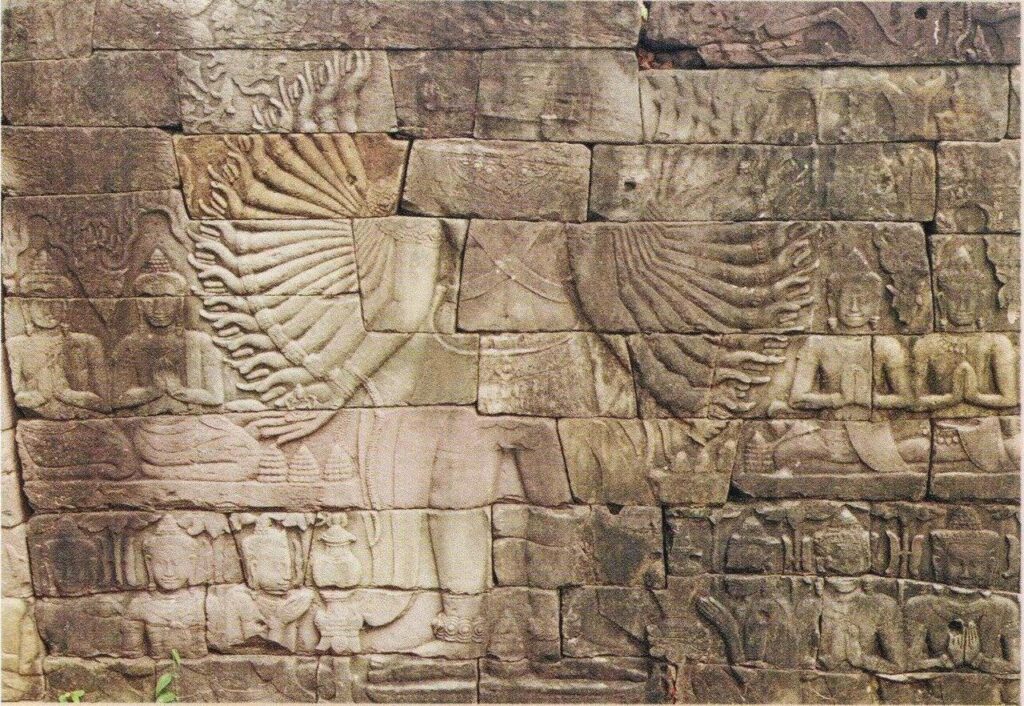
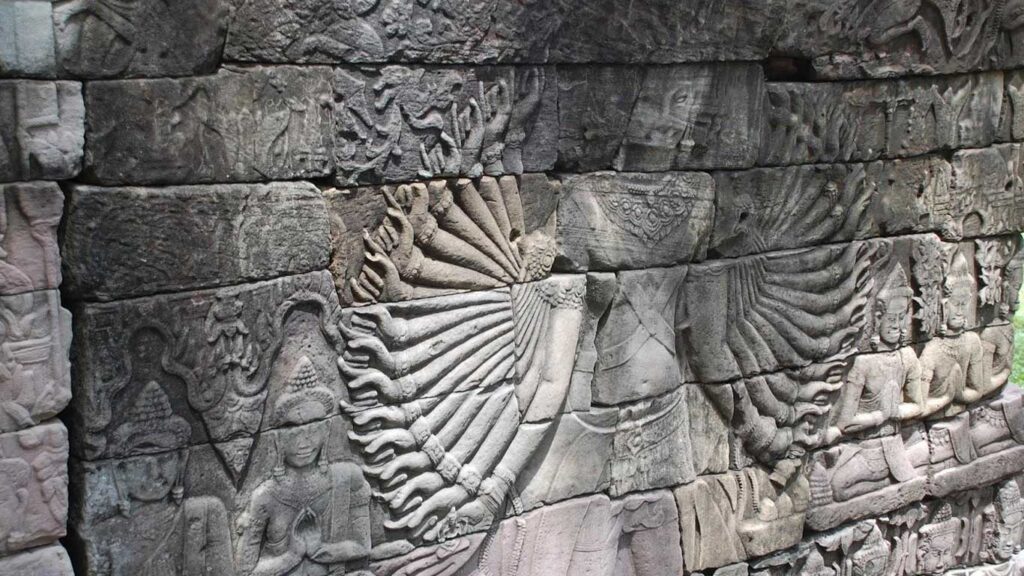
Ten-Armed Lokeshvara and Avalokiteshvara
One of the most remarkable artistic subjects associated with Banteay Chhmar is Lokeshvara, also known as Avalokiteshvara, the bodhisattva of compassion in Mahayana Buddhism.
The western gallery was decorated with a series of eight representations of Lokeshvara. Among them is a famous ten-armed figure, shown with smaller devotees and religious imagery.
This sculpture represents compassion and the power to relieve suffering. Its distinctive artistic treatment makes the Banteay Chhmar reliefs especially important in the study of Khmer Buddhist art.
Royal Processions and Court Scenes
Other reliefs show processions, royal audiences, ceremonial activities, and figures associated with the royal court.
These scenes help visitors understand how religion and royal authority were connected during the reign of Jayavarman VII. The temple was not simply a place of worship; it also communicated the ideals and political identity of the kingdom.
Scenes of Everyday Life
Beyond religious and military subjects, Khmer temple reliefs can preserve details of ordinary life. Banteay Chhmar’s wider sculptural programme includes human figures, activities, and scenes that help researchers explore the society and culture of the Angkorian period.
When examining the carvings, look closely at the smaller details rather than concentrating only on the large figures. Clothing, movement, weapons, animals, and the arrangement of people can reveal additional information about the world represented by the sculptors.
4. Looting, Conservation, and the Missing Sculptures
Banteay Chhmar’s remote location contributed to the deterioration of parts of the monument and made it vulnerable to looting.
In 1998, four of the eight Lokeshvara sculptures were forcibly removed from the surrounding wall. Two were seized at the Thailand border and subsequently transferred to the National Museum of Cambodia in Phnom Penh. The other two remain in undisclosed locations, according to the Cleveland Museum of Art.
The ten-armed Lokeshvara relief became internationally known through a special exhibition at the Cleveland Museum of Art in 2017. The large sandstone section was displayed under an agreement with Cambodia’s National Museum, helping introduce this important Khmer artwork to an international audience.
Conservation efforts involving Cambodian institutions, local communities, and heritage organisations have also supported the protection of the monument. Community-based tourism provides an additional way for local residents to earn income while helping safeguard their cultural heritage.
5. Satellite Temples Around Banteay Chhmar
The main temple is surrounded by nine satellite temples. Many are less studied and remain in a ruined condition, but they help explain the scale of the wider religious landscape.
Prasat Ta Prohm
Prasat Ta Prohm is one of the better-known satellite temples. It is especially interesting for its Bayon-style face towers and offers a different atmosphere from the main temple complex.
Prasat Samnang Tasok
Prasat Samnang Tasok is surrounded by vegetation and has a more secluded setting. Its ruins provide an opportunity to see how smaller sanctuaries formed part of the larger Banteay Chhmar religious landscape.
Prasat Mebon
Prasat Mebon is located on an artificial island in the ancient baray. Access may depend on seasonal conditions, and the local community tourism group can advise whether a visit is practical.
Banteay Torp Temple
Banteay Torp is another important historical site approximately 12 kilometres south of the main Banteay Chhmar temple. It can be considered as an additional heritage stop when local conditions and access permit.
For satellite temple visits, arrange a local guide or transport through the community tourism group rather than attempting to find remote ruins independently.
6. Community-Based Tourism and Local Experiences
Banteay Chhmar is also known for community-based tourism. The local programme connects visitors with village residents and supports livelihoods through guiding, accommodation, food services, and cultural activities.
When travel is permitted, possible community experiences include:
- Local temple guiding: Learn about the temple’s architecture, carvings, and history with a community guide.
- Homestays: Experience rural Cambodian hospitality in a traditional village home.
- Traditional Khmer food: Arrange local meals and learn about regional cooking.
- Silk centre visits: Discover local handicraft and silk-related activities.
- Ox-cart rides: Explore aspects of village life and the surrounding countryside.
- Traditional music: Learn about Cambodian instruments and local musical traditions.
- Remote temple excursions: Visit selected satellite temples with local assistance.
These activities provide an opportunity to support the local community while gaining a deeper understanding of the area’s cultural heritage. Check current availability directly with the community tourism organisation before making arrangements.
7. How to Get to Banteay Chhmar
Under normal travel conditions, Banteay Chhmar is reached through Sisophon, the provincial transport hub in Banteay Meanchey.
From Sisophon
The main temple is approximately 65 kilometres north of Sisophon, via National Road 56. The community tourism website describes the journey as taking around one hour by taxi or other local transport, depending on road and weather conditions.
From Siem Reap
The local visitor information site gives an approximate road distance of 170 kilometres from Siem Reap. The usual route passes through Sisophon before continuing north to Banteay Chhmar.
Older community travel information estimates around 1.5 to 2 hours between Siem Reap and Sisophon, followed by approximately one hour from Sisophon to the temple. Actual journey times can vary.
From Phnom Penh
Banteay Chhmar can historically be reached from Phnom Penh through the national highway network towards Sisophon. However, this is a long overland journey and should not be planned without first checking the current security situation and travel advisories.
8. Entrance Fees, Opening Hours, and Visitor Information
Current entrance arrangements and opening hours should be confirmed before any future visit.
The official community tourism website has displayed a temple entrance fee of US$5 per person on its temple information page. However, its detailed price list is labelled for 2025 and states that those prices were valid only through December 2025. This should not be treated as a confirmed 2026 fee.
The community tourism organisation can provide updated information about entrance arrangements, local guides, accommodation, transport, and activities.
Official visitor information: Visit Banteay Chhmar – Community-Based Tourism.
9. Best Time to Visit Banteay Chhmar
When official travel restrictions no longer apply, the dry season is generally more practical for exploring the temple grounds and nearby satellite monuments.
- Dry season: Generally offers easier road conditions and more practical access to surrounding heritage sites.
- Rainy season: Rain may increase travel times and make access to some remote areas more difficult.
- Early morning: Often more comfortable for walking around large temple complexes and observing architectural details.
Seasonal conditions are only one consideration. The current security situation and official travel advice must take priority over normal tourism planning.
10. Responsible Visiting and Heritage Protection
Banteay Chhmar is an important part of Cambodia’s cultural heritage. Its surviving carvings and structures are fragile, and responsible behaviour is essential to their long-term protection.
- Never touch, scratch, remove, or climb on fragile carvings and ancient structures.
- Do not remove stones, pottery fragments, or other archaeological objects.
- Follow barriers and instructions from heritage staff and local guides.
- Dress respectfully when visiting religious areas.
- Ask permission before photographing local residents.
- Use local guides and community services when available and safe.
- Do not explore isolated ruins or unfamiliar areas without local guidance.
Responsible tourism can help preserve the monument and support the people who live around it.
11. Is Banteay Chhmar a UNESCO World Heritage Site?
Banteay Chhmar is included on Cambodia’s UNESCO World Heritage Tentative List. Cambodia submitted the archaeological complex for consideration on 27 March 2020, under cultural criteria (ii), (iii), and (iv).
Being on the Tentative List is an important step in the World Heritage process, but it does not mean the site has already been inscribed on the UNESCO World Heritage List.
The proposed heritage property recognises the importance of the temple, its satellite monuments, ancient reservoir, water-management system, architecture, and surrounding cultural landscape.
Official reference: UNESCO – The Archaeological Complex of Banteay Chhmar.
Frequently Asked Questions About Banteay Chhmar Temple
1. Where is Banteay Chhmar Temple located?
Banteay Chhmar Temple is located in Banteay Chhmar Commune, Thma Puok District, Banteay Meanchey Province, northwestern Cambodia.
2. Who built Banteay Chhmar Temple?
The temple was commissioned under King Jayavarman VII during the late 12th to early 13th centuries.
3. What is Banteay Chhmar famous for?
It is famous for its enormous Angkorian temple complex, Bayon-style face towers, historical bas-reliefs, and distinctive representations of the Buddhist bodhisattva Lokeshvara.
4. What do the bas-reliefs show?
The carvings include Khmer–Cham battles, royal processions, religious imagery, ceremonial scenes, and representations of Avalokiteshvara.
5. Is Banteay Chhmar on the UNESCO World Heritage List?
It is on Cambodia’s UNESCO World Heritage Tentative List, submitted in March 2020. It has not yet been inscribed as a UNESCO World Heritage Site.
6. Are there other temples near Banteay Chhmar?
Yes. The main complex is associated with nine satellite temples. Banteay Torp, approximately 12 kilometres south of the main temple, is another nearby heritage site.
7. Can visitors stay in a local homestay?
The community tourism programme has offered homestays and guesthouses. Availability and prices should be confirmed directly with the local organisation before planning a stay.
8. Is it safe to visit Banteay Chhmar in November 2026?
Current travel advisories warn against travel within specified distances of the Cambodia–Thailand border, including areas of Banteay Meanchey Province. Because Banteay Chhmar is close to the border, travellers should not plan a visit while the applicable advisory remains in force. Check the latest official advice before making any decision.
Conclusion: Discovering the Heritage of Banteay Chhmar
Banteay Chhmar Temple is one of the most significant surviving monuments of the Jayavarman VII period. Its remarkable architecture, historical bas-reliefs, face towers, and ancient water system reveal the ambition and artistic achievements of the Khmer Empire.
The temple also tells a human story through its memorial sculptures, religious imagery, and the efforts of local communities to protect their heritage.
Although it deserves a place in Cambodia’s wider heritage and cultural tourism story, visitor plans must take account of the current border security situation. Once travel restrictions are lifted and local access is confirmed, Banteay Chhmar can be considered as an important addition to a deeper exploration of Cambodia’s ancient temples.
For more information about Cambodia’s temple heritage, explore these GoToKH guides:
- Angkor Thom: A Visitor’s Guide to the Great Khmer City
- Bayon Temple: Exploring the Iconic Face Towers
- Ta Prohm Temple: History, Ancient Trees, and Visitor Tips
- Best Temples to Visit in the Angkor Archaeological Park
Explore Cambodia’s history and culture with GoToKH.com, your guide to the Kingdom of Cambodia.