




































Bayon Temple: Exploring the Iconic Smiling Face Towers of Angkor Thom

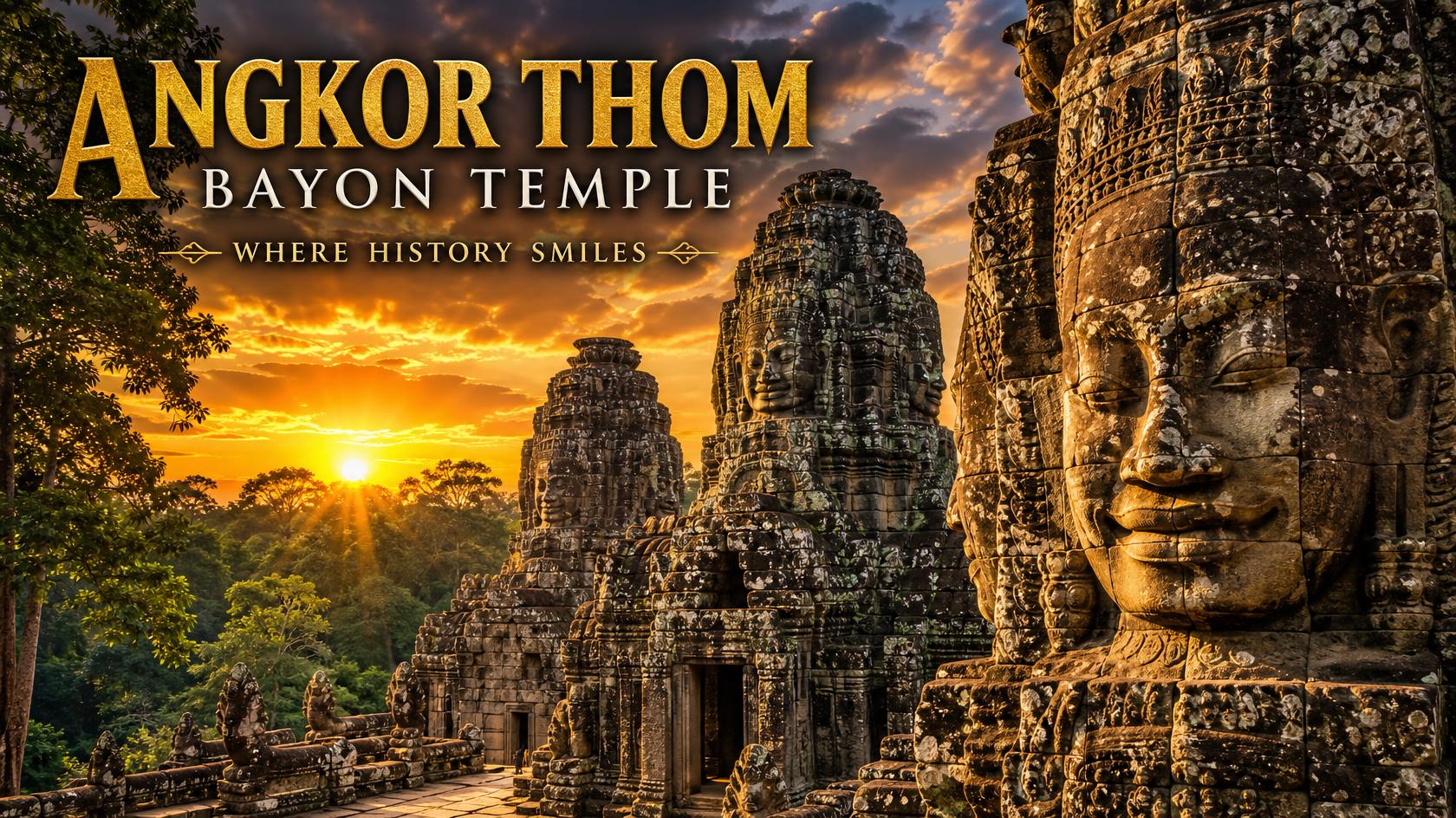
Bayon Temple is one of the most recognizable monuments in Cambodia. Located at the heart of Angkor Thom in Siem Reap, this extraordinary Khmer temple is famous for its enormous stone towers decorated with serene, enigmatic faces that seem to smile down at visitors from every direction.
Built during the reign of King Jayavarman VII in the late 12th century, Bayon was designed as a major state temple within the royal city of Angkor Thom. Unlike the long galleries and monumental symmetry of Angkor Wat, Bayon has a more complex and intimate character, with towers, corridors, galleries and carvings appearing to merge into one another.
Beyond its famous faces, Bayon is also an important historical record. Its bas-reliefs portray battles, royal processions, religious imagery and remarkably detailed scenes of everyday Khmer life. Markets, cooking, fishing, animals, musicians and ordinary people appear alongside scenes of warfare and mythology.
This makes Bayon more than a place for photographs. It is a monument through which visitors can explore the religious beliefs, political history, architecture and daily life of the Khmer Empire.
Quick Summary: Bayon Temple
| Feature | Details |
|---|---|
| Location | Center of Angkor Thom, Siem Reap Province |
| Built | Late 12th century |
| King | Jayavarman VII |
| Religious tradition | Mahayana Buddhism |
| Architectural style | Bayon style |
| Famous feature | Stone towers decorated with large faces |
| Original towers | Generally described as 49 or 54 |
| Towers still standing | 37, according to APSARA National Authority |
| Recommended visit | About 1.5–2 hours |
| World Heritage status | Part of the UNESCO World Heritage Site of Angkor |
Where Is Bayon Temple?
Bayon stands almost exactly at the center of Angkor Thom, the great walled city established under King Jayavarman VII.
Angkor Thom covers approximately 900 hectares and is surrounded by massive walls and a wide moat. Five monumental gates provide access to the city, while roads extend toward the central Bayon temple.
UNESCO identifies Bayon as one of the principal monuments within Angkor, the enormous archaeological landscape in Siem Reap that extends across approximately 400 square kilometres and contains temples, reservoirs, canals and ancient urban remains.
The temple’s central position was highly symbolic. Rather than being placed at the edge of the city, Bayon occupied its heart, reinforcing its role as a religious and political center of Jayavarman VII’s capital.
The History of Bayon Temple
Bayon was constructed toward the end of the 12th century during the reign of King Jayavarman VII, one of the most important rulers in Khmer history.
Jayavarman VII came to power after a period of conflict that included the Cham attack and occupation of Angkor in 1177. He subsequently rebuilt and transformed the capital, establishing Angkor Thom and commissioning an extraordinary series of monuments.
Bayon became the principal state temple of this new capital and was associated with the king’s Mahayana Buddhist faith.
APSARA National Authority describes Bayon as a Mahayana Buddhist temple dedicated to the Buddha under the protection of the naga, with the temple originally known as Chey Kiri, meaning “Triumphant Mountain.”
Jayavarman VII and Mahayana Buddhism
Jayavarman VII’s religious vision strongly influenced the architecture of Angkor Thom. Mahayana Buddhism became central to the royal ideology, while Hindu traditions and earlier religious practices continued to influence the cultural landscape.
This mixture can be seen throughout Bayon. Buddhist imagery appears alongside older Hindu motifs and representations of local deities.
The result is a temple that reflects the religious complexity of the Khmer Empire rather than a simple separation between Buddhism and Hinduism.
The Mysterious Smiling Faces of Bayon
The most famous feature of Bayon is its collection of enormous stone faces.
The faces appear on the towers surrounding the central sanctuary. They are characterized by calm expressions, gently closed or lowered eyes and a subtle smile.
When viewed from different positions, the faces seem to look toward the visitor from every direction.
How Many Face Towers Does Bayon Have?
This is one of the most frequently misunderstood details about Bayon.
Historical descriptions commonly refer to 49 or 54 towers, each associated with multiple faces. However, many of the original towers no longer survive. APSARA National Authority currently states that only 37 towers remain standing.
This is why different books and websites sometimes provide different numbers. Some figures refer to the original architectural arrangement, while others describe the surviving structures.
Whose Face Is It?
The identity represented by the faces has been debated by scholars for generations.
One of the most common interpretations identifies them with Avalokiteshvara, the Mahayana Buddhist bodhisattva associated with compassion. Other interpretations have proposed that the faces may also have been connected symbolically with Jayavarman VII himself.
It is therefore safer to describe the faces as having a strong association with Mahayana Buddhist imagery and royal ideology rather than claiming that every face is definitively a portrait of the king or exclusively a representation of one deity.
Why Does Bayon Have So Many Faces?
The faces can be understood as part of Bayon’s larger religious and political symbolism.
From the center of Angkor Thom, the temple represented a sacred mountain at the heart of the royal city. The surrounding faces created a powerful visual presence that could be interpreted as an expression of divine protection, compassion and royal authority.
The exact meaning remains a subject of scholarly discussion. That uncertainty is part of what makes Bayon fascinating: the monument communicates through architecture and symbolism without giving modern visitors a single simple explanation.
Bayon Architecture: A Temple That Feels Like a Maze
Bayon’s architecture is very different from the highly ordered appearance of Angkor Wat.
The temple contains multiple levels, galleries, corridors, towers and courtyards. As visitors move toward the center, the spaces become increasingly dense and dramatic.
The Central Sanctuary
At the center of Bayon is the main sanctuary, surrounded by layers of architectural structures.
The central area represents the symbolic heart of the temple and historically housed an important Buddhist image associated with Jayavarman VII.
According to APSARA National Authority, the original central Buddhist image was a Buddha seated beneath a naga and was known as Jayabuddhamahanatha. The statue has experienced changes associated with religious transformations over time and is now preserved elsewhere.
The Galleries
The galleries contain some of the most valuable historical carvings at Angkor.
Unlike purely mythological temple decoration, Bayon’s bas-reliefs include remarkably detailed scenes from the world of the Khmer Empire.
Visitors can see boats, markets, soldiers, animals, musicians, cooking, fishing and people engaged in everyday activities.
These scenes provide a rare visual window into life during the Angkorian period.
Bayon Bas-Reliefs: History Carved in Stone
If you have only a short time at Bayon, do not spend the entire visit looking upward at the faces. The bas-reliefs deserve equal attention.
Scenes of War
Some reliefs depict military campaigns involving Khmer forces and their enemies. Soldiers, commanders, elephants, boats and weapons appear in detailed compositions.
These carvings are particularly valuable because they help historians understand how warfare and royal power were represented during the reign of Jayavarman VII.
Scenes of Daily Life
Bayon is famous for depicting ordinary activities that are rarely represented so extensively at other ancient monuments.
Look for scenes of:
- People preparing food
- Fishing
- Markets and merchants
- Musicians
- Farm and household activities
- Animals
- Children and families
- Boat journeys
- Construction work
APSARA National Authority specifically highlights scenes of marketplaces, road construction, food preparation, fishing and other aspects of everyday Khmer life.
Chinese Figures at Bayon
Another interesting feature is the presence of figures interpreted as Chinese people within several relief scenes.
APSARA notes that Chinese figures appear as soldiers, shopkeepers and people participating in activities around the Khmer world. These details provide evidence of the multicultural environment connected with Angkor.
Bayon and Angkor Thom: Understanding the Connection
To understand Bayon properly, you should understand Angkor Thom.
Angkor Thom was not simply a collection of temples. It was a planned royal city surrounded by walls and a moat, with monumental gates and roads leading toward the central Bayon.
The city was conceived during the reign of Jayavarman VII as an important political and religious center.
The five main gates are associated with the famous Churning of the Ocean of Milk imagery, with rows of devas and asuras pulling the naga along the approaches.
APSARA describes Bayon as playing a symbolic role in relation to Angkor Thom and the cosmic imagery of the Churning of the Ocean of Milk.
The Four Faces at Angkor Thom Gates
Before reaching Bayon, visitors usually pass through one of Angkor Thom’s monumental gates.
These gates are topped by large towers with faces, creating a visual connection with the faces at Bayon.
The bridges leading toward the gates are lined with figures of devas and asuras holding the body of the naga. The imagery represents the famous Hindu story of the Churning of the Ocean of Milk.
This means the faces are not isolated to Bayon. They form part of a much larger architectural and symbolic program extending across Angkor Thom.
Bayon vs Angkor Wat
| Feature | Bayon | Angkor Wat |
|---|---|---|
| Period | Late 12th century | Early 12th century |
| Associated ruler | Jayavarman VII | Suryavarman II |
| Original religious tradition | Mahayana Buddhism | Hinduism, dedicated to Vishnu |
| Location | Center of Angkor Thom | South of Angkor Thom |
| Most famous feature | Face towers | Five central towers and extensive galleries |
| Architectural character | Dense, complex and multi-level | Large, symmetrical and processional |
| Special attraction | Faces and daily-life bas-reliefs | Cosmic symbolism and monumental galleries |
Both temples are essential to understanding Angkor, but they provide very different experiences. Angkor Wat emphasizes monumental symmetry and grand scale, while Bayon rewards close exploration of faces, corridors and narrative carvings.
How Long Should You Spend at Bayon?
APSARA National Authority recommends approximately 1.5 to 2 hours for a visit to Bayon.
This is enough time for most visitors to see the major towers and bas-reliefs without rushing.
1-Hour Visit
If you are following a tight Angkor itinerary, focus on the central towers, most recognizable faces and a few sections of the bas-reliefs.
1.5–2 Hours
This is a better option for first-time visitors. You can explore the outer galleries, examine the daily-life carvings and spend time among the face towers.
2+ Hours
Photography enthusiasts, history lovers and travelers with a professional guide can easily spend longer studying the carvings and architectural details.
Best Time to Visit Bayon Temple
Bayon is usually included in the classic Angkor itinerary, so visitor numbers can change significantly throughout the day.
Early morning is generally attractive because temperatures are cooler and the light is softer. Late afternoon can also provide beautiful light on the sandstone towers.
| Time | Experience |
|---|---|
| Early morning | Cooler temperatures and softer light |
| Morning | Good for detailed exploration before stronger heat |
| Midday | Hotter; indoor/gallery areas can still provide interesting exploration |
| Late afternoon | Warm light and potentially more atmospheric photography |
Current access hours should always be checked before your visit because conservation activities can temporarily affect access to individual areas.
Photography Tips for Bayon
Bayon’s architecture is particularly challenging and rewarding to photograph because the towers are densely packed together.
- Use a wide-angle lens to capture several face towers together.
- Look for symmetrical compositions between opposing faces.
- Photograph the faces from different heights.
- Use early or late light to emphasize the texture of the sandstone.
- Look beyond the famous faces and photograph architectural details.
- Spend time photographing the bas-reliefs at eye level.
- Be patient when crowds move through narrow passages.
Avoid blocking narrow walkways while taking photographs and never climb architectural structures simply to obtain a different camera angle.
How to Visit Bayon Temple
Bayon is normally visited as part of an Angkor itinerary rather than as an isolated destination.
Classic Small Circuit
- Angkor Wat
- Angkor Thom South Gate
- Bayon
- Baphuon
- Phimeanakas and Royal Enclosure area
- Terrace of the Elephants
- Terrace of the Leper King
- Ta Prohm
The exact order can be changed according to crowd levels, weather and your guide’s recommendations.
Getting to Bayon
From Siem Reap, visitors can reach Bayon by tuk-tuk, private car, bicycle, scooter or organized tour.
The South Gate of Angkor Thom is one of the most commonly photographed entrances, and Bayon is located a short distance farther inside the city.
What to Wear at Bayon
Bayon is a religious and heritage site, so visitors should dress respectfully.
- Cover your shoulders.
- Wear clothing that covers the knees.
- Choose comfortable walking shoes.
- Wear a hat or cap for sun protection.
- Bring a light rain layer during the wet season.
Respectful clothing is especially important when visiting areas that continue to have religious significance.
Bayon Visitor Etiquette
- Do not climb on the temple structures.
- Do not touch delicate carvings unnecessarily.
- Stay on designated visitor paths.
- Do not cross barriers.
- Keep your voice low in sacred areas.
- Respect monks and worshippers.
- Do not leave rubbish behind.
- Do not write or carve names into the stone.
- Ask permission before photographing people closely.
- Follow instructions from APSARA staff and conservation teams.
These simple actions help protect an ancient monument that continues to be studied, maintained and conserved.
Bayon Conservation and Restoration
Bayon has required extensive conservation work because of centuries of weathering, structural movement, vegetation, water and other environmental pressures.
Conservation at Angkor has involved Cambodian authorities and international partners for more than a century. APSARA notes that the Japanese Safeguarding Angkor project has undertaken extensive conservation and restoration work at Bayon since 1994.
Because conservation is ongoing, some parts of Bayon may occasionally be closed or surrounded by protective structures.
Visitors should never interpret restoration equipment or temporary barriers as part of the original temple. They are necessary to help protect the monument for future generations.
What to Look for When Exploring Bayon
Instead of simply walking through the temple looking for the largest face, try using this checklist:
- Look upward: Count how many face towers you can see from different locations.
- Look closely: Examine the expressions and differences between faces.
- Look downward: Notice the floor plans, stones and changes in level.
- Study the bas-reliefs: Search for markets, animals, boats and food preparation.
- Look for foreign figures: Chinese figures appear in several scenes.
- Notice the architecture: Observe how galleries and towers overlap.
- Think about the city: Remember that Bayon stands at the center of Angkor Thom.
Practical Tips for First-Time Visitors
- Start early: Cooler temperatures make walking easier.
- Bring water: Exploring Angkor involves significant walking.
- Wear good shoes: Stone surfaces can be uneven.
- Hire a guide: The carvings become much more meaningful when their stories are explained.
- Carry a camera: Bayon provides excellent architectural photography opportunities.
- Don’t rush: The temple’s details are easy to miss.
- Check access conditions: Conservation work can temporarily change visitor routes.
- Combine with Angkor Thom: Allow enough time to see the South Gate, terraces and other monuments nearby.
🏛️ GoToKH Travel Tip
When visiting Bayon, spend at least a few minutes looking at the bas-reliefs before heading toward the face towers. The famous smiling faces attract most cameras, but the everyday-life scenes carved into the galleries may be the most informative part of the temple for understanding life in the Khmer Empire.
Frequently Asked Questions
What is Bayon Temple famous for?
Bayon is famous for its large stone towers decorated with enigmatic smiling faces. It is also known for detailed bas-reliefs depicting battles, religious stories and everyday Khmer life.
Who built Bayon Temple?
Bayon was built during the reign of King Jayavarman VII toward the end of the 12th century.
Is Bayon inside Angkor Thom?
Yes. Bayon stands at the center of Angkor Thom, the great walled royal city established during the reign of Jayavarman VII.
How many faces are at Bayon Temple?
The historical number of face towers is commonly described as 49 or 54, while APSARA National Authority states that 37 towers are currently standing. The exact count depends on whether surviving or original structures are being discussed.
Who do the faces of Bayon represent?
The most common scholarly interpretation connects the faces with Avalokiteshvara, the Mahayana Buddhist bodhisattva of compassion. Some interpretations also associate them with Jayavarman VII. The exact identity and symbolism remain debated.
Is Bayon a Buddhist temple?
Yes. Bayon was constructed as a Mahayana Buddhist state temple during the reign of Jayavarman VII. Hindu imagery and traditions also remained part of the broader religious landscape of Angkor.
How long should I spend at Bayon Temple?
APSARA National Authority recommends approximately 1.5 to 2 hours. Travelers interested in photography, history or detailed architectural study may want longer.
Can I visit Bayon without a guide?
Yes. You can explore Bayon independently, but a knowledgeable guide can explain the faces, bas-reliefs, Buddhist symbolism and historical events represented in the temple.
What other temples should I visit with Bayon?
Bayon is commonly combined with Angkor Wat, Angkor Thom’s South Gate, Baphuon, the Terrace of the Elephants, the Terrace of the Leper King and Ta Prohm.
Is Bayon part of a UNESCO World Heritage Site?
Yes. Bayon is part of the UNESCO World Heritage Site of Angkor, which was inscribed in 1992 and encompasses a much larger archaeological landscape across Siem Reap.
Sources & References
- APSARA National Authority – Bayon Temple
- APSARA National Authority – Angkor Temples and Angkor Thom information
- UNESCO World Heritage Centre – Angkor
- UNESCO World Heritage Centre – Angkor and Bayon documentation
- APSARA National Authority – Conservation and restoration information
Conclusion
Bayon Temple is one of the most fascinating monuments in Cambodia because it combines architecture, religion, royal power and everyday life in a remarkably concentrated space.
The famous smiling faces are only the beginning. Behind them are complex galleries filled with scenes of warfare, markets, food preparation, fishing, animals and ordinary people. Together, these carvings provide a valuable glimpse into the world of the Khmer Empire during the reign of Jayavarman VII.
Its position at the center of Angkor Thom is equally important. Bayon was not designed as an isolated monument. It formed the sacred and symbolic heart of a great royal city whose gates, walls, roads and surrounding monuments were carefully integrated into a larger vision of the Khmer capital.
When you visit, take your time. Look beyond the most famous photographs, study the faces from different angles, examine the bas-reliefs and imagine the enormous city that once surrounded this extraordinary temple.
Planning your Angkor adventure? Visit Bayon together with Angkor Wat, Angkor Thom and Ta Prohm to experience the architectural, religious and historical diversity of Cambodia’s ancient Khmer capital.
