

















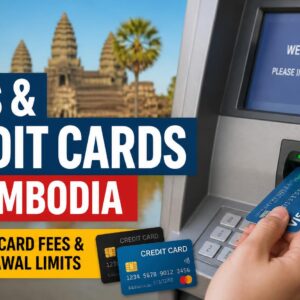


















ATMs and Credit Cards in Cambodia: Foreign Card Fees & Withdrawal Limits

Using an ATM or credit card in Cambodia is relatively easy, especially in Phnom Penh, Siem Reap, Sihanoukville, Kampot, Battambang, and other major tourist destinations. However, international travelers should understand the fees, withdrawal limits, currency choices, and card-acceptance differences before relying entirely on plastic.
Cambodia uses the Khmer riel (KHR) as its national currency, while US dollars remain widely used for many everyday transactions. As a result, travelers may see ATMs offering both USD and KHR, depending on the bank and machine.
For most visitors, the best strategy is to carry a combination of cash, a debit card, and a credit card. Cards are useful for hotels, larger restaurants, shopping centers, and other established businesses, while cash remains important for small restaurants, markets, tuk-tuks, local shops, and places outside major tourist areas.
This guide explains how Cambodian ATMs work in 2026, what foreign-card users should expect to pay, how much you can withdraw, where Visa and Mastercard are accepted, and how to avoid unnecessary fees.
Quick Summary: ATMs and Cards in Cambodia
| Question | What Travelers Should Know |
|---|---|
| Can foreigners use ATMs? | Yes. Major Cambodian banks accept many international Visa, Mastercard, UnionPay and other networks. |
| Can ATMs dispense USD? | Yes. Many Cambodian ATMs offer USD; some also offer KHR. |
| Can I use Visa and Mastercard? | Yes, particularly at hotels, restaurants, shops and businesses in major tourist destinations. |
| Are ATM fees charged? | Often yes. The fee depends on the Cambodian ATM operator and your card issuer. |
| Is there one nationwide ATM withdrawal limit? | No. Limits vary by bank, ATM and card. |
| Is cash still important? | Yes. Cash remains useful for small purchases and businesses that do not accept cards. |
1. Can Foreigners Use ATMs in Cambodia?
Yes. International travelers can use ATMs operated by major Cambodian banks, provided their card is supported by the ATM network.
ABA Bank, for example, states that its ATMs accept Visa, Mastercard, UnionPay International, JCB, and CSS cards. Its ATMs can dispense both US dollars and Khmer riel.
This makes withdrawing local cash relatively convenient for tourists. However, not every ATM supports every card network, and your own bank may also impose restrictions on international withdrawals.
Common International Card Networks
- Visa
- Mastercard
- UnionPay
- JCB
- Cirrus
- Maestro, where supported
Before traveling, check that your card is enabled for international ATM withdrawals and that you know your PIN.
2. Can You Withdraw US Dollars From Cambodian ATMs?
Yes. One of the unusual features of Cambodia’s banking system for international travelers is the widespread availability of US-dollar cash.
Many Cambodian ATMs allow customers to choose between USD and KHR. ABA, for example, explicitly states that its ATMs allow withdrawals in both currencies.
This can be useful because US dollars are still widely accepted in Cambodia, particularly in the tourism and hospitality sectors.
However, the Khmer riel remains Cambodia’s official national currency and is particularly useful for smaller purchases. Tourism Cambodia recommends carrying small riel notes for small transactions.
USD or KHR: Which Should You Withdraw?
For many travelers, the answer depends on how they plan to spend their money.
- USD: Useful for hotels, larger purchases, tours, and businesses that quote prices in dollars.
- KHR: Convenient for local markets, small restaurants, street food, tuk-tuks, and small everyday purchases.
A combination of both currencies is often the most practical approach.
3. How Much Can You Withdraw From an ATM in Cambodia?
There is no single withdrawal limit for every ATM in Cambodia. The maximum depends on the bank operating the ATM, the specific machine, your card type, and sometimes your own bank’s daily limit.
For example, current published limits from Cambodian banks show significant differences between card products.
| Bank / Card Example | Published Daily ATM Limit | Published Per-Transaction Limit |
|---|---|---|
| ABA Visa Classic Debit | Up to US$5,000/day | Depends on ATM/card settings |
| ABA Visa Platinum Debit | Up to US$20,000/day | Depends on ATM/card settings |
| Canadia Visa Classic | Up to US$1,500/day | Up to US$1,000 |
| Canadia Visa Elite Debit | Up to US$10,000/day | Up to US$2,000 |
These figures illustrate that limits vary considerably by card and bank. ABA lists a US$5,000 daily withdrawal limit for its Visa Classic debit card, while its Visa Platinum debit card lists up to US$20,000 per day. Canadia’s Visa Classic lists up to US$1,500 per day, with a maximum US$1,000 per transaction.
Important for tourists: your foreign bank may impose a much lower daily withdrawal limit than the Cambodian ATM. The lower limit will effectively apply.
4. How Much Does It Cost to Withdraw Cash?
This is where international travelers need to be careful.
An ATM withdrawal can involve several different charges:
- Cambodian ATM operator fee
- Your home bank’s international ATM fee
- Foreign-exchange fee, depending on your card
- Currency conversion or dynamic currency conversion charges, if you accept an unfavorable conversion offered by the ATM
These charges are not necessarily all applied to every transaction. The exact cost depends on your card issuer, the ATM, the currency selected, and the transaction type.
Why There Is No Single “Cambodia ATM Fee”
It is misleading to say that every Cambodian ATM charges tourists exactly US$5 or exactly 2%. Cambodian banks publish different fee structures for their own cards and services, while the fees charged to an international cardholder can also depend on the foreign card issuer and network.
For example, Canadia’s published debit-card information lists a 2% fee or minimum US$5 for cash withdrawals using an international-bank ATM. Its standard debit-card information also shows a daily withdrawal limit of up to US$5,000, subject to transaction limits.
For comparison, ABA’s published Visa Classic debit-card schedule states that withdrawals at ABA ATMs are free for ABA cardholders, while withdrawals using non-ABA ATMs/POS are charged 2% with a US$5 minimum. This is a fee schedule for the ABA-issued card and should not be interpreted as a universal fee for foreign cards using ABA ATMs.
Money-saving tip: Always look at the ATM’s final fee screen before confirming a withdrawal. If the fee is unexpectedly high, cancel the transaction and try another ATM.
5. What Is Dynamic Currency Conversion (DCC)?
One of the most important ATM tips for international travelers is understanding Dynamic Currency Conversion (DCC).
An ATM may sometimes ask whether you want the transaction processed in your home currency rather than the local currency or withdrawal currency.
This can appear convenient, but the exchange rate offered by the ATM operator may be less favorable than the rate used by your card network or bank.
What Should You Choose?
If the ATM gives you a choice between using a Cambodian currency amount and allowing the ATM to convert the transaction into your home currency, carefully review the exchange rate and fee information.
In many situations, travelers prefer to decline the ATM’s currency conversion and allow their own card network or bank to handle the conversion. However, the best choice depends on your card issuer’s exchange rates and fees.
Do not automatically accept a conversion simply because the ATM describes it as convenient or guaranteed.
6. Are Credit Cards Widely Accepted in Cambodia?
Yes, but acceptance varies significantly by location and business.
Major hotels, international restaurants, shopping centers, tour companies, supermarkets, and established businesses in Phnom Penh and major tourist destinations commonly accept international cards.
Cash is still important for smaller businesses, markets, street food vendors, local transport, and many businesses outside major tourist centers.
Tourism Cambodia identifies Visa and Mastercard among the widely accepted card networks in Cambodia and notes that card acceptance is concentrated particularly in major tourist areas.
Where Are Cards Most Useful?
- Hotels and resorts
- Airlines and travel companies
- Large supermarkets
- Shopping malls
- Upscale restaurants
- International businesses
- Some cafés
- Online bookings
Where Is Cash Usually Better?
- Local markets
- Street-food stalls
- Small family restaurants
- Tuk-tuks and local transport
- Small shops
- Rural areas
- Small entrance fees
- Informal vendors
7. Visa vs. Mastercard in Cambodia
Both Visa and Mastercard are widely useful in Cambodia.
ABA’s ATM network, for example, supports both Visa and Mastercard along with several other international networks.
For a tourist, there is usually no need to rely on only one card network. Carrying both a Visa and Mastercard can provide useful backup if one card is declined or a particular ATM does not support it.
Before your trip, check:
- International ATM withdrawals are enabled.
- International purchases are enabled.
- Your card has a PIN suitable for ATM use.
- You know your daily withdrawal limit.
- You know your foreign transaction fee.
- You have a backup card stored separately.
8. Debit Card vs. Credit Card for Cambodian ATMs
For ordinary cash withdrawals, a debit card is usually more practical than a credit card.
Using a credit card at an ATM may be treated as a cash advance. This can result in additional fees and interest, depending on your card issuer.
For example, ABA’s published credit-card information notes that cash withdrawals can be subject to cash-advance interest.
| Feature | Debit Card | Credit Card |
|---|---|---|
| ATM cash withdrawal | Usually preferred | Can be expensive |
| Uses your own bank balance | Yes | No |
| Cash advance interest | Usually no | Possible |
| Good for purchases | Yes | Yes |
| Emergency backup | Yes | Excellent |
Best strategy: use a debit card for normal ATM withdrawals and keep a credit card available for purchases and emergencies.
9. How to Use a Cambodian ATM Safely
Choose a Bank ATM
Whenever possible, use an ATM physically attached to or located inside a recognized bank branch, shopping center, airport, or secure commercial location.
Inspect the ATM
Before inserting your card, check the card slot and keypad for anything unusual. Avoid machines that appear damaged or have suspicious attachments.
Cover Your PIN
Use your hand to cover the keypad while entering your PIN, even if nobody appears to be watching.
Keep Your Card Secure
Never leave your card unattended and never give your PIN to another person.
Take Your Receipt
If the ATM produces a receipt, keep it until the transaction appears correctly in your banking application.
10. What If an ATM Keeps Your Card?
If an ATM retains your card, do not panic.
If the ATM is located at a bank branch, enter the branch and immediately ask the bank staff for assistance.
If the ATM is outside a branch, contact the bank’s official customer-service number and report the problem.
ABA, for example, provides procedures for customers whose cards are retained by ATMs and advises contacting its call center or visiting a branch.
Never accept help from a stranger who asks for your PIN or offers to “fix” the ATM.
11. What If Your Account Is Debited but the ATM Gives No Cash?
This can occasionally happen because of a communication or ATM-processing problem.
If your account is debited but no cash is dispensed:
- Keep the ATM receipt if available.
- Take note of the ATM location.
- Record the date and time.
- Check your banking application.
- Contact your card issuer.
- Contact the Cambodian ATM operator if necessary.
Do not immediately make repeated withdrawals if you are unsure whether the first transaction has been completed.
ABA’s ATM guidance specifically instructs customers to file a complaint with the bank if an ATM does not dispense cash but the account is debited.
12. How Much Cash Should You Carry in Cambodia?
There is no universal amount that every traveler needs. A practical approach is to carry enough cash for one or two days while keeping most of your money secure.
For example, a traveler staying mainly in major cities might keep approximately US$50–150 in accessible cash, depending on accommodation, activities, and travel style.
You do not need to carry your entire travel budget in your wallet.
For larger trips, divide your money between:
- Your wallet
- A secure travel bag
- Your hotel safe, where appropriate
- A debit card
- A backup credit card
Keep backup cards and emergency cash separate from your everyday wallet.
13. US Dollars or Khmer Riel: Which Is Better?
Cambodia’s national currency is the Khmer riel, but US dollars continue to be widely used, particularly in tourist areas and for larger transactions. Tourism Cambodia recommends carrying small riel denominations for everyday small purchases.
| Situation | Useful Currency |
|---|---|
| Local market | KHR |
| Street food | KHR |
| Small tuk-tuk fare | KHR or USD |
| Hotel | USD or KHR |
| Large tourist purchase | USD or KHR |
| Small change | KHR |
When receiving change in Cambodia, check US-dollar notes carefully. Tourism Cambodia warns that damaged US-dollar notes can be difficult to use.
14. How to Reduce ATM Fees in Cambodia
1. Withdraw Larger Amounts Less Frequently
If your ATM charges a flat fee per transaction, making fewer withdrawals can reduce the total amount you pay.
However, do not withdraw an unnecessarily large amount simply to avoid one fee. Security and convenience should also be considered.
2. Check Your Home Bank’s Fees
Your Cambodian ATM fee is only one part of the total cost. Your own bank may charge an international ATM fee, foreign transaction fee, or currency-conversion fee.
3. Use a Travel-Friendly Debit Card
Some banks offer cards with low or no foreign ATM fees. Check your card’s fee schedule before leaving home.
4. Decline Unfavorable Currency Conversion
Review any DCC offer carefully and compare the ATM’s exchange rate with the rate that your card issuer would normally provide.
5. Use a Second Card
If one ATM charges an unexpectedly high fee or does not accept your card, having another card network available can save time and money.
15. ATM Availability Outside Major Cities
ATMs are widely available in Cambodia’s major cities and tourist destinations, but availability becomes less predictable in remote rural areas.
Tourism Cambodia notes international-access ATMs in destinations including Phnom Penh, Siem Reap, Sihanoukville, Kampot, and Battambang.
If you are travelling to remote villages, islands, national parks, trekking areas, or rural provinces, withdraw enough cash before leaving the nearest major town.
This is particularly important when travelling through areas where internet connectivity, electricity, or banking infrastructure may be limited.
16. Credit Card Surcharges in Cambodia
Some Cambodian businesses may add a surcharge when customers pay by credit card.
The amount is not necessarily the same everywhere. Some businesses absorb card-processing costs, while others may add a service or card fee.
Before paying a large bill, ask:
- Is there a card surcharge?
- Is the displayed price the cash price?
- Is the final amount shown in USD or KHR?
- Will the card transaction use the merchant’s conversion rate?
If you are paying for an expensive hotel, tour, or service, confirming the final amount before inserting your card can prevent surprises.
17. Best Money Strategy for First-Time Visitors
For a first trip to Cambodia, a balanced approach works well:
- Bring two payment cards. Preferably from different networks or issuers.
- Bring some emergency cash. Do not depend entirely on ATMs.
- Withdraw a moderate amount at a time.
- Keep some small Khmer riel. It is useful for everyday purchases.
- Use cards at established businesses.
- Use cash at small local businesses.
- Check ATM fees before confirming.
- Decline unfavorable currency conversion when appropriate.
- Keep backup cards separately.
Frequently Asked Questions
Can I use my foreign debit card in Cambodia?
Yes. International Visa, Mastercard and other supported card networks can generally be used at major Cambodian ATMs. ABA, for example, states that its ATMs accept Visa, Mastercard, UnionPay International and JCB.
Can I withdraw US dollars from an ATM in Cambodia?
Yes. Many Cambodian ATMs dispense US dollars. Some machines also offer Khmer riel. ABA’s ATM network, for example, offers both USD and KHR withdrawals.
What is the ATM withdrawal limit in Cambodia?
There is no single nationwide limit. It varies by bank, ATM and card. Published examples range from around US$1,500 per day on Canadia Visa Classic to US$20,000 per day on ABA Visa Platinum debit, although the actual amount available to a foreign traveler may be limited by the foreign card issuer and the specific ATM.
How much does a Cambodian ATM charge foreign cards?
There is no single fee for all ATMs. The total cost can include the Cambodian ATM operator fee, your home bank’s international withdrawal fee, and possible currency-conversion charges. Always check the ATM’s fee screen before confirming.
Is Visa or Mastercard better in Cambodia?
Both are widely useful. Carrying both is a good backup strategy because acceptance can vary between ATMs and merchants.
Should I use a credit card to withdraw cash?
Usually, a debit card is preferable for normal ATM withdrawals. Credit-card withdrawals may be treated as cash advances and can incur additional fees and interest.
Do I need cash in Cambodia?
Yes. Even though card and digital payments are increasingly common, cash remains useful for markets, street food, local transport, small shops, and businesses outside major tourist areas.
Should I withdraw USD or Cambodian riel?
Both can be useful. USD is widely used for many tourist-related transactions, while KHR is particularly convenient for small local purchases.
Can I use an ATM in rural Cambodia?
ATMs are much easier to find in major cities and tourist destinations. In remote areas, availability may be limited, so withdraw sufficient cash before leaving a major town.
What should I do if an ATM keeps my card?
Contact the bank operating the ATM immediately. Do not give your PIN to anyone offering assistance. If possible, visit the bank branch connected to the ATM.
Practical ATM & Card Checklist for Cambodia
- ☐ Notify your bank that you are travelling internationally if required.
- ☐ Confirm international ATM withdrawals are enabled.
- ☐ Know your daily withdrawal limit.
- ☐ Know your foreign transaction and ATM fees.
- ☐ Bring at least two payment cards.
- ☐ Remember your PIN.
- ☐ Carry some emergency cash.
- ☐ Keep small Khmer riel for everyday spending.
- ☐ Check ATM fees before confirming withdrawals.
- ☐ Be careful with dynamic currency conversion.
- ☐ Use secure ATMs at recognized banks or commercial locations.
- ☐ Keep your cards and cash in separate places.
Sources & References
- ABA Bank: Current ATM network, supported card networks, currencies, and card fee/withdrawal-limit schedules.
- Canadia Bank: Current debit-card fees, international ATM charges, withdrawal limits, and transaction limits.
- Tourism Cambodia: Cambodia currency, banking, ATM availability, and credit-card acceptance information.
Important: ATM fees, withdrawal limits, card acceptance, and banking policies can change. The figures in this guide are based on published information available in 2026. Always check the current fee schedule of your own card issuer and the ATM screen before completing a transaction.
Conclusion
Using ATMs and credit cards in Cambodia is convenient for most international travelers, especially in Phnom Penh, Siem Reap, Sihanoukville, Kampot, Battambang, and other major destinations. Visa and Mastercard are widely useful, while major Cambodian ATM networks support several international card systems.
The most important point is that there is no single ATM fee or withdrawal limit across Cambodia. Fees and limits depend on the Cambodian bank, the ATM, your card type, and your own bank’s international-fee policy.
For most travelers, the smartest approach is to use a debit card for ATM withdrawals, keep a credit card as backup, carry some Khmer riel and US dollars, and avoid unnecessary currency-conversion charges. Check the ATM fee before confirming, and always keep a second payment option available.
With a little preparation, managing money in Cambodia can be simple, flexible, and much less expensive during your trip.
