


































Angkor Wat may be the most famous temple in Cambodia, but the archaeological landscape around Siem Reap is far larger and more diverse than one iconic monument. Beyond the crowds of Angkor Wat, Bayon, and Ta Prohm, visitors can discover quieter temples hidden among forests, rice fields, ancient reservoirs, and rural communities.
Some of these lesser-known temples are only a short drive from central Siem Reap, while others require a longer journey into the countryside. They offer a different experience of Khmer heritage: peaceful paths, weathered sandstone, ancient brick towers, jungle vegetation, and architectural details that can be easier to appreciate without large tour groups.
This guide introduces some of the most interesting hidden and lesser-known temples to add to your Siem Reap itinerary. It also explains how to combine them with Angkor, when to visit, what to expect, and how to explore responsibly.
Quick Summary: Hidden Temples Around Siem Reap
| Temple | Approximate Location | Best For | Atmosphere |
|---|---|---|---|
| Ta Nei | Angkor Archaeological Park | Forest ruins and photography | Quiet and atmospheric |
| Banteay Kdei | Angkor Archaeological Park | Architecture and history | Peaceful and spacious |
| Banteay Samre | East of the East Baray | Detailed carvings | Quiet and impressive |
| Beng Mealea | East of Angkor | Adventure and ruins | Wild and atmospheric |
| Prei Monti | Roluos area | Early Angkorian history | Very peaceful |
| Bakong | Roluos area | Early Khmer architecture | Open and historic |
| Lolei & Preah Ko | Roluos area | Ancient brick temples | Local and tranquil |
Note: “Hidden” does not mean unknown or inaccessible. These are established heritage sites, but many generally receive fewer visitors than the most famous Angkor monuments.
1. Ta Nei Temple: A Forgotten Gem in the Forest
If you are looking for a temple that feels genuinely hidden, Ta Nei is one of the most rewarding places to explore.
Located deep in the forest within the Angkor Archaeological Park, Ta Nei is a relatively small Buddhist temple associated with the reign of King Jayavarman VII. APSARA National Authority describes it as a temple hidden in the forest north of Ta Keo and Ta Prohm, reached by a narrow forest road.
Unlike the major monuments where visitors often follow organized tour routes, Ta Nei has a much quieter atmosphere. Trees surround the ruins, stone structures are weathered, and the combination of vegetation and architecture creates the feeling of discovering an ancient sanctuary away from the main tourist paths.
The temple dates to the late 12th century and follows the Bayon architectural style. Visitors can look for Buddhist-inspired pediments, lintels, and other surviving decorative details.
Why Visit Ta Nei?
- Peaceful forest environment
- Fewer visitors than Angkor Wat and Ta Prohm
- Atmospheric ruins and vegetation
- Interesting late-12th-century Buddhist architecture
- Excellent opportunity for quiet photography
Best experience: Visit in the morning when the forest is cooler and the light is softer.
2. Banteay Kdei: A Quiet Temple Near Srah Srang
Banteay Kdei is not completely unknown to visitors, but it is often overlooked in favor of nearby Ta Prohm. That makes it an excellent choice for travelers who want to explore a major historical monument with a calmer atmosphere.
The temple was built during the reign of King Jayavarman VII in the late 12th century and was dedicated to Mahayana Buddhism. It stands south of Ta Prohm, directly opposite the large reservoir of Srah Srang.
According to APSARA National Authority, Banteay Kdei was more than simply a religious sanctuary. It formed part of the urban and educational environment of the Angkorian period and is associated with a monastic complex where monks and students could live and study.
The temple features galleries, courtyards, sandstone structures, laterite elements, and decorative carvings. Its Hall of Dancers is another interesting feature for visitors interested in Khmer art.
Why Visit Banteay Kdei?
- Close to other important Angkor temples
- Less crowded than Ta Prohm
- Beautiful combination of trees and stone architecture
- Interesting Buddhist history
- Easy to combine with Srah Srang
Banteay Kdei is particularly suitable for travelers who want to slow down and look carefully at architectural details rather than simply checking another temple off a sightseeing list.
3. Banteay Samre: An Underrated Architectural Masterpiece
Located east of the East Baray, Banteay Samre is one of the most rewarding lesser-visited temples around Siem Reap.
The temple dates to the middle of the 12th century and is associated with the reign of King Suryavarman II, the ruler traditionally associated with the construction of Angkor Wat. Its architecture and decorative style share important characteristics with the Angkor Wat period.
Banteay Samre is surrounded by a sense of rural tranquility. Compared with the busiest Angkor monuments, visitors can often take more time to appreciate its galleries, walls, entrances, carvings, and overall proportions.
One of its distinctive architectural features is the inner moat surrounding the central complex. The temple has also undergone restoration using anastylosis, a conservation method involving the careful reassembly of original architectural elements.
Why Visit Banteay Samre?
- Beautiful sandstone architecture
- Detailed carvings and decorative elements
- Generally quieter than the major Angkor temples
- Strong connection with the architectural period of Angkor Wat
- Excellent choice for travelers interested in photography
Travel tip: Combine Banteay Samre with Banteay Srei or a countryside itinerary to make better use of your travel time.
4. Beng Mealea: The Temple of Ruins and Adventure
For travelers who want something more adventurous, Beng Mealea is one of the most memorable temple experiences outside the main Angkor circuit.
The temple is located approximately 40 kilometers east of the main Angkor temple group and about 77 kilometers by road from Siem Reap. It was built during the 12th century in an architectural style closely related to Angkor Wat.
Unlike the more extensively restored monuments in the central Angkor area, Beng Mealea retains a dramatic ruined character. Collapsed galleries, fallen stones, trees, vegetation, and weathered structures create a distinctive atmosphere.
The temple was constructed mainly from sandstone and features multiple enclosures, galleries, courtyards, decorative elements, and a large surrounding moat. Its position on ancient routes also reflects the wider infrastructure and transportation network of the Khmer Empire.
Why Visit Beng Mealea?
- Wild and atmospheric temple ruins
- Architecture related to the Angkor Wat period
- Excellent for travelers who enjoy exploration
- Less urban and more rural surroundings
- Different experience from the restored central Angkor temples
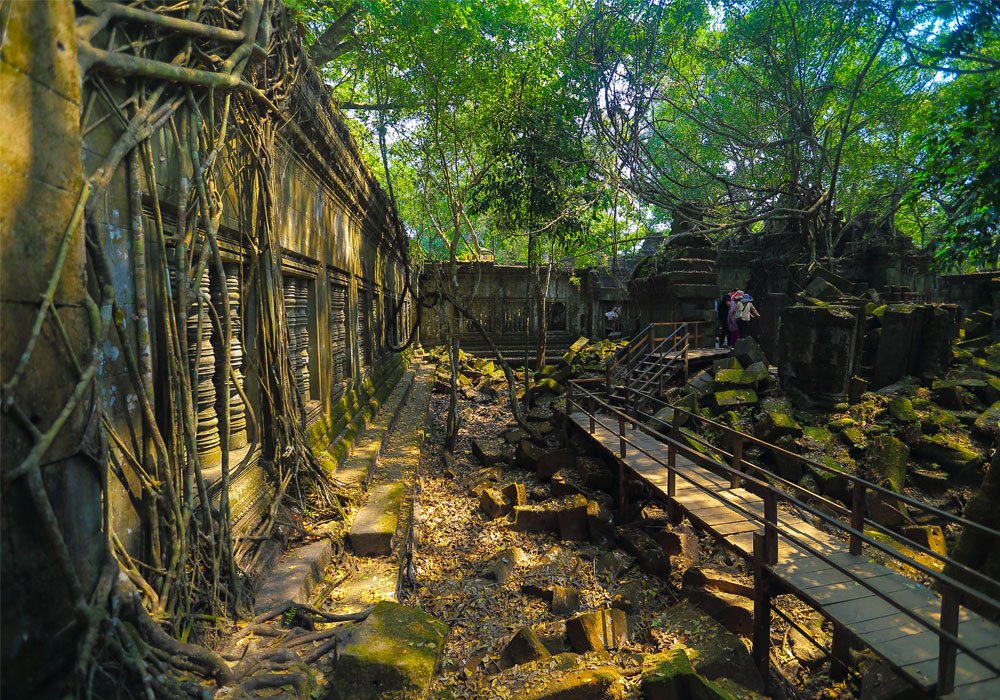
Beng Mealea is farther from Siem Reap than most temples on the standard Angkor circuit, so it is better treated as a half-day or full-day excursion rather than a quick stop.
5. Prei Monti: Discover the Early Angkorian World
If your interest is ancient history rather than famous monuments, Prei Monti deserves a place on your itinerary.
Prei Monti is a small group of three brick towers located in the Roluos area, approximately 2 kilometers south of Bakong. APSARA National Authority dates the site to the 9th century and identifies it as a possible part of the domain of the early Angkorian capital of Hariharalaya.
The site is much smaller than Angkor Wat, but its importance lies in what it reveals about the early development of Khmer architecture.
Recent APSARA research and conservation work has also highlighted distinctive features at Prei Monti, including a sandstone pool with inscriptions and carvings. The surrounding environment remains relatively quiet and offers a very different experience from the main Angkor monuments.
Why Visit Prei Monti?
- Early 9th-century Khmer heritage
- Small brick temple structures
- Very peaceful surroundings
- Connection with the early capital of Hariharalaya
- Interesting destination for history enthusiasts
Prei Monti is particularly suitable for repeat visitors who have already seen the major temples and want to explore lesser-known aspects of early Khmer civilization.
6. Bakong: The Birth of the Khmer Temple Mountain
Bakong is more substantial than the tiny hidden temples, but it is still frequently overshadowed by Angkor Wat, Bayon, and Ta Prohm.
Located in the Roluos area about 15 kilometers southeast of Siem Reap, Bakong is one of the most important early Khmer temples in the region.
APSARA National Authority identifies Bakong as the first fully developed pyramid-shaped temple mountain in Cambodia. It was consecrated in 881 during the reign of King Indravarman I and formed part of the ancient capital of Hariharalaya.
The complex is much larger than its central pyramid suggests. Its outer enclosure measures approximately 900 by 700 meters and contains the remains of numerous smaller structures.
The temple is particularly interesting for visitors who want to understand how the architectural concept of the Khmer temple mountain developed before the great monuments of later Angkor.
Why Visit Bakong?
- Important early Khmer architecture
- Historic connection to Hariharalaya
- Large pyramid-shaped central temple
- Ancient moats and enclosures
- Excellent introduction to early Angkorian architecture
Because Bakong, Preah Ko, Lolei, and Prei Monti are all in the Roluos region, they can be combined into a single cultural excursion.
7. Lolei and Preah Ko: The Ancient Roluos Temples
The Roluos group is one of the best places to explore Cambodia’s early Angkorian heritage away from the main tourist concentration.
The area includes important temples such as Lolei, Preah Ko, and Bakong. These monuments belong to an earlier stage of Khmer architectural development and provide important context for understanding how the Angkorian civilization evolved.
Lolei Temple
Lolei was constructed on an artificial island in the middle of the Indratataka reservoir. APSARA National Authority records its date as the 9th century and associates it with King Yasovarman I.
The temple’s inscriptions provide valuable historical information, including the date of its consecration. Its original setting within a large reservoir also demonstrates the importance of water management in early Khmer urban planning.
Preah Ko Temple
Preah Ko, meaning “Sacred Bull,” was dedicated by King Indravarman I in 880 to his ancestors. The temple is particularly notable for its brick towers and refined stucco decoration.
Together, Preah Ko and Lolei provide an opportunity to see an earlier architectural tradition before the sandstone monuments that dominate many visitors’ impressions of Angkor.
Why Explore the Roluos Group?
- Excellent introduction to early Angkorian history
- Ancient brick architecture
- Less crowded atmosphere
- Easy to combine several sites in one trip
- Important connection with Hariharalaya
8. Koh Ker: A Worthwhile Day Trip Beyond Siem Reap
Although Koh Ker is not in Siem Reap Province, it deserves a special mention for travelers staying in Siem Reap who want to explore one of Cambodia’s most remarkable ancient temple landscapes.
Koh Ker was a capital of the Khmer Empire during the 10th century. UNESCO describes it as the ancient city of Lingapura or Chok Gargyar and notes that it served as the Khmer capital from 921 to 944 CE.
The archaeological site contains numerous temples, sanctuaries, sculptures, inscriptions, and remains of ancient hydraulic infrastructure. Its most recognizable monument is the massive pyramid of Prasat Thom.
In 2023, UNESCO inscribed Koh Ker on the World Heritage List because of its historical, architectural, artistic, and cultural significance.
Koh Ker is substantially farther from Siem Reap than the other temples in this guide, so it should be planned as a dedicated day trip. It is particularly suitable for travelers who have several days available and want to explore beyond the standard Angkor itinerary.
Why Visit Koh Ker?
- Former Khmer imperial capital
- Unique 10th-century architectural style
- Large number of archaeological monuments
- Forest and rural setting
- UNESCO World Heritage status

Important: Do not confuse Koh Ker with a temple located inside the Angkor Archaeological Park. It is a separate archaeological site and requires additional travel planning.
How to Plan a Hidden Temple Day in Siem Reap
You do not need to visit all of these temples on one trip. The best approach is to group temples geographically and according to your interests.
Option 1: Easy Hidden-Temple Day
- Ta Nei
- Banteay Kdei
- Srah Srang
- Other nearby Angkor temples
This option works well for first-time visitors who want to add quieter locations without traveling far from the main Angkor circuit.
Option 2: Early Angkorian History
- Prei Monti
- Preah Ko
- Lolei
- Bakong
This route focuses on the Roluos area and the early development of Angkorian civilization.
Option 3: Adventure and Countryside
- Banteay Samre
- Beng Mealea
- Local villages and countryside
This is a better choice for travelers who want to spend more time outside the central Angkor zone.
Option 4: Extended Archaeological Adventure
- Beng Mealea
- Koh Ker
Allow a full day for this type of trip and arrange transportation in advance.
Best Time to Visit Hidden Temples in Siem Reap
The best time of day for temple exploration is generally early morning or late afternoon. Temperatures are usually more comfortable, the light can be attractive for photography, and popular sites may be less crowded.
The dry season, roughly from November through April, is often convenient for road travel and outdoor sightseeing. The wet season, from around May through October, can bring rain and muddy conditions, but the surrounding landscape can become exceptionally green.
For smaller temples such as Ta Nei and Prei Monti, the atmosphere itself is part of the experience. Visiting slowly rather than rushing from one monument to another can make these sites much more rewarding.
How to Explore Cambodia’s Temples Responsibly
Ancient temples are fragile heritage sites, and many remain active cultural or religious spaces. Visitors should follow the guidance of the APSARA National Authority and local authorities.
- Do not climb structures unless access is clearly permitted.
- Do not touch carvings unnecessarily.
- Do not remove stones or archaeological objects.
- Wear appropriate clothing at religious sites.
- Keep noise levels low.
- Do not leave rubbish behind.
- Ask permission before photographing people closely.
- Follow barriers and official visitor routes.
- Use local guides where appropriate.
- Respect local communities living around heritage sites.
APSARA National Authority’s visitor guidance emphasizes respecting worshippers and monks, wearing appropriate clothing, not touching or climbing monuments, taking rubbish with you, and behaving responsibly at Angkor.
What to Bring for a Hidden Temple Adventure
- Comfortable walking shoes
- Lightweight, modest clothing
- Hat and sunscreen
- Reusable drinking water
- Insect repellent
- Small backpack
- Phone or camera
- Cash for local services when needed
- Rain protection during the wet season
Some remote temple areas have fewer shops and services than central Siem Reap, so carry enough water and basic necessities before leaving town.
Frequently Asked Questions
What are the best hidden temples near Siem Reap?
Some excellent lesser-known choices include Ta Nei, Banteay Kdei, Banteay Samre, Prei Monti, and the temples of the Roluos area. Beng Mealea is another excellent option if you are willing to travel farther from central Siem Reap.
Is Ta Nei Temple worth visiting?
Yes, especially for travelers who enjoy quiet ruins, forest scenery, photography, and less crowded heritage sites. Its secluded setting makes it very different from the busiest Angkor temples.
Is Beng Mealea part of Angkor Wat?
Beng Mealea is an Angkorian-era temple but it is located outside the main Angkor Archaeological Park temple group. It is approximately 40 kilometers east of the main Angkor monuments and requires a separate journey from central Siem Reap.
Which hidden temples are closest to Siem Reap?
The Roluos temples are among the more convenient options outside the central Angkor area, while Ta Nei and Banteay Kdei are within the Angkor Archaeological Park. Exact travel time depends on traffic, route, weather, and the starting point.
Can I visit hidden temples without a guide?
Some sites can be explored independently, but a knowledgeable local guide can add considerable value by explaining architectural details, history, religious symbolism, and local context. For less-developed or more remote sites, professional or local guidance can also make the visit easier and safer.
How many days should I spend exploring temples around Siem Reap?
Three to four days provides a comfortable starting point for combining the major Angkor monuments with several lesser-known temples. Travelers with five or more days can add destinations such as Beng Mealea, Kbal Spean, or Koh Ker.
Is Koh Ker in Siem Reap?
No. Koh Ker is a separate archaeological site outside Siem Reap Province. However, it can be visited as a longer day trip from Siem Reap and is particularly worthwhile for travelers interested in Khmer history and archaeology.
Are hidden temples safe to visit?
Established visitor sites are generally managed for tourism, but conditions vary. Follow official access rules, stay on designated routes, pay attention to signs, and check current local conditions before visiting remote areas.
Sources & References
- APSARA National Authority – Official information on Angkor temples, conservation, visitor guidance, Ta Nei, Banteay Kdei, Bakong, Lolei, Prei Monti, and other archaeological sites.
- Tourism Cambodia – Official tourism information on Beng Mealea, Banteay Samre, Kbal Spean, and attractions in Siem Reap.
- UNESCO World Heritage Centre – Official information on Koh Ker: Archaeological Site of Ancient Lingapura or Chok Gargyar and its World Heritage status.
- Ministry of Culture and Fine Arts, Cambodia – Cultural heritage and conservation information relating to Cambodia’s archaeological monuments.
Temple access, conservation work, visitor routes, road conditions, and opening arrangements can change. Travelers should check current official information before visiting remote or recently restored sites.
Conclusion: Discover the Cambodia Beyond Angkor Wat
Angkor Wat is an essential part of any first visit to Siem Reap, but it is only one chapter of Cambodia’s extraordinary archaeological story.
At Ta Nei, you can walk through a quiet forest temple. At Banteay Kdei, you can explore a former Buddhist complex associated with education and community life. Banteay Samre reveals impressive 12th-century architecture, while Beng Mealea offers the atmosphere of a vast ruined sanctuary surrounded by nature.
The Roluos temples take you even further back into the development of the early Angkorian civilization, while Prei Monti offers a glimpse into a quieter and less-visited part of that history. For travelers with more time, Koh Ker provides an opportunity to explore the remains of a former Khmer capital and a UNESCO World Heritage site.
These lesser-known temples show that the real richness of Siem Reap is not limited to its most famous monuments. Slow down, travel beyond the standard circuit, and take time to discover the quieter places where Cambodia’s ancient history continues to live among forests, villages, and local communities.
Beyond Angkor Wat, a much larger world of Khmer heritage is waiting to be explored.
