




























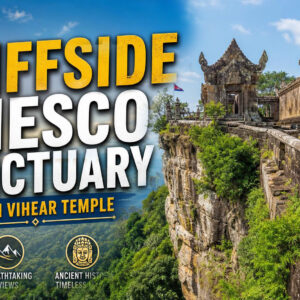






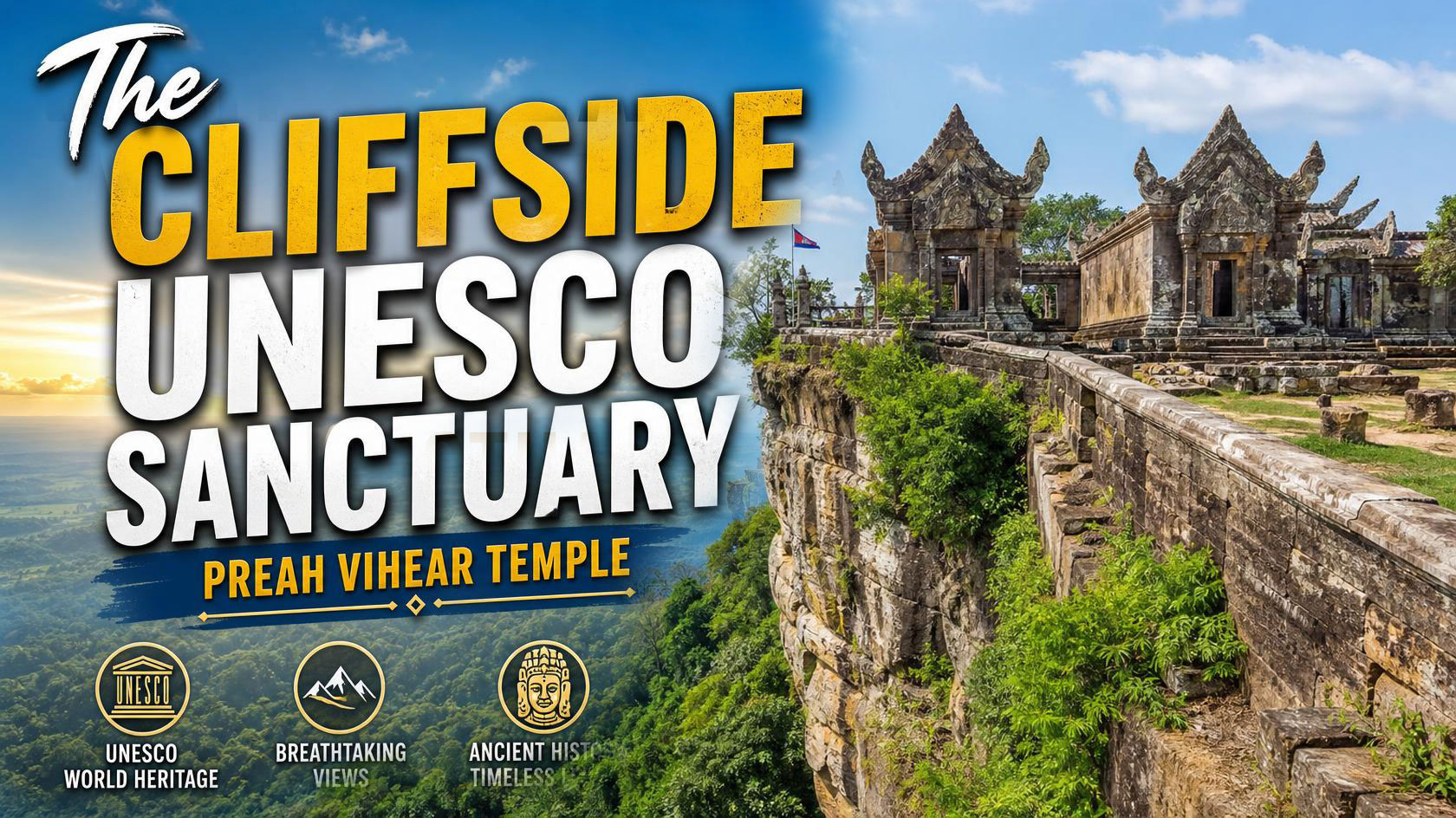

Perched dramatically on the Dangrek Mountains in northern Cambodia, Preah Vihear Temple is one of the most extraordinary ancient temples in Southeast Asia. Rather than standing on a flat plain like many famous Khmer monuments, the temple follows a natural mountain ridge and gradually rises toward a spectacular cliff-top sanctuary.
The journey through its long sequence of causeways, stairways, courtyards and carved stone pavilions reveals a different side of Khmer architecture. The temple was dedicated to the Hindu god Shiva and developed over several centuries before becoming one of Cambodia’s most important surviving examples of sacred mountain architecture.
Preah Vihear was inscribed on the UNESCO World Heritage List in 2008 under Criterion (i), recognizing it as an outstanding masterpiece of Khmer architecture. UNESCO describes the temple as an exceptional combination of architecture, carved ornamentation and its dramatic relationship with the surrounding landscape.
For travelers, however, Preah Vihear is more than an archaeological site. It is a mountain journey, a cultural experience and a place where architecture and landscape are inseparable.
Quick Summary: Preah Vihear Temple
| Feature | Details |
|---|---|
| Location | Choam Ksan District, Preah Vihear Province, northern Cambodia |
| Mountain | Dangrek Mountains |
| Elevation | About 547–625 meters depending on the reference point used |
| Religious tradition | Hinduism, dedicated to Shiva |
| Architectural axis | Approximately 800 meters |
| Main structures | Five principal gopuras connected by causeways and stairways |
| UNESCO inscription | 7 July 2008 |
| UNESCO criterion | Criterion (i) |
| Best for | History, architecture, photography, mountain scenery and cultural tourism |
Where Is Preah Vihear Temple?
Preah Vihear Temple is located in Choam Ksan District of Preah Vihear Province, in northern Cambodia, on the Dangrek mountain range. The Cambodian Ministry of Culture and Fine Arts identifies the temple site in Thommacheat Village, Sra Em Commune.
The temple occupies a high natural plateau overlooking the Cambodian plains. Its elevated position is one of the defining features of the site and helps explain why the ancient builders designed the sanctuary as a long processional route up the mountain.
From the lower landscape, the temple is difficult to understand as a single building. Instead, it is best experienced as a sequence of architectural spaces connected along the mountain.

Why Is Preah Vihear Temple a UNESCO World Heritage Site?
UNESCO inscribed the Temple of Preah Vihear on the World Heritage List in 2008. The site was recognized under Criterion (i), which concerns outstanding examples of human creative achievement.
UNESCO highlights three elements that make the site exceptional:
- The quality and originality of its Khmer architectural design.
- The sophisticated carved stone decoration.
- The way the temple’s architecture is integrated with the natural mountain landscape.
The temple complex covers a relatively compact World Heritage property, while a much larger surrounding buffer zone contributes to its protection. UNESCO’s current World Heritage listing records the property at approximately 154.7 hectares, with a buffer zone of about 2,642.5 hectares.
Unlike many archaeological monuments that were constructed on flat terrain, Preah Vihear uses the mountain itself as part of the sacred design. The natural slope becomes a monumental processional route.
The History of Preah Vihear Temple
The history of Preah Vihear extends across several centuries of the Khmer Empire. The National Authority for Preah Vihear states that construction began during the reign of King Yasovarman I in the late 9th or early 10th century and continued under later rulers, including King Suryavarman I and King Suryavarman II.
UNESCO dates the principal architectural development of the temple to the first half of the 11th century while noting that the site’s history reaches back to the 9th century.
This long development explains why visitors can see different architectural and decorative characteristics within the complex. The temple was not simply built as one project at one moment. It developed as a sacred landscape over generations.
A Temple Dedicated to Shiva
Preah Vihear was dedicated to Shiva, one of the principal deities of Hinduism. The National Authority for Preah Vihear associates the sanctuary with the manifestations Sikharesvara and Bhadresvara, reflecting the sacred relationship between the deity and the mountain setting.
The combination of mountain, elevation, sacred architecture and long ceremonial approach is therefore central to understanding the original religious purpose of the site.
Understanding the Architecture: Five Gopuras and an 800-Meter Axis
One of the most remarkable characteristics of Preah Vihear is its long north-south architectural axis. The National Authority for Preah Vihear describes the complex as extending for approximately 800 meters and containing five principal gopuras.
A gopura is a monumental entrance pavilion or gateway. At Preah Vihear, these architectural elements are connected by terraces, causeways, stairways and courtyards.
Instead of walking directly into one large temple building, visitors move progressively from one architectural space to another.
Gopura V
Gopura V is associated with the lower approach to the temple. The ancient route begins from the mountain side and leads pilgrims upward toward the sanctuary.
The long ascent helps create a gradual transition from the ordinary landscape into a sacred architectural environment.
The Ancient Stairway
The approach includes steep stairways and long stone pathways. Tourism Cambodia records sections of the historic northern stairway with large numbers of steps, reflecting the demanding nature of the original pilgrimage route.
Today, visitors should expect walking, uneven surfaces and significant changes in elevation. Comfortable footwear is strongly recommended.
The Naga Courtyard
One of the distinctive features along the approach is the Naga courtyard, where stone naga imagery forms part of the architectural composition.
Nagas, or serpent beings, are important figures in South and Southeast Asian religious traditions and appear frequently in Khmer architecture. At Preah Vihear, the naga forms part of the transition between different levels of the sacred complex.
Gopura IV
As visitors continue upward, the architectural spaces become increasingly elaborate. Gopura IV is one of the most visually impressive structures along the processional route and contains detailed stone carvings and architectural elements.
Take time to look closely at lintels, pediments, doorways and decorative stonework rather than simply walking through the gateway.
Gopura III and the Central Sanctuary
Higher sections of the complex contain larger architectural spaces traditionally associated with royal and religious functions. The upper sanctuary represents the culmination of the long journey through the temple.
The architectural sequence is important: the mountain slope, stairways, gateways and final sanctuary work together as one monumental composition.
The Famous Cliff and Mountain View
The dramatic landscape is one of the reasons Preah Vihear feels so different from Angkor Wat and other Cambodian temples.
The sanctuary stands at the edge of the Dangrek Mountains, providing broad views toward the Cambodian plains. The temple’s position was not accidental. UNESCO specifically recognizes the relationship between the architecture and the natural environment as part of the site’s Outstanding Universal Value.
For photographers, the combination of sandstone architecture, mountain vegetation and distant plains creates opportunities that change throughout the day.
Best Time for Photography
- Early morning: Cooler temperatures and softer light.
- Late afternoon: Warm light can emphasize sandstone textures.
- Cloudy weather: Can create atmospheric views across the mountains.
- Clear days: Offer broader views across the surrounding landscape.
Always follow current safety barriers and site instructions around cliff edges. The dramatic viewpoint is part of the experience, but the terrain can be hazardous.
Preah Vihear vs Angkor Wat: What Is Different?
| Feature | Preah Vihear | Angkor Wat |
|---|---|---|
| Setting | Mountain ridge and cliff | Flat plain surrounded by moat |
| Main character | Long processional mountain route | Large monumental temple complex |
| Religious origin | Hindu temple dedicated to Shiva | Originally dedicated to Vishnu |
| Landscape | Mountain and panoramic views | Moat, reservoirs and surrounding plains |
| Architecture | Five principal gopuras along an approximately 800-meter axis | Central quincunx of towers and extensive galleries |
| Travel experience | Remote mountain and heritage journey | Major archaeological destination with extensive visitor infrastructure |
These temples should not be viewed as competing versions of the same experience. Their architecture responds to very different landscapes and historical contexts.
How to Visit Preah Vihear Temple
For travelers approaching from within Cambodia, the usual journey involves traveling toward Sra Em and then continuing toward the mountain area of Preah Vihear.
Because access conditions can change according to conservation work, security arrangements and weather, visitors should confirm the current access situation with the National Authority for Preah Vihear or local authorities before making a dedicated trip.
Older tourism information may list historical opening times or access arrangements that do not reflect current conditions. This is particularly important in 2026 because the site is undergoing conservation and restoration following extensive damage reported after the 2025 armed clashes.
Important 2026 Travel Update: Conservation and Restoration
Travelers should be aware that Preah Vihear is currently an active conservation site.
A joint UNESCO-ICOMOS advisory mission conducted in March 2026 assessed the temple following damage sustained in 2025. UNESCO’s World Heritage documentation lists the 2026 mission report among the site’s official conservation documents.
In September 2026, the International Coordinating Committee for the Safeguarding and Development of Preah Vihear reported that experts had identified serious conservation needs, including drainage improvements and structural support in high-risk areas. The assessment documented 562 damaged locations within the temple complex.
This means visitors should not expect every part of the monument to look exactly as it did in older photographs. Some areas may be restricted, under assessment or undergoing conservation work.
For a responsible visit:
- Follow all current access restrictions.
- Do not enter cordoned-off areas.
- Do not touch damaged or unstable stone structures.
- Follow instructions from site authorities.
- Do not remove stones, carvings or archaeological material.
- Take photographs from designated safe areas.
- Respect ongoing restoration and conservation work.
How Long Should You Spend at Preah Vihear?
For most travelers, half a day to a full day is a practical amount of time for the temple itself, depending on transportation arrangements and current access conditions.
Half-Day Visit
- Travel to the mountain area.
- Explore the main architectural sequence.
- Spend time at the upper sanctuary and viewpoints.
- Return to Sra Em or continue your journey.
Full-Day Visit
- Start early.
- Explore the temple carefully rather than rushing through the gateways.
- Visit the viewpoints.
- Learn about the history and conservation of the site.
- Combine the visit with nearby attractions or community experiences where practical.
What to Bring
- Comfortable walking shoes
- Lightweight clothing
- Sun protection
- Hat or cap
- Reusable water bottle
- Camera or smartphone
- Power bank
- Small backpack
- Rain protection during the wet season
- Personal medication
Because the temple involves walking and elevation changes, visitors should avoid carrying unnecessarily heavy luggage.
Best Time to Visit Preah Vihear
Cambodia’s cooler and generally drier months from approximately November to February are often comfortable for outdoor exploration. March to May can be considerably hotter, making an early start particularly useful.
The rainy season from roughly June to October can produce greener landscapes and atmospheric mountain scenery, but heavy rainfall may affect roads and walking conditions.
| Period | What to Expect |
|---|---|
| November–February | Generally cooler and comfortable for walking |
| March–May | Hotter; early morning visits are preferable |
| June–October | Greener landscape, but higher chance of rain and slippery conditions |
Regardless of season, check the current situation before traveling because conservation work and access arrangements can change independently of the weather.
Responsible Tourism at a UNESCO Heritage Site
Preah Vihear is not simply an old building. It is protected cultural heritage with ongoing international conservation work.
Visitors can help protect it by following a few basic principles:
- Stay on designated paths.
- Do not climb fragile structures.
- Never touch carvings unnecessarily.
- Do not sit on delicate architectural elements.
- Keep the site clean.
- Do not leave graffiti or markings.
- Keep noise low in sacred areas.
- Respect other visitors and local worshippers.
- Follow instructions from heritage authorities.
- Support legitimate local tourism services.
Heritage Tip: The best souvenir from Preah Vihear is a photograph and a deeper understanding of Khmer history—not a piece of stone, pottery or architectural material taken from the site.
Nearby Places to Consider
Preah Vihear Province contains more than the famous cliff-top sanctuary. Travelers with additional time can explore other archaeological and natural attractions in the wider province.
Koh Ker
Koh Ker, an ancient Khmer capital, is another major archaeological destination in the region. It was inscribed separately on the UNESCO World Heritage List in 2023 and provides a very different architectural experience from Preah Vihear.
Preah Khan of Kampong Svay
Also known as Bakan, this extensive temple complex lies in Preah Vihear Province. Its large scale and connection with the reign of Jayavarman VII make it an interesting destination for travelers interested in Khmer archaeology.
Local Mountain and Community Attractions
The wider province also contains mountain landscapes, community tourism areas and natural attractions. Travelers who have several days can combine cultural heritage with rural landscapes instead of treating Preah Vihear as a quick stop.
Suggested Preah Vihear Itinerary
1-Day Trip
- Leave early for the Preah Vihear area.
- Travel up toward the temple access area.
- Spend several hours exploring the architectural sequence.
- Enjoy the mountain views from safe designated areas.
- Return in the afternoon.
2-Day Heritage Trip
- Day 1: Travel to Sra Em, explore the local area and prepare for the temple visit.
- Day 2: Visit Preah Vihear early, then continue to another archaeological or community attraction if current access conditions permit.
3-Day Northern Cambodia Heritage Journey
- Day 1: Travel toward Preah Vihear Province.
- Day 2: Visit Preah Vihear Temple and explore the surrounding area.
- Day 3: Continue to Koh Ker or another suitable heritage destination before returning toward Siem Reap or Phnom Penh.
Frequently Asked Questions
Why is Preah Vihear Temple famous?
Preah Vihear is famous for its exceptional Khmer architecture, its dramatic position on the Dangrek Mountains and its long sequence of sanctuaries, causeways and stairways extending for approximately 800 meters.
When did Preah Vihear become a UNESCO World Heritage Site?
Preah Vihear Temple was inscribed on the UNESCO World Heritage List on 7 July 2008 during the 32nd session of the World Heritage Committee in Quebec City, Canada.
Who built Preah Vihear Temple?
The temple developed over several reigns rather than being the work of a single king. Historical sources identify King Yasovarman I, King Suryavarman I and King Suryavarman II among the rulers associated with its development.
Which god was Preah Vihear Temple dedicated to?
The temple was dedicated to Shiva, a major Hindu deity. The National Authority for Preah Vihear associates the sanctuary with the mountain-related forms Sikharesvara and Bhadresvara.
How long is Preah Vihear Temple?
The temple complex extends for approximately 800 meters along its main architectural axis, with five principal gopuras connected by causeways, stairways and courtyards.
Is Preah Vihear Temple difficult to visit?
The visit involves walking, stairs and changes in elevation, so comfortable footwear and reasonable physical mobility are helpful. Current access may also be affected by conservation work, so visitors should check conditions before traveling.
Can I visit Preah Vihear Temple in 2026?
Access conditions should be confirmed before travel. The temple is undergoing conservation and restoration following extensive damage documented in 2026, and some areas may have restrictions or ongoing works.
Is Preah Vihear Temple near Angkor Wat?
It is not a short local excursion from Angkor Wat. Preah Vihear is in Preah Vihear Province in northern Cambodia, while Angkor is in Siem Reap Province. Travelers should plan it as a separate journey.
Can I combine Preah Vihear and Koh Ker?
Yes. Both are major archaeological destinations in northern Cambodia, and they can be combined in a multi-day itinerary when road conditions, opening arrangements and available time allow.
Sources & References
- UNESCO World Heritage Centre – Temple of Preah Vihear
- UNESCO World Heritage Centre – Preah Vihear conservation and advisory mission documentation
- Cambodia Ministry of Culture and Fine Arts – Temple of Preah Vihear
- National Authority for Preah Vihear – Temple history and archaeological information
- Tourism Cambodia – Preah Vihear Province and Temple information
- International Coordinating Committee for the Safeguarding and Development of Preah Vihear – Conservation information
Conclusion
Preah Vihear Temple is one of Cambodia’s most remarkable ancient monuments because its architecture cannot be separated from the mountain on which it stands. The long ascent through five principal gopuras, stone causeways and sacred courtyards creates an experience very different from visiting a conventional temple complex.
Its UNESCO status recognizes not only the quality of its carvings and architecture but also the extraordinary relationship between the ancient Khmer builders and the natural landscape.
For travelers planning a visit in 2026, however, the temple should also be approached as a living conservation site. Extensive damage documented after the 2025 conflict has made protection, assessment and restoration an important part of its current story. Visitors can contribute by respecting restrictions, following heritage rules and treating the monument with care.
Planning a Cambodia heritage journey? Add Preah Vihear to your northern Cambodia itinerary for a unique combination of ancient Khmer architecture, mountain scenery, sacred history and one of the country’s most dramatic UNESCO World Heritage landscapes.
