


































Every year, Cambodia enters a special period when families return to their hometowns, pagodas become busy with visitors, and people gather to remember deceased relatives and ancestors. This important tradition is known as Pchum Ben.
For Cambodian people, Pchum Ben is much more than a public holiday. It is a deeply meaningful religious and family occasion connected with Buddhism, remembrance, generosity, and respect for previous generations.
For travelers, Pchum Ben offers a unique opportunity to see an important part of Cambodian life beyond temples and tourist attractions. Visitors can observe families visiting pagodas, preparing food, making offerings, and participating in ceremonies. However, because these are genuine religious and family occasions, travelers should approach them with sensitivity and respect.
What Is Pchum Ben?
Pchum Ben is one of Cambodia’s most important traditional and religious festivals. It is commonly associated with remembering deceased family members and ancestors and making offerings at Buddhist pagodas.
The name is often translated into English as Ancestors’ Day or the Ancestor Festival. The festival is closely connected with Cambodian Theravada Buddhist practice, while also reflecting older traditions concerning family, ancestors, and the relationship between the living and the dead.
During the Pchum Ben period, Cambodian families visit pagodas, bring food and other offerings, listen to Buddhist chanting and teachings, and pray or make merit for deceased relatives.
The Cambodian Ministry of Culture and Fine Arts recognizes Pchum Ben and related rituals as part of Cambodia’s living cultural traditions. The ministry describes social practices, rituals, and festive events as important forms of intangible cultural heritage transmitted between generations.
Why Is Pchum Ben Important to Cambodians?
At the heart of Pchum Ben is the relationship between generations.
Cambodian families use this period to remember parents, grandparents, relatives, and ancestors who have passed away. For many people, returning to their family’s home province is an important part of the festival.
It is also a time for families to reconnect. Cambodians who live in Phnom Penh or other cities may travel back to their hometowns, while people working far from home may make special efforts to return.
As a result, Pchum Ben combines several important aspects of Cambodian life:
- Remembering ancestors and deceased relatives
- Making merit through Buddhist practices
- Giving food and offerings
- Spending time with family
- Returning to one’s hometown
- Maintaining religious and cultural traditions
When Is Pchum Ben Celebrated?
Pchum Ben follows the Cambodian lunar calendar, so its dates change each year in the Gregorian calendar.
The observance traditionally extends over a period of 15 days. The final day, known as Pchum Ben Day, is the best-known and most important day of the period.
The exact Gregorian dates should therefore be checked for the specific year when planning a trip to Cambodia.
The period is also commonly associated with Kan Ben, a series of days during which families take turns bringing offerings to their local pagoda.
What Is Kan Ben?
Kan Ben refers to the days leading up to the main Pchum Ben observance. Families or community groups may take responsibility for bringing food and offerings to the pagoda on particular days.
This creates a rhythm of repeated community activity rather than making Pchum Ben a single-day event.
People may prepare food at home, travel to the pagoda early in the morning, offer food to monks, listen to chanting, and participate in merit-making activities.
For travelers who visit Cambodia during this period, Kan Ben can sometimes provide an even more intimate view of local religious life because activities take place repeatedly across several days.
What Happens at a Cambodian Pagoda During Pchum Ben?
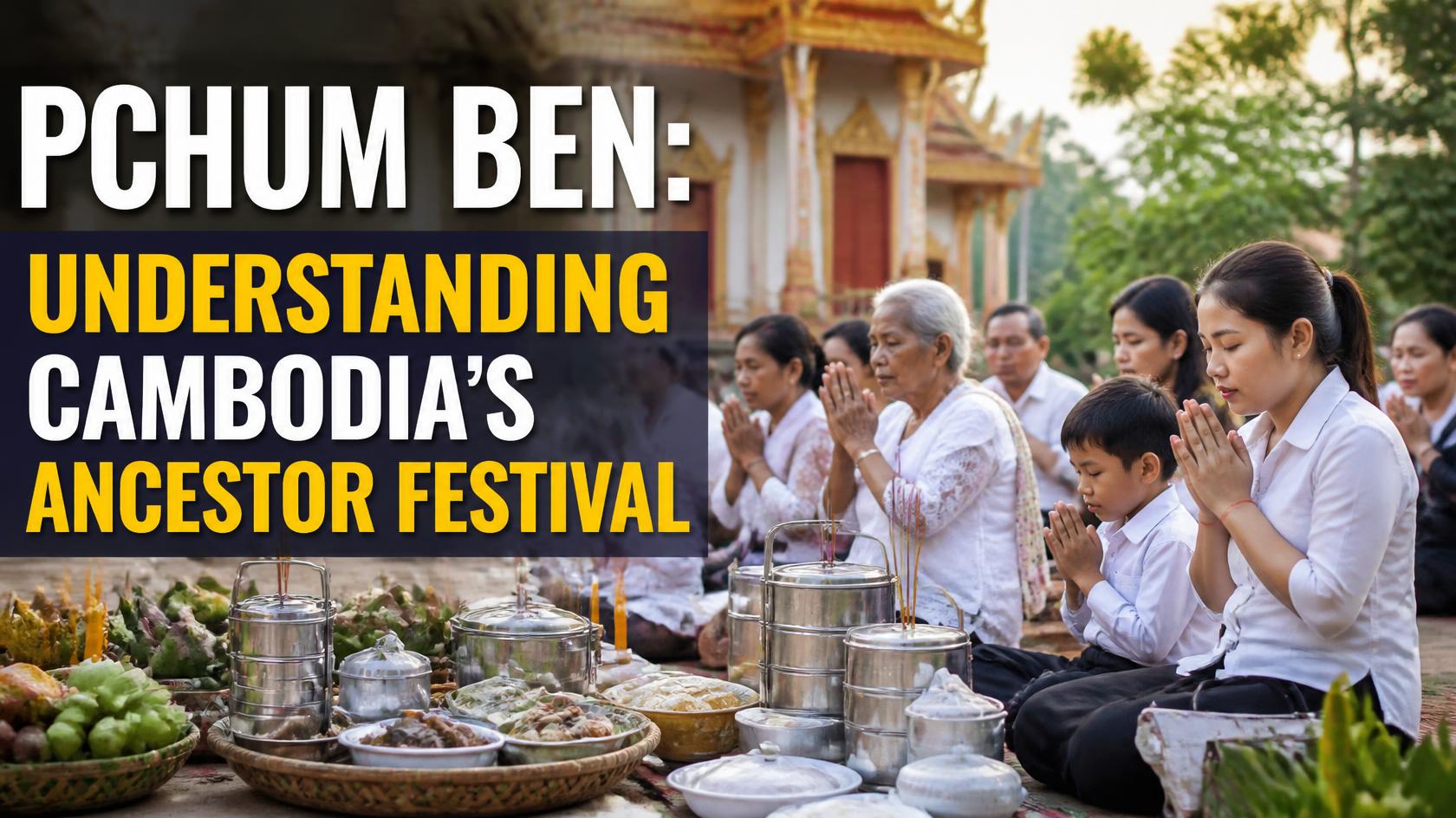
Pagodas can become especially active during Pchum Ben. Families arrive carrying trays, containers, baskets, or other offerings prepared at home.
Common activities include:
- Bringing cooked food to the pagoda
- Offering food to Buddhist monks
- Listening to Buddhist chanting
- Making offerings and donations
- Praying or dedicating merit to deceased relatives
- Gathering with extended family members
- Participating in ceremonies organized by the pagoda
In some communities, pagodas can become crowded, particularly on important days. The atmosphere may combine religious seriousness with the social energy of families meeting one another.
Why Do Cambodian People Bring Food?
Food is one of the most visible parts of Pchum Ben.
Families prepare meals and bring them to the pagoda as offerings. Food may be offered to monks, with the merit from the religious act dedicated to deceased family members.
The food also reflects the importance of generosity in Cambodian Buddhist practice. Preparing and giving food requires effort, time, and resources, making the act both practical and symbolic.
For Cambodian families, the preparation of food can itself become a family activity. Different generations may help cook, prepare ingredients, pack food, and travel together to the pagoda.
What Is the Connection Between Pchum Ben and Ancestors?
Pchum Ben is strongly associated with the remembrance of ancestors and deceased relatives.
Cambodian religious traditions contain ideas about the relationship between the living, the dead, merit, and offerings. During Pchum Ben, families perform religious acts with the intention of dedicating merit to deceased loved ones.
It is important to understand that explanations of Pchum Ben can vary among Cambodian families and communities. Some people describe the festival primarily through Buddhist teachings, while others emphasize traditional beliefs about ancestral spirits and the dead.
This combination of Buddhist practice and older Cambodian spiritual traditions is part of what makes Pchum Ben an important expression of Cambodian cultural identity.
Why Do People Return to Their Hometowns?
Pchum Ben is one of the major occasions when Cambodians travel back to their home provinces.
For families living in Phnom Penh or working in other cities, the festival can be an important opportunity to return home, visit parents and relatives, clean or prepare family spaces, and attend the local pagoda.
This annual movement also highlights the importance of provincial and village connections in Cambodian society.
A traveler may therefore notice heavier traffic on major roads and increased activity at transport terminals around the festival period.
Pchum Ben and Cambodian Family Life
Family is at the center of Pchum Ben.
Children may accompany their parents to the pagoda. Adults may organize food and offerings, while older family members may explain the significance of particular ceremonies and traditions.
In this way, Pchum Ben helps transmit cultural knowledge from one generation to the next.
The festival is not only about remembering people who have died. It also reinforces relationships among those who are still living.
Relatives who rarely meet during the year may gather together, share meals, talk about family history, and visit the pagoda as a group.
Pchum Ben in Modern Cambodia
Although Cambodia is rapidly changing, Pchum Ben remains an important part of contemporary Cambodian life.
People now use smartphones and social media to stay connected, travel by modern transportation, and live increasingly urban lifestyles. Yet many still return to their hometowns and participate in Pchum Ben traditions.
The Ministry of Culture and Fine Arts continues to describe Cambodian rituals and festive events as living intangible cultural heritage that communities transmit and recreate over generations.
Recent official cultural activities also show that Pchum Ben remains part of public and community life. For example, the Ministry of Culture and Fine Arts reported a Krong Peali and offering ceremony at the Tuol Sleng Genocide Museum on October 4, 2026, connected with Kan Ben and Pchum Ben activities.
Pchum Ben Is More Than a Religious Festival
It is tempting for visitors to describe Pchum Ben simply as a Buddhist festival. While Buddhism is central to its contemporary practice, the meaning of Pchum Ben is broader.
It brings together:
- Religion through Buddhist ceremonies and merit-making
- Family through reunions and remembrance
- Food through traditional offerings and shared meals
- Community through collective activities at pagodas
- Memory through honoring deceased relatives
- Identity through the continuation of Cambodian traditions
This is why Pchum Ben remains meaningful even as Cambodian lifestyles continue to modernize.
Can Tourists Experience Pchum Ben?
Yes. Travelers can encounter Pchum Ben activities at pagodas throughout Cambodia, especially in towns and villages where local communities gather for religious ceremonies.
However, Pchum Ben should not be treated as a staged tourist event. It is a genuine religious and family observance.
The best approach is to observe quietly, follow local customs, and avoid interfering with ceremonies.
If you are staying in Cambodia during Pchum Ben, consider asking your hotel, guesthouse, local guide, or Cambodian friends whether there is a nearby pagoda where visitors may respectfully observe public activities.
How Travelers Should Behave at Pchum Ben
A few simple rules can help visitors show respect.
Dress Modestly
Wear clothing that covers the shoulders and knees when visiting a pagoda. Avoid beachwear or revealing clothing in religious spaces.
Ask Before Taking Photos
Always be sensitive when photographing monks, worshippers, elderly people, children, or ceremonies. Ask permission when appropriate and avoid interrupting religious activities.
Keep a Respectful Distance
Do not stand directly in front of people who are praying or making offerings simply to get a photograph. Give families enough space to conduct their religious activities.
Follow Pagoda Rules
Remove your shoes where required and follow signs or instructions from monks and temple staff.
Do Not Treat Offerings as Decorations
Food, flowers, candles, incense, and other items may have religious significance. Do not touch or move offerings unless invited to do so.
Be Quiet During Ceremonies
Keep conversations quiet, silence your phone when appropriate, and avoid disruptive behavior.
What Might Travelers See During Pchum Ben?
Depending on the community and the day, visitors may see:
- Families arriving at pagodas early in the morning
- People carrying trays of prepared food
- Monks chanting inside the pagoda
- Families making offerings
- People lighting incense or candles
- Relatives sitting together around the pagoda grounds
- Traditional foods being prepared and shared
- Busy local roads as people travel to their hometowns
These everyday scenes can offer travelers a deeper understanding of Cambodia than a conventional sightseeing tour alone.
Pchum Ben and Cambodian Food
Food plays an important role in the festival. Families may prepare a variety of Cambodian dishes to bring to the pagoda and share with relatives.
The exact foods vary by household and region, but rice, soups, curries, vegetables, desserts, fruit, and other prepared dishes may form part of the offerings.
In many Cambodian families, preparing food for Pchum Ben is itself an important tradition. Recipes and cooking practices can be passed between generations, connecting food with family memory.
Is Pchum Ben a Sad Festival?
Pchum Ben has a serious spiritual dimension because it involves remembering people who have died. However, it is not simply a sad occasion.
For many Cambodian families, it is also a time of reunion, generosity, religious devotion, and community connection.
People may remember deceased relatives while simultaneously enjoying time with living family members. The atmosphere can therefore include both solemn religious moments and warm social gatherings.
Pchum Ben and Other Cambodian Festivals
Pchum Ben is one part of Cambodia’s annual cycle of cultural and religious celebrations.
- Khmer New Year — A major traditional celebration marking the beginning of the Cambodian New Year.
- Visak Bochea — A major Buddhist observance associated with important events in the life of the Buddha.
- Royal Ploughing Ceremony — A traditional royal ceremony connected with agriculture and the farming cycle.
- Water Festival — A major cultural celebration associated with the changing flow of the Tonle Sap River and traditional boat racing.
Among these celebrations, Pchum Ben is particularly associated with family remembrance, ancestors, Buddhist merit-making, and visits to pagodas.
Practical Travel Tips During Pchum Ben
If you plan to travel in Cambodia during Pchum Ben, keep several practical considerations in mind.
- Expect increased domestic travel: Roads and transport services can become busier as people return to their home provinces.
- Book transportation early: This is especially useful if traveling between Phnom Penh and the provinces.
- Allow extra travel time: Traffic can be heavier than usual.
- Check opening arrangements: Some businesses and services may operate on different schedules during public holidays.
- Respect local religious activities: Tourist attractions may be quieter while pagodas and family gatherings are particularly busy.
- Consider traveling outside the major tourist centers: Provincial communities can offer a more direct view of everyday Pchum Ben traditions.
Frequently Asked Questions
What is Pchum Ben in Cambodia?
Pchum Ben is an important Cambodian religious and cultural festival associated with remembering deceased relatives and ancestors, making merit, giving offerings, and visiting Buddhist pagodas.
How long does Pchum Ben last?
The traditional observance lasts for 15 days, culminating in the main Pchum Ben Day. The exact dates change each year because the festival follows the Cambodian lunar calendar.
What is Kan Ben?
Kan Ben refers to the series of days leading up to the main Pchum Ben observance, during which families or community groups take turns bringing offerings to pagodas.
Why do Cambodians visit pagodas during Pchum Ben?
Families visit pagodas to make merit, offer food, participate in Buddhist ceremonies, and dedicate merit to deceased relatives and ancestors.
Can tourists visit pagodas during Pchum Ben?
Yes, visitors can generally observe public activities at many pagodas, but they should behave respectfully, dress modestly, and avoid disturbing worshippers or ceremonies.
What should I wear when visiting a pagoda during Pchum Ben?
Wear modest clothing covering the shoulders and knees. Comfortable but respectful clothing is appropriate, especially when entering religious buildings.
Is Pchum Ben a Buddhist festival?
Pchum Ben is deeply connected with Theravada Buddhist practice, particularly merit-making and offerings. It also incorporates Cambodian family traditions and beliefs concerning ancestors and the dead.
What food is offered during Pchum Ben?
Families may bring rice, prepared Cambodian dishes, soups, curries, vegetables, fruit, desserts, and other foods. The exact offerings vary between families and communities.
Is Pchum Ben a good time to visit Cambodia?
It can be a fascinating time for travelers interested in Cambodian culture because visitors may observe an important living tradition. However, travelers should expect increased domestic travel and possible changes to business and transportation schedules.
Sources & References
- Ministry of Culture and Fine Arts of Cambodia — Intangible Cultural Heritage
- Ministry of Culture and Fine Arts of Cambodia — Krong Peali and Offering Ceremony Held at Tuol Sleng Museum, October 2026
- Ministry of Tourism of Cambodia — Traveler etiquette and cultural guidance
- National Institute of Statistics of Cambodia — Population and religious statistics
Conclusion: Experiencing Pchum Ben Respectfully
Pchum Ben offers a powerful insight into Cambodian family life, Buddhism, and the importance of remembering previous generations. For Cambodian people, it is a time to return home, visit the pagoda, make offerings, honor deceased relatives, and strengthen relationships with family and community.
For travelers, the most valuable way to experience Pchum Ben is not simply to watch the ceremonies, but to understand why they matter. Approach pagodas with humility, respect people’s privacy, and remember that the festival is a living tradition rather than a performance created for visitors.
By taking the time to understand Pchum Ben, travelers gain a deeper appreciation of the connections between family, Buddhism, memory, generosity, and Cambodian identity.
Planning a cultural journey through Cambodia? Explore more GoToKH guides to Cambodian festivals, religion, traditions, history, food, and everyday life.
