






















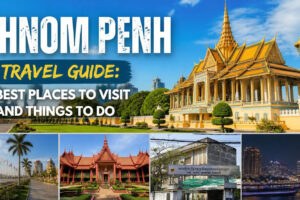













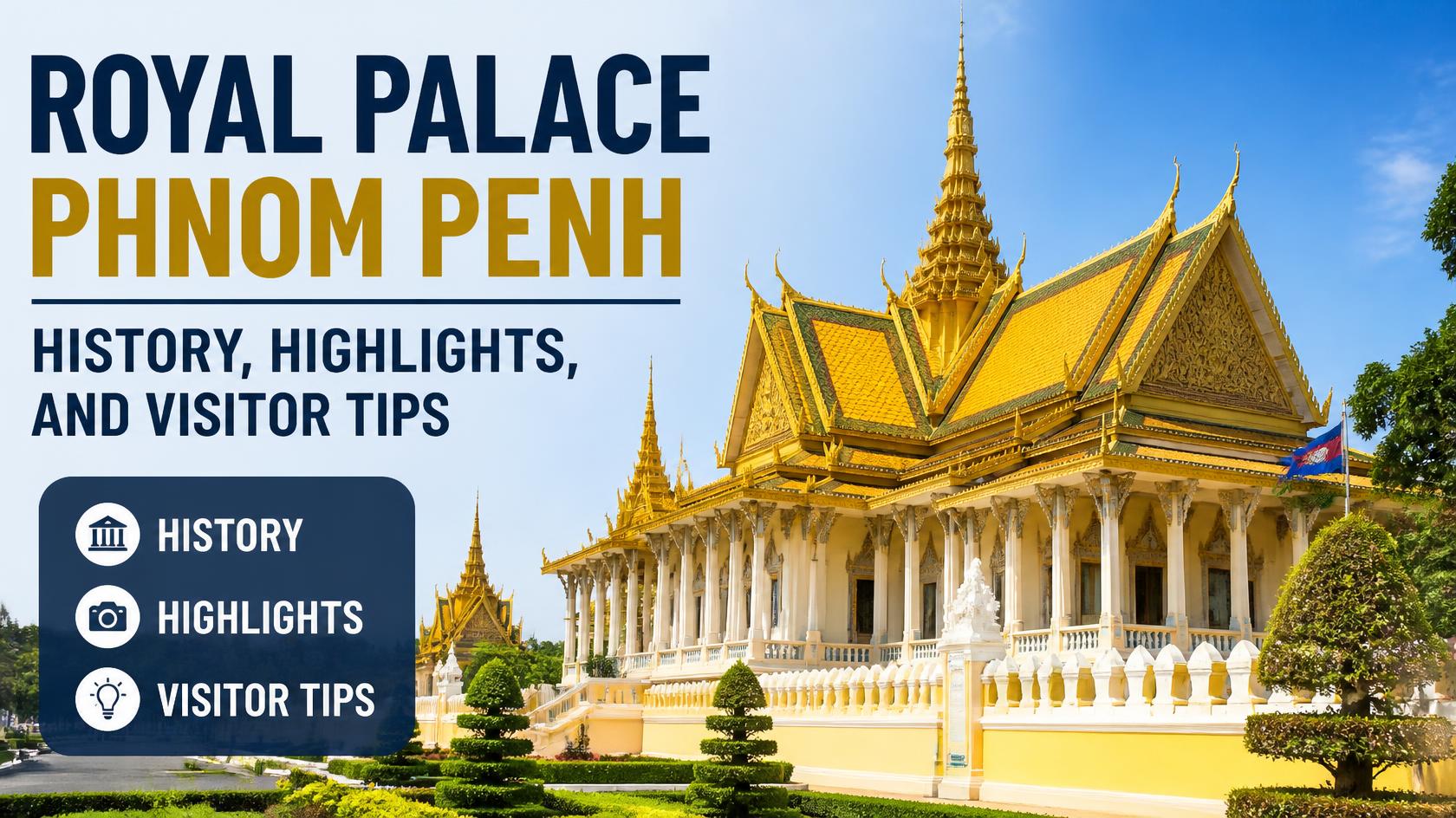

The Royal Palace in Phnom Penh is one of Cambodia’s most beautiful and historically important landmarks. With its golden roofs, elegant Khmer architecture, landscaped courtyards, and sacred Buddhist treasures, the palace offers visitors a fascinating introduction to Cambodia’s royal heritage and cultural traditions.
Located close to the riverfront in Cambodia’s capital, the Royal Palace has served as the principal royal residence since the nineteenth century. Its magnificent buildings reflect the country’s monarchical history, Buddhist faith, traditional craftsmanship, and the development of Phnom Penh as a modern capital.
The palace complex is best known for its spectacular Throne Hall and the nearby Silver Pagoda, also called Wat Preah Keo Morakot. Visitors can admire royal ceremonial architecture, carefully maintained gardens, remarkable religious sculptures, and murals illustrating stories from Cambodian literature.
Unlike an ordinary historical museum, however, the Royal Palace remains an active royal residence. Certain buildings are open to visitors, while the King’s private residential areas are strictly off-limits. Access may also change during official royal events.
This complete Royal Palace Phnom Penh travel guide explores the history of the palace, its most important buildings, cultural meaning, ticket prices, opening hours, dress code, photography rules, and practical advice for first-time visitors.
Royal Palace Phnom Penh at a Glance
| Visitor Information | Details |
|---|---|
| Official Name | Royal Palace of Cambodia |
| Khmer Name | ព្រះបរមរាជវាំង |
| Location | Samdech Sothearos Boulevard, Phnom Penh, Cambodia |
| Construction Began | 1866, during the reign of King Norodom |
| Main Architectural Style | Traditional Khmer royal architecture with selected European influences |
| Famous Highlights | Throne Hall, Silver Pagoda, Chan Chhaya Pavilion, Reamker murals |
| Current Function | Active royal residence and ceremonial complex |
| Typical Visiting Hours | 8:00–11:00 AM and 2:00–5:00 PM, subject to confirmation |
| Indicative Foreign Adult Ticket | Approximately US$10 |
| Recommended Visit Duration | 1.5–2 hours |
| Dress Code | Shoulders and knees covered |
Travel information reviewed in October 2026. Opening times and ticket prices are indicative, not guaranteed official rates. Royal ceremonies, maintenance, and security arrangements may affect admission without advance notice.
1. The History of the Royal Palace in Phnom Penh
To understand the Royal Palace, it helps to know how Phnom Penh became Cambodia’s royal capital.
For centuries, Cambodia’s royal courts were based at different locations following the decline of Angkor as the principal political center. These included places such as Longvek and Oudong.
During the nineteenth century, Cambodia faced significant regional political pressures while also entering the period of French protection established by the 1863 treaty.
King Norodom and the Move from Oudong
In the 1860s, King Norodom transferred the royal court from Oudong to Phnom Penh.
Construction of a new palace complex at its present site began in 1866, helping establish the city as the center of royal and political life.
The palace was built near the city’s important river junction, where the Tonle Sap, Mekong, and Bassac waterways form the wider Chaktomuk landscape.
This setting connected royal architecture with the transportation routes and commercial activity that helped Phnom Penh develop.
The palace complex gradually expanded with ceremonial halls, residences, religious buildings, gardens, and surrounding walls.
Rebuilding and Architectural Development
Not every building visitors see today dates from the original construction.
Successive Cambodian monarchs renovated, expanded, and rebuilt important structures during the late nineteenth and twentieth centuries.
The present Throne Hall was inaugurated in 1919, replacing an earlier ceremonial building.
The Silver Pagoda also underwent major reconstruction during the twentieth century while preserving its role as an important royal Buddhist sanctuary.
These changes explain why the Royal Palace combines traditional Khmer design with architectural features from different historical periods.
The Royal Palace During the Twentieth Century
Cambodia experienced major political transformations during the twentieth century, including independence from France in 1953, subsequent conflict, and the devastating Khmer Rouge period from 1975 to 1979.
The monarchy and the palace’s role were disrupted during the years of political upheaval.
Some palace buildings and religious treasures survived, although the country’s wider cultural and religious heritage suffered enormous losses.
Following the restoration of the Cambodian monarchy in 1993, the Royal Palace resumed its role as a central symbol of the constitutional monarchy.
The Royal Palace Today
Today, the palace remains the official residence of King Norodom Sihamoni, who became King of Cambodia in 2004.
It continues to serve as a setting for ceremonial occasions, royal audiences, and events associated with the Cambodian monarchy.
For travelers, the public areas provide insight into the country’s royal traditions, although the private residential compound, including the Khemarin Palace, is not open to ordinary visitors.
2. Throne Hall – The Most Impressive Building at the Royal Palace
The magnificent Throne Hall, known in Khmer as Preah Tineang Tevea Vinichhay (ព្រះទីនាំងទេវាវិនិច្ឆ័យ), is the architectural centerpiece of the Royal Palace complex.
Its elegant multi-tiered roofs, golden decorative elements, and towering central spire make it one of Phnom Penh’s most recognizable buildings.
What Makes the Throne Hall Special?
The present structure was completed in the early twentieth century and inaugurated in 1919.
Its approximately 59-meter central spire is a striking example of Khmer ceremonial architecture.
The top of the spire features a four-faced Brahma motif, reflecting religious and artistic influences inherited from Cambodia’s earlier history.
From the outside, the building’s symmetrical design, decorative rooflines, and grand entrance express the ceremonial importance of the Cambodian monarchy.
What Is the Throne Hall Used For?
The hall serves important royal functions, including coronations, formal audiences, and certain state or ceremonial occasions.
Its role is fundamentally different from an ordinary museum gallery: it remains part of Cambodia’s living royal institutions.
Visitor access to the interior can be restricted. During normal public visits, travelers should expect to admire the building from authorized viewing areas rather than assume they can walk freely through it.
Photography Tips
The Throne Hall is particularly photogenic from the gardens and central courtyard.
Morning light can illuminate the roof details while producing softer conditions for walking around the grounds.
Photography is commonly permitted in designated outdoor areas, but photographing the interior of the Throne Hall is prohibited.
Follow posted instructions and avoid crossing barriers to obtain a better angle.
3. Silver Pagoda – A Treasure of Cambodian Buddhism
The Silver Pagoda, formally known as Wat Preah Keo Morakot (វត្តព្រះកែវមរកត), is among Cambodia’s most significant royal religious buildings.
Located within a separate enclosure of the Royal Palace complex, it contains valuable Buddhist images, ceremonial objects, and examples of traditional Khmer craftsmanship.
Although widely called the Silver Pagoda, its name is not related to a silver exterior.
The English nickname comes from its extraordinary floor.
Why Is It Called the Silver Pagoda?
The interior floor contains more than 5,000 silver tiles, with many guides reporting approximately 5,329.
Most of the floor is covered with carpets or protective material to preserve the historic surface, so visitors should not expect to see thousands of shining tiles exposed.
Sections may be visible near designated areas, depending on current conservation and visitor arrangements.
The Emerald Buddha
One of the sanctuary’s most important religious objects is a revered image commonly known as the Emerald Buddha.
Despite the name, the figure is generally described as being made of crystal rather than emerald gemstone.
It occupies an important place in the artistic and religious identity of the pagoda.
The Golden Buddha
Another famous treasure is a life-size golden Buddha statue, traditionally described as weighing approximately 90 kilograms and decorated with numerous diamonds.
The statue demonstrates the exceptional craftsmanship and ceremonial wealth historically associated with Cambodia’s royal religious collections.
The exact count and description of precious stones differ slightly among published accounts, so such numbers should be treated as historical descriptions rather than independently verified contemporary inventories.
Is the Silver Pagoda Still a Religious Site?
Yes. The sanctuary remains important to Cambodia’s Buddhist and royal traditions.
Visitors should behave respectfully, even when exploring the area primarily for its architecture or artwork.
Photography is not permitted inside the Silver Pagoda. Remove your shoes wherever required and follow instructions concerning bags, restricted areas, and religious objects.
4. The Reamker Murals – Cambodia’s Epic Story in Art
One of the most culturally rewarding features of the Silver Pagoda enclosure is its remarkable collection of Reamker murals.
The Reamker is the Cambodian adaptation of the Ramayana narrative, a major literary and artistic tradition that has influenced Khmer performing arts, literature, and religious imagery.
The paintings stretch across the walls of the cloister surrounding the pagoda compound.
When Were the Murals Painted?
The murals were created in the early twentieth century, commonly dated to 1903–1904.
They portray episodes from the Reamker using detailed scenes of royal figures, armies, mythical beings, forests, and elaborate architecture.
Some portions have been restored, while others show deterioration caused by age, weather, and environmental conditions.
What Stories Do They Show?
The Reamker includes figures such as Preah Ream, Neang Seda, Preah Leak, Hanuman, and the opposing forces of the epic narrative.
Its themes include loyalty, duty, conflict, relationships, and moral choices.
The story is also represented in Cambodian classical dance and other traditional art forms.
Visitors who are interested in Khmer literature and the Royal Ballet will find these murals particularly meaningful.
Visitor Tip
Allow time to walk slowly through the accessible gallery rather than treating it as a quick stop between the buildings.
Do not touch painted surfaces or lean against the walls. Conservation work may restrict access to individual sections.
5. Chan Chhaya Pavilion – The Moonlight Pavilion
The Chan Chhaya Pavilion, also spelled Chanchhaya Pavilion, is one of the Royal Palace’s most elegant architectural landmarks.
Often called the Moonlight Pavilion, it is located toward the palace’s eastern frontage along Sothearos Boulevard.
The building is closely associated with royal ceremonial life and Khmer performing arts.
Royal Dance and Ceremonies
Historically, the pavilion served as a venue or setting for performances by the royal dancers and for occasions when the monarch addressed or appeared before assembled crowds.
It reflects the historical relationship between the Cambodian court and classical dance.
Today, the Royal Ballet of Cambodia remains an important cultural tradition recognized by UNESCO as intangible cultural heritage.
Visitors exploring the palace can admire the pavilion’s traditional roof structure and ornate decoration from permitted viewpoints.
Photography tip: The pavilion is also a recognizable landmark from the public street outside the Royal Palace, making it an interesting subject even when visiting hours are over.
6. Napoleon III Pavilion – A European Architectural Influence
Among the Royal Palace’s traditional Khmer buildings stands an unusual structure commonly known as the Napoleon III Pavilion.
Its iron construction and European architectural appearance distinguish it from the surrounding ceremonial halls and pagodas.
The pavilion is traditionally associated with a nineteenth-century gift from France to King Norodom.
Historical descriptions of the building’s original intended use and relationship to Emperor Napoleon III differ, so visitors should be cautious about treating every popular story concerning its provenance as fully established fact.
Its presence nevertheless reflects the political and cultural connections between the Cambodian monarchy and France during the protectorate era.
The pavilion makes an interesting contrast with the classical Khmer architecture of the Throne Hall and nearby structures.
Visitor tip: Access to the pavilion or its immediate surroundings can vary. Admire it from authorized visitor areas and follow barriers or conservation notices.
7. Royal Gardens, Stupas, and Other Architectural Highlights
Beyond the main buildings, the Royal Palace grounds feature landscaped gardens, decorative pathways, religious structures, and ornamental details.
These elements help create a peaceful atmosphere despite the palace’s central location in the busy capital.
Royal Gardens
The gardens feature carefully maintained lawns, flowering plants, ornamental trees, and views of the palace roofs.
They provide attractive opportunities for exterior photography and a moment of rest between the principal monuments.
Royal Stupas
Within the Silver Pagoda enclosure are several stupas associated with members of the Cambodian royal family.
These structures reflect the connection between royal history, Buddhist customs, and the commemoration of deceased family members.
Architectural Details
Look closely at the richly decorated roofs, naga motifs, gilded elements, columns, and ceremonial gateways.
These details demonstrate the sophistication of Khmer craftsmanship and the continuity of artistic traditions that developed over many centuries.
Visitors interested in Cambodian architecture will recognize themes also visible in pagodas and historical monuments elsewhere in the country.
8. Which Parts of the Royal Palace Are Open to Visitors?
The Royal Palace is divided into ceremonial, religious, and private residential areas.
Tourists generally visit designated portions of the ceremonial compound and the Silver Pagoda area.
However, access is controlled and not every building can be entered.
| Area | Typical Visitor Access |
|---|---|
| Throne Hall courtyard and exterior | Usually accessible during public visiting sessions |
| Throne Hall interior | Restricted; do not assume interior access |
| Silver Pagoda | Usually part of the public visitor route, subject to religious and security rules |
| Reamker mural galleries | Accessible sections may be viewed |
| Chan Chhaya Pavilion | Usually viewed from approved areas |
| Napoleon III Pavilion | Exterior visibility depends on route and restrictions |
| Khemarin Palace and royal private residence | Not open to the public |
The exact visitor route may change because of ceremonies, repairs, conservation, and security arrangements.
Important: An entrance ticket does not grant unrestricted access to the entire palace compound.
9. Royal Palace Phnom Penh Entrance Fees in 2026
Travel guides reviewed in October 2026 commonly report an entrance fee of approximately US$10 per foreign adult visitor.
The standard visitor ticket generally covers designated palace grounds and the Silver Pagoda compound.
However, the published sources reviewed for this guide did not establish a consistently maintained official palace ticketing page confirming all visitor categories and fees.
For that reason, US$10 should be treated as an indicative current price, not a permanent or guaranteed official rate.
Where to Buy Tickets
Visitors ordinarily purchase admission at the designated palace ticket counter along the Sothearos Boulevard side of the complex.
Bring cash, including smaller denominations of US dollars or Cambodian riel, because electronic payment options may be limited.
Do not assume that a third-party website using the words “Royal Palace” is an official online ticket vendor.
Are Guided Tours Available?
Local guides may offer tours or historical explanations near the entrance.
Hiring a knowledgeable guide can be helpful because the Royal Palace contains numerous references to Cambodian monarchy, Buddhism, classical arts, and the country’s modern history.
Ask about the language, duration, total cost, and exact route before accepting a guided service.
10. Royal Palace Opening Hours
Recent visitor sources commonly report the following visiting sessions:
| Session | Typical Hours |
|---|---|
| Morning | 8:00 AM–11:00 AM |
| Midday | Closed to regular visitors |
| Afternoon | 2:00 PM–5:00 PM |
These are typical reported hours rather than a guarantee of admission on a particular day.
Why Does the Royal Palace Sometimes Close?
The palace is a functioning royal residence and ceremonial complex.
Parts of it, or sometimes the entire visitor area, may close for:
- Royal ceremonies.
- Official state events.
- Religious observances.
- Security arrangements.
- Maintenance or conservation work.
Closures may take place at short notice, and public-holiday access can differ from the ordinary schedule.
Best advice: If visiting the palace is an essential part of your trip, check its status shortly before traveling and avoid leaving it until your final hours in Phnom Penh.
11. Best Time to Visit the Royal Palace
The most comfortable time to explore the palace is usually early in the morning.
Phnom Penh has a tropical climate, and the open courtyards can become hot during the middle of the day.
Morning Visit
Arriving close to the start of the morning session offers cooler walking conditions and good opportunities to photograph the exterior architecture.
It also leaves enough time to visit the nearby National Museum before lunch.
Afternoon Visit
The afternoon session may be convenient for travelers who want to combine the palace with an evening walk along the riverfront.
However, heat can remain strong and entry is limited to the published afternoon session.
Best Season
November to February generally provides relatively comfortable sightseeing weather.
March to May is often hotter, making morning visits particularly attractive.
June to October brings wetter conditions, but visitors can still enjoy the palace when the weather permits.
Bring rain protection during the wet season and follow any restrictions affecting slippery surfaces or outdoor access.
12. What to Wear at the Royal Palace
The Royal Palace has a strict dress code because it remains a royal and religious site.
Visitors should wear clothing that covers both shoulders and knees.
Recommended Clothing
- Shirts or blouses with sleeves.
- Long trousers or modest skirts covering the knees.
- Comfortable shoes suitable for walking.
- Lightweight fabrics appropriate for warm weather.
- A hat or other sun protection for outdoor areas.
Clothing to Avoid
- Very short shorts and skirts.
- Sleeveless or strapless tops.
- Revealing clothing.
- Transparent garments that do not provide appropriate coverage.
Some visitors may be able to purchase coverings near the entrance, but this should not be relied upon. Wearing appropriate clothing from the beginning is more convenient.
Remove shoes at religious buildings whenever required.
13. Photography Rules and Cultural Etiquette
The Royal Palace is a popular photography destination, but photography is not unrestricted.
Where Can You Take Photographs?
Photography is commonly allowed in designated courtyards, gardens, and outdoor viewing areas.
Visitors can often photograph the exterior of the Throne Hall and other accessible buildings.
Where Is Photography Restricted?
Photography is prohibited inside the Silver Pagoda and Throne Hall, and other restrictions may apply to religious or ceremonial areas.
Always obey current signs and instructions given by palace staff.
Respect Royal and Religious Traditions
- Do not enter private royal areas or cross barriers.
- Speak quietly inside religious compounds.
- Do not touch religious objects or fragile decorations.
- Ask before photographing monks or worshippers.
- Avoid intrusive photographs during ceremonies.
- Follow instructions from palace security and staff.
- Keep the grounds clean and avoid damaging plants or historical structures.
Visitors should remember that this is a place of national importance, not merely an architectural backdrop for photographs.
14. How Long Should You Spend at the Royal Palace?
Allow approximately 90 minutes to two hours for a comfortable first visit.
Visitors particularly interested in royal history, architecture, Buddhist art, and the Reamker murals may wish to spend longer where permitted.
Suggested Two-Hour Visit
| Approximate Time | Activity |
|---|---|
| First 15 minutes | Enter, review visitor rules, and explore the principal courtyard |
| Next 30 minutes | Admire the Throne Hall and nearby ceremonial buildings |
| Next 35 minutes | Explore the Silver Pagoda compound and religious treasures |
| Next 25 minutes | Examine the accessible Reamker murals and royal stupas |
| Final 15 minutes | Enjoy the gardens, exterior architecture, and permitted photography |
The route and timing are suggestions only. Follow the direction of visitor pathways and any instructions from staff.
15. How to Get to the Royal Palace in Phnom Penh
The Royal Palace is centrally located on Samdech Sothearos Boulevard, near the Phnom Penh riverfront.
Its location makes it relatively convenient to reach from several popular accommodation areas.
From the Riverside Area
Travelers staying near Sisowath Quay may be able to walk to the palace, depending on their hotel’s exact location and the weather.
Use designated pedestrian crossings where available and be careful around traffic.
By Tuk-Tuk
Tuk-tuks are a convenient way to travel around central Phnom Penh.
Ride-hailing applications such as Grab and PassApp can make it easier to arrange transportation and review the fare in advance.
By Private Car or Taxi
A car is a comfortable alternative for families, older visitors, or travelers staying farther from the city center.
Allow additional travel time during busy traffic periods.
Can You Drive Directly Inside the Palace?
Ordinary sightseeing visitors should expect to enter through the designated public entrance rather than drive into the royal compound.
Ask your driver to drop you near the visitor entrance without blocking traffic or restricted access.
16. Best Attractions Near the Royal Palace
The Royal Palace is located near several important Phnom Penh attractions, making it easy to plan a culturally focused half-day or full-day sightseeing itinerary.
National Museum of Cambodia
The National Museum of Cambodia is one of the best nearby attractions to visit after the palace.
Its collections include Khmer sculptures, Buddhist and Hindu religious art, and important archaeological objects.
The museum provides valuable historical context for the artistic traditions visible at the Royal Palace.
According to the National Museum’s official website, it normally opens from 8:00 AM to 5:00 PM, with the last admission at 4:30 PM. Adult foreign admission is US$10.
Official website: National Museum of Cambodia.
Wat Ounalom
Wat Ounalom is an important Buddhist monastery near the riverfront.
It provides an opportunity to learn more about Cambodia’s Buddhist culture and the continuing role of religious institutions in Phnom Penh.
Visit respectfully and follow any restrictions on photography or entry to prayer areas.
Sisowath Quay
Sisowath Quay is a lively waterfront promenade offering scenic river views, restaurants, cafés, and opportunities to observe everyday city life.
It is a pleasant place to walk after visiting the palace, particularly in the late afternoon.
Wat Phnom
Wat Phnom is associated with the traditional story explaining the origins of Phnom Penh’s name.
Located farther north, the temple is an interesting additional stop for visitors interested in the city’s Buddhist heritage and historical identity.
It is best reached by a short vehicle journey if you are combining it with the palace and museum.
17. Suggested Half-Day Phnom Penh Cultural Itinerary
For first-time visitors, a morning focused on the Royal Palace area is one of the easiest ways to begin sightseeing in the capital.
Morning Cultural Route
- 8:00–10:00 AM: Visit the Royal Palace and Silver Pagoda, assuming the normal public visiting session is operating.
- 10:15–11:45 AM: Explore the National Museum of Cambodia.
- Late morning or lunchtime: Enjoy Cambodian food at a nearby restaurant.
- Early afternoon: Visit Wat Ounalom or explore the surrounding historic streets.
- Late afternoon: Walk along Sisowath Quay and enjoy the waterfront atmosphere.
This itinerary combines royal heritage, Khmer art, Buddhism, and city life without requiring long travel distances between the main attractions.
If the palace is closed for an official ceremony, visit the National Museum first and adjust the remainder of the day according to the palace’s actual access arrangements.
18. Is the Royal Palace Worth Visiting?
For most first-time visitors to Phnom Penh, the Royal Palace is worth including in the itinerary.
It provides a strong visual introduction to Cambodia’s royal architecture and explains a part of the country’s history that is different from the ancient temples of Angkor.
The Silver Pagoda and its religious treasures are particularly significant for travelers interested in Buddhist art.
The Reamker murals add another layer of cultural meaning, connecting the royal complex with Cambodian literature and performing arts.
However, expectations matter. Travelers will not be able to explore the King’s private living quarters or freely enter every building.
The experience focuses primarily on designated ceremonial areas, religious architecture, courtyards, gardens, and historical interpretation.
Visitors whose main interest is Cambodia’s ancient sculpture may also wish to prioritize the nearby National Museum.
19. Practical Tips for First-Time Visitors
- Arrive early: The morning session usually offers more comfortable temperatures.
- Check for closures: Official royal events can interrupt public access at short notice.
- Carry small cash: Tickets are normally purchased at the entrance.
- Dress appropriately: Cover shoulders and knees before you arrive.
- Bring drinking water: Large outdoor courtyards can become hot.
- Allow two hours: Avoid rushing through the Silver Pagoda and Reamker galleries.
- Respect photography restrictions: Do not photograph inside restricted buildings.
- Stay on public routes: The compound remains an active royal residence.
- Consider a knowledgeable guide: Historical explanations can make the visit more meaningful.
- Combine nearby attractions: The National Museum and riverside are convenient additions.
- Wear comfortable shoes: Expect outdoor walking and occasional shoe removal.
- Do not rely on old travel information: Ticketing, opening hours, and accessible sections can change.
Frequently Asked Questions About the Royal Palace in Phnom Penh
Where is the Royal Palace in Phnom Penh?
The Royal Palace is located on Samdech Sothearos Boulevard in central Phnom Penh, close to the riverfront and the National Museum of Cambodia.
When was the Royal Palace built?
Construction began in 1866 during the reign of King Norodom, following the transfer of the royal court from Oudong to Phnom Penh. Many of the present structures were built or rebuilt later.
Who lives in the Royal Palace today?
The Royal Palace remains the official residence of King Norodom Sihamoni. The private residential areas are closed to tourists.
How much is the Royal Palace entrance fee in 2026?
Recent travel sources report a standard foreign adult admission fee of approximately US$10. Confirm the current official price at the palace entrance, as rates and visitor categories may change.
What are the opening hours of the Royal Palace?
Commonly reported visiting hours are 8:00–11:00 AM and 2:00–5:00 PM. However, royal ceremonies, official events, and maintenance can cause changes or closures.
Is the Royal Palace open every day?
It usually operates regular visiting sessions, but there is no guarantee that all public areas will be open on a particular day. Special royal and state functions can interrupt access.
Can tourists visit inside the Royal Palace?
Tourists can usually explore selected ceremonial and religious areas, including accessible parts of the Silver Pagoda compound. Private residential sections and certain building interiors are restricted.
What is the Silver Pagoda famous for?
The Silver Pagoda is known for its floor containing more than 5,000 silver tiles and its important Buddhist images, including the crystal Emerald Buddha and a famous gold Buddha statue.
Is the Silver Pagoda included in the palace ticket?
Yes, the ordinary palace visitor route generally includes the Silver Pagoda compound, subject to current restrictions. Confirm the ticket’s coverage when purchasing.
Can you take photographs at the Royal Palace?
Photography is generally allowed in designated outdoor areas. Photography inside the Throne Hall and Silver Pagoda is prohibited, and additional restrictions may apply.
What should I wear to the Royal Palace?
Wear modest clothing covering the shoulders and knees. Sleeved shirts, long trousers, and appropriately long skirts are suitable.
How long does it take to visit the Royal Palace?
Most first-time visitors should allow approximately 1.5–2 hours, depending on the areas open and their interest in history, architecture, and religious art.
Is the Royal Palace suitable for children?
Yes, families can visit, although children should be supervised closely and taught to respect religious sites, restricted spaces, and historical objects. Ticket rules for children should be confirmed at the entrance.
Is the Royal Palace accessible to wheelchair users?
Accessibility varies across courtyards and buildings. Steps, thresholds, surface conditions, and restrictions in historic structures may present obstacles. Visitors with mobility needs should confirm the current accessible route and assistance arrangements before visiting.
What attractions are near the Royal Palace?
Nearby places include the National Museum of Cambodia, Wat Ounalom, and Sisowath Quay. Wat Phnom is another important historical and religious site within the broader central area.
What is the best time to visit the Royal Palace?
Early morning is generally the most comfortable time because temperatures are lower. November through February usually offers pleasant conditions for sightseeing in Phnom Penh.
Is Phnom Penh’s Royal Palace the same as Angkor Wat?
No. The Royal Palace is a nineteenth-century and later royal ceremonial complex in Phnom Penh. Angkor Wat is a twelfth-century temple near Siem Reap, built during the Khmer Empire. Both are important Cambodian landmarks but belong to different historical periods and serve different purposes.
Sources and References
This guide draws on Cambodian tourism information, established travel publications, descriptions of Cambodian royal history, and official museum resources. Information about palace admission and opening hours is based on recently published visitor accounts rather than a continuously updated official palace ticketing notice.
- Cambodia Tourism Information – Royal Palace: History, principal buildings, royal residence, Throne Hall, Silver Pagoda, and architectural features.
- Lonely Planet – Royal Palace, Phnom Penh: Architectural highlights, the Silver Pagoda, ceremonial buildings, and visitor restrictions.
- Visit Southeast Asia – Royal Palace: Regional tourism overview of the Royal Palace, its design, and its role in Cambodian royal history.
- Canby Publications – The Royal Palace and Silver Pagoda: Historical development of the palace, including King Norodom’s reign and later architectural changes.
- Along Dusty Roads – Visiting the Royal Palace in Phnom Penh: Updated October 2026 travel information on ticket prices, visiting sessions, and practical visitor considerations.
- Renown Travel – Royal Palace and Silver Pagoda: Detailed descriptions of the ceremonial compound, pavilions, and religious buildings.
- National Museum of Cambodia – Official Admission Information: Opening hours, admission fees, and photography regulations for the museum near the palace.
- UNESCO – Royal Ballet of Cambodia: Historical and cultural importance of Cambodian royal classical dance.
Conclusion: Discover Cambodia’s Royal Heritage in Phnom Penh
The Royal Palace of Phnom Penh is one of Cambodia’s most meaningful cultural landmarks, offering visitors a remarkable introduction to the country’s royal history, Buddhist traditions, and architectural achievements.
From the magnificent Throne Hall and the sacred Silver Pagoda to the Chan Chhaya Pavilion and historic Reamker murals, the complex preserves an important part of Cambodian national identity.
Its golden roofs and ceremonial courtyards make it visually impressive, but the palace’s real significance goes deeper. It remains an active royal residence and a place where Cambodia’s historical monarchy connects with contemporary national life.
For first-time visitors, the best approach is to arrive early, dress respectfully, allow approximately two hours, and take time to understand the purpose of each building rather than focusing only on photographs.
Combining the Royal Palace with the nearby National Museum, Wat Ounalom, and Phnom Penh Riverside creates an excellent introduction to the capital’s history and culture.
Whether you are exploring the city for a single day or spending several nights in Phnom Penh, visiting the Royal Palace provides a rewarding opportunity to appreciate Cambodia’s living royal heritage.
Discover more of Cambodia with GoToKH.com through our guides to Phnom Penh, Khmer architecture, Cambodian royal history, Buddhist traditions, museums, and the remarkable destinations of the Kingdom of Wonder.
