



































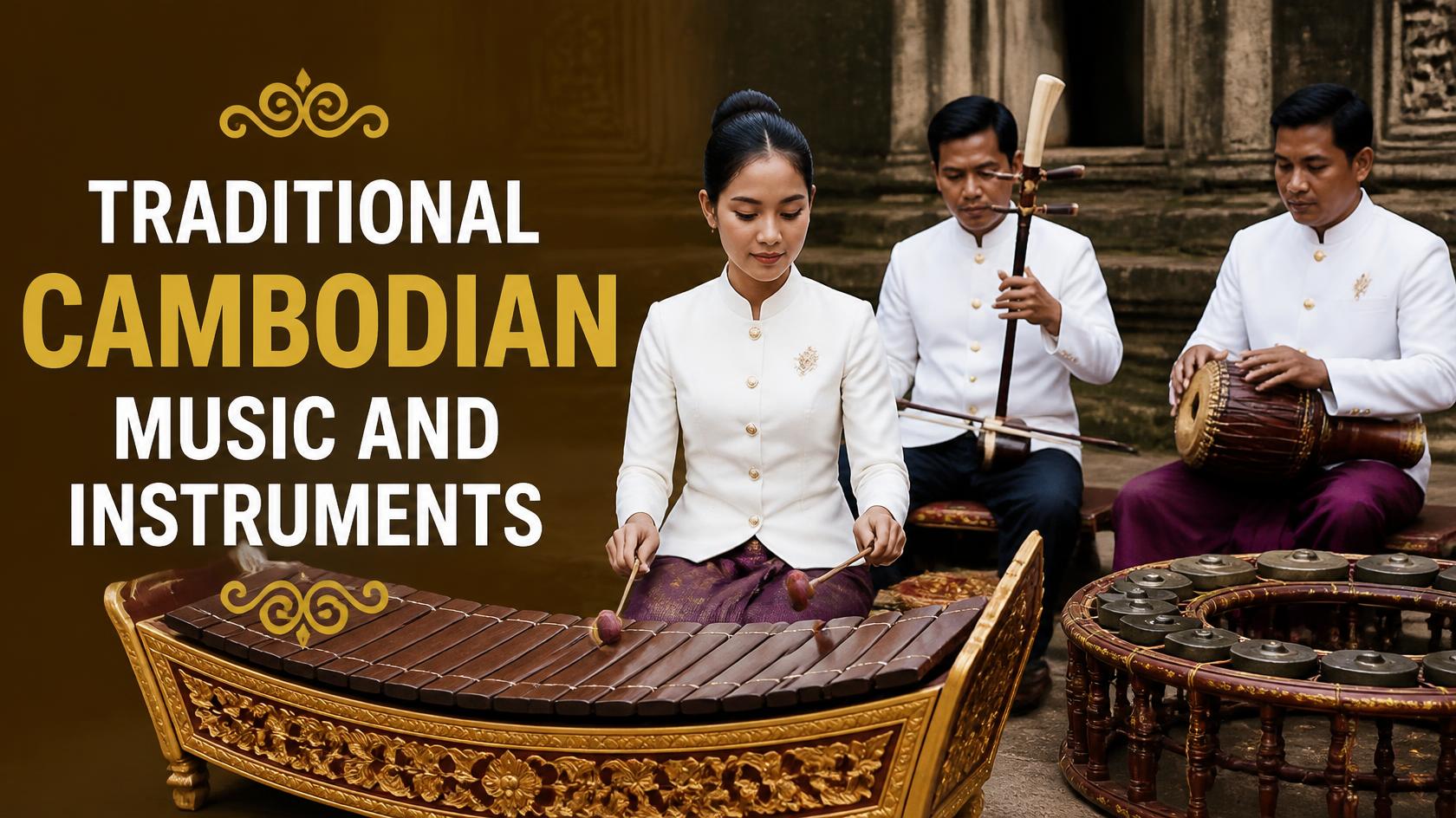

Traditional Cambodian music is one of the most beautiful and enduring expressions of Khmer culture. From the powerful sounds of the Pinpeat orchestra accompanying classical dance to the gentle melodies of the Mohori ensemble and the storytelling traditions of Chapei Dang Veng, music has played an essential role in Cambodian society for centuries.
Across Cambodia, traditional music is closely connected with royal ceremonies, Buddhist religious practices, weddings, festivals, theatrical performances, and community life. Each musical tradition has its own instruments, rhythms, melodies, and cultural meaning.
For travelers, listening to Khmer traditional music offers a deeper understanding of Cambodia’s history and artistic heritage. The sounds of wooden xylophones, bronze gongs, bowed string instruments, bamboo flutes, drums, and long-necked lutes create musical experiences that are distinctively Cambodian.
These musical traditions are not simply historical artifacts. They remain living cultural practices maintained by musicians, teachers, performers, families, and communities throughout Cambodia and among Cambodian communities overseas.
This guide explores the history of Cambodian traditional music, its major musical ensembles, famous Khmer instruments, cultural significance, UNESCO recognition, and where visitors can experience authentic performances.
Traditional Cambodian Music at a Glance
| Music Tradition | Main Characteristics | Common Cultural Context |
|---|---|---|
| Pinpeat (ពិណពាទ្យ) | Powerful ensemble featuring xylophones, gongs, reed instruments, and drums | Classical dance, shadow theatre, religious and royal ceremonies |
| Mohori (មហោរី) | Melodic ensemble featuring string, wind, and percussion instruments | Entertainment, social gatherings, and traditional performances |
| Phleng Kar (ភ្លេងការ) | Traditional wedding music with specific ceremonial songs | Khmer wedding rituals and blessings |
| Phleng Arak (ភ្លេងអារក្ស) | Music associated with traditional spirit-related rituals | Community religious and ceremonial practices |
| Chapei Dang Veng (ចាប៉ីដងវែង) | Long-necked lute accompanied by singing and storytelling | Education, cultural storytelling, festivals, and social commentary |
| Chhayam (ឆៃយ៉ាំ) | Lively drumming and group performance | Festivals, processions, and community celebrations |
The History of Traditional Cambodian Music
Cambodia’s musical heritage developed over many centuries through interactions among local traditions, royal patronage, religious beliefs, and regional cultural exchange.
Musical practices existed in the region long before the modern Cambodian state emerged. Archaeological evidence, inscriptions, temple carvings, and historical records show that music and performance were important parts of Khmer civilization.
Music During the Khmer Empire
During the Khmer Empire, traditionally dated from the ninth to the fifteenth centuries, religious ceremonies and royal institutions played important roles in artistic life.
Khmer temples contain representations of musicians, dancers, drums, gongs, and other instruments, demonstrating the importance of performance in religious and courtly settings.
At Angkor Wat and other historical monuments, sculptural reliefs preserve visual evidence of musical traditions that formed part of the wider artistic world of ancient Cambodia.
However, it is important to distinguish ancient evidence from present-day performance. Temple carvings reveal the presence of instruments and musicians, but they cannot establish that every melody or ensemble performed today has remained unchanged since the Angkorian period.
Traditional Cambodian music has evolved through generations of cultural exchange, adaptation, and artistic development.
Royal Court and Religious Traditions
Music became closely associated with Cambodian royal ceremonies, classical dance, theatre, and Buddhist religious activities.
The Pinpeat orchestra developed an especially important role in formal performance, accompanying dancers, narrators, and ceremonial events.
Other musical ensembles provided entertainment at royal and community gatherings, while specialized traditions accompanied weddings and spiritual observances.
Different musical styles developed according to their functions, and their instruments and repertoires often overlapped.
Music in Cambodian Community Life
Traditional Cambodian music was never confined to royal courts.
Village musicians performed at weddings, religious festivals, celebrations, and other community gatherings.
Music accompanied important moments in life, including marriage ceremonies and rituals associated with religious beliefs.
Performers also preserved stories, poems, humor, and social observations through sung traditions and theatrical performances.
These practices helped pass cultural knowledge from one generation to another.
1. Pinpeat Orchestra – Cambodia’s Classical Ceremonial Music
The Pinpeat orchestra, known in Khmer as Vong Phleng Pinpeat (វង់ភ្លេងពិណពាទ្យ), is among Cambodia’s most important traditional musical ensembles.
Its distinctive sound is created by combining melodic percussion instruments, reed instruments, and drums.
Pinpeat is especially associated with the Royal Ballet of Cambodia, classical dance, masked theatre, shadow puppetry, and religious ceremonies.
The music can sound majestic, energetic, dramatic, or solemn depending on the occasion and the composition being performed.
Main Instruments of the Pinpeat Orchestra
- Roneat Ek: A high-pitched wooden or bamboo xylophone.
- Roneat Thung: A lower-pitched xylophone that complements the Roneat Ek.
- Kong Vong Touch: A circular arrangement of smaller tuned gongs.
- Kong Vong Thom: A circular arrangement of larger tuned gongs.
- Sralai: A traditional double-reed wind instrument with a penetrating tone.
- Sampho: A double-headed barrel drum.
- Skor Thom: Large paired drums producing powerful rhythmic patterns.
- Chhing: Small hand cymbals used to mark rhythmic cycles.
Not every Pinpeat ensemble uses exactly the same instruments. The size and composition may vary according to the performance, institution, and local tradition.
When Is Pinpeat Music Performed?
Pinpeat can accompany:
- Khmer classical dance and the Royal Ballet.
- Traditional masked theatre, including Lakhon Khol.
- Sbek Thom large shadow-puppet performances.
- Selected Buddhist and traditional religious ceremonies.
- Royal and ceremonial occasions.
- Cultural presentations and educational performances.
One of the best ways to experience Pinpeat is during a high-quality Khmer classical dance performance where live musicians accompany the dancers.
Cultural significance: Pinpeat demonstrates the close relationship between music, movement, storytelling, and ceremonial traditions in Cambodian culture.
2. Mohori Music – Elegant Melodies and Traditional Entertainment
Mohori music, also spelled Mahori or Mohaori, represents another important Cambodian musical tradition.
Compared with the powerful ceremonial sound of Pinpeat, Mohori frequently emphasizes gentler instrumental combinations and melodic expression.
The ensemble commonly includes bowed string instruments, plucked strings, flutes, xylophones, and light percussion.
Mohori has traditionally been associated with entertainment, social gatherings, cultural performances, and selected forms of traditional dance.
Common Mohori Instruments
- Tro: Traditional bowed string instruments.
- Khloy: A bamboo flute or duct flute.
- Takhe or Krapeu: A horizontal plucked zither.
- Khim: A hammered string instrument.
- Roneat: A traditional xylophone.
- Chhing: Small cymbals for rhythmic coordination.
- Small drums: Used to support the musical rhythm.
The exact instrumentation depends on the ensemble and performance style.
What Does Mohori Music Sound Like?
Mohori melodies can be expressive, lyrical, and flowing.
Traditional songs may explore themes such as love, nature, beauty, personal emotions, and relationships.
Musicians may decorate a shared melody with individual variations, creating a layered musical texture.
Mohori performances can include vocalists as well as instrumentalists.
Best for travelers: Cultural concerts, traditional music demonstrations, and performances where visitors want to appreciate the individual sounds of Khmer string and wind instruments.
3. Phleng Kar – Traditional Khmer Wedding Music
Phleng Kar (ភ្លេងការ) is the traditional musical repertoire associated with Cambodian wedding ceremonies.
Unlike music intended simply for entertainment, Phleng Kar plays a ceremonial role. Different songs accompany particular stages of a traditional wedding.
These performances can express respect for parents, blessings for the couple, gratitude toward ancestors, and the cultural meaning of marriage.
The Role of Music in Khmer Weddings
Traditional Cambodian weddings include a series of rituals, and music helps mark transitions between them.
Depending on the family’s customs and the ceremony’s format, musicians may perform during activities associated with the groom’s arrival, ceremonial preparation, blessings, and other important moments.
Certain wedding songs have well-established associations with specific rituals, although repertoires and arrangements vary among musicians and communities.
Music master Chum Ngek explains that Phleng Kar is traditionally performed by singers and instrumentalists whose songs correspond to particular ceremonial stages.
Traditional Wedding Instruments
Phleng Kar ensembles may include:
- Tro So and other bowed fiddles.
- Tro Ou, producing a lower tone.
- Khloy flute.
- Takhe or Krapeu zither.
- Khim hammered dulcimer.
- Skor Arak and other drums.
- Chhing cymbals.
- Male and female vocalists.
The instruments used vary by locality, ensemble, and the form of the wedding ceremony.
Cultural meaning: Traditional wedding music helps transform a family celebration into a structured ceremonial occasion connected with Khmer customs and social values.
4. Phleng Arak – Music and Traditional Spiritual Practices
Phleng Arak (ភ្លេងអារក្ស) is a traditional Cambodian music genre associated with ceremonies involving spirits and local religious beliefs.
These practices reflect older layers of Cambodian spiritual culture that have interacted with Buddhist and other religious traditions over time.
Phleng Arak may be performed in ceremonies intended to communicate with or honor spirits, including rituals that participants understand as having protective or healing significance.
The instruments and repertoire vary by community and ceremonial context.
Traditional ensembles can include bowed strings, wind instruments, drums, and other locally used instruments.
For visitors, the important point is that these performances may form part of meaningful religious practices rather than public entertainment.
Traveler’s tip: Do not enter private ceremonies or photograph participants without permission. Respect the spiritual significance that the music holds for the community.
Any healing meaning attributed to such ceremonies belongs to the participants’ cultural and religious beliefs and should not be confused with scientifically established medical treatment.
5. Chapei Dang Veng – The Cambodian Art of Musical Storytelling
Chapei Dang Veng (ចាប៉ីដងវែង) is one of Cambodia’s most distinctive traditional musical arts.
It combines the sound of a long-necked plucked lute with singing, poetry, storytelling, humor, and improvised commentary.
A skilled performer may sing about moral lessons, Buddhist stories, historical events, personal experiences, social issues, or everyday life.
The performer must be both a musician and a storyteller, using melody and language to engage the audience.
What Is the Chapei Instrument?
The Chapei Dang Veng is a long-necked lute traditionally played by plucking its strings.
The instrument produces a distinctive, resonant sound that supports the musician’s singing.
Although the accompaniment may appear simple, expert performance requires specialized knowledge of rhythm, melodic patterns, language, and improvisation.
Why Is Chapei Important?
Chapei performances preserve oral traditions and provide an artistic space for exchanging knowledge.
UNESCO identifies several important functions of the tradition, including:
- Passing on social and cultural values.
- Teaching moral lessons.
- Preserving traditional poetry and storytelling.
- Introducing audiences to older Khmer language forms.
- Providing humorous or critical commentary on society.
- Connecting younger and older generations.
UNESCO Recognition of Chapei Dang Veng
In 2016, UNESCO inscribed Chapei Dang Veng on the List of Intangible Cultural Heritage in Need of Urgent Safeguarding.
The designation recognizes the importance of the tradition and the serious challenges facing its continued transmission.
The Khmer Rouge period caused devastating losses among Cambodian artists and interrupted the transfer of specialized musical knowledge.
UNESCO has supported safeguarding efforts aimed at documenting Chapei, training teachers, supporting young musicians, and raising public awareness.
Important distinction: Chapei Dang Veng is specifically inscribed on UNESCO’s Urgent Safeguarding List. This does not mean that every Cambodian musical genre has a separate UNESCO inscription.
6. Chhayam – Traditional Festive Drumming
Chhayam (ឆៃយ៉ាំ) is a lively Cambodian drumming and performance tradition often associated with celebrations and community events.
Chhayam groups may combine drumming, movement, rhythmic coordination, and festive presentation.
The performances are often energetic and visually engaging, making them especially suitable for outdoor celebrations and processions.
Depending on the community and event, Chhayam may accompany religious festivities, cultural celebrations, or other public gatherings.
Its strong rhythms provide a distinctive contrast to the refined melodies of Mohori and the formal ceremonial arrangements of Pinpeat.
Famous Traditional Cambodian Musical Instruments
Cambodian musical instruments can be grouped into several broad families according to how they produce sound.
These include percussion instruments, string instruments, and wind instruments.
The following are some of the most recognizable traditional Khmer instruments.
1. Roneat Ek – The High-Pitched Xylophone
The Roneat Ek (រនាតឯក) is one of the most recognizable instruments in Cambodian classical music.
It consists of a series of tuned wooden or bamboo bars suspended above a boat-shaped resonating frame.
Musicians strike the bars with mallets to produce bright, rapid melodic passages.
Roneat Ek frequently carries important melodic material in Pinpeat ensembles and other forms of traditional music.
2. Roneat Thung – The Lower-Pitched Xylophone
The Roneat Thung (រនាតធុង) is a lower-pitched xylophone.
Its deeper sound complements the brighter tone of the Roneat Ek.
When performed together, the two instruments can create a rich musical texture through complementary melodic patterns.
3. Kong Vong – Circular Tuned Gongs
The Kong Vong (គងវង់) is a traditional gong instrument arranged in a circular frame around the seated musician.
Each small gong produces a different pitch, allowing the player to perform melodies and ornamented musical passages.
Two common versions are Kong Vong Touch, which has a higher register, and Kong Vong Thom, which has a lower register.
These instruments are especially associated with Pinpeat music.
4. Sralai – The Traditional Double-Reed Instrument
The Sralai (ស្រឡៃ) is a traditional wind instrument that produces a strong, penetrating sound.
Unlike a simple bamboo flute, the Sralai uses a double reed.
Its expressive tone can be heard clearly alongside drums, gongs, and xylophones.
It plays an important melodic role in many Pinpeat performances.
5. Khloy – The Cambodian Flute
The Khloy (ខ្លុយ) is a traditional Cambodian flute, commonly made from bamboo.
It is used in several musical traditions, including Mohori and selected wedding music ensembles.
The Khloy’s sound is generally softer than that of the Sralai, making it suitable for lyrical and expressive melodic passages.
6. Tro – Traditional Bowed String Instruments
The Tro (ទ្រ) refers to a family of Cambodian bowed string instruments.
Musicians draw a bow across the strings to create sustained melodic tones.
Different instruments in the family have different sizes, constructions, and tonal ranges.
Examples include:
- Tro So: A relatively higher-register fiddle.
- Tro Ou: A lower-pitched fiddle producing a deeper tone.
- Tro Khmer: A traditional bowed instrument associated with particular Khmer musical repertoires.
Tro instruments can be heard in Mohori, Phleng Kar, and other Cambodian musical traditions.
7. Takhe or Krapeu – The Crocodile Zither
The Takhe or Krapeu (តាខេ) is a horizontal plucked string instrument.
Its Cambodian name is associated with a crocodile, reflecting the instrument’s traditional form and historical naming.
The musician sits beside the instrument and plucks its strings while adjusting pitch through the appropriate playing technique.
It is used in Mohori music and selected wedding ensembles.
8. Khim – The Hammered Dulcimer
The Khim (ឃឹម) is a string instrument played by striking its strings with small, lightweight beaters.
Its sound is bright and delicate, adding a distinctive melodic quality to ensembles that use it.
The instrument is associated with certain Cambodian traditional music groups, especially those featuring string instruments.
9. Chapei Dang Veng – The Long-Necked Lute
The Chapei Dang Veng (ចាប៉ីដងវែង) is a plucked lute especially associated with traditional singing and storytelling.
Its long neck and distinctive tone make it visually and musically recognizable.
Unlike ensemble instruments used primarily to accompany a larger group, the Chapei is often played by a musician who also sings and narrates.
10. Sampho – The Double-Headed Barrel Drum
The Sampho (សំភោរ) is a traditional double-headed drum used in Pinpeat music.
The musician produces different tones and rhythmic patterns by striking the drumheads.
The Sampho contributes to the rhythmic structure and coordination of the ensemble.
11. Skor Thom – The Large Ceremonial Drums
The Skor Thom (ស្គរធំ) consists of large drums commonly played as a pair in Pinpeat ensembles.
Their powerful tones contribute dramatic emphasis to ceremonial music and classical performance.
They are particularly recognizable during performances that accompany theatre and dance.
12. Chhing – The Small Hand Cymbals
The Chhing (ឈឹង) consists of two small cymbals struck together.
Although relatively simple in appearance, the Chhing has an important role in marking rhythmic cycles and helping musicians coordinate their performances.
Its sharp metallic sound can often be distinguished among larger instruments.
13. Kse Diev – The One-String Instrument
The Kse Diev (ខ្សែដៀវ) is a traditional one-string plucked instrument with a distinctive construction and sound.
It represents another aspect of Cambodia’s diverse musical heritage, particularly in traditional solo and small-ensemble repertoires.
Recordings preserved by Smithsonian Folkways demonstrate its importance as part of Cambodia’s historic instrumental traditions.
Quick Reference: Khmer Musical Instruments
| Instrument | Family | Common Use |
|---|---|---|
| Roneat Ek | Melodic percussion | Pinpeat, Mohori |
| Roneat Thung | Melodic percussion | Pinpeat, Mohori |
| Kong Vong | Tuned gongs | Pinpeat |
| Sralai | Double-reed wind | Pinpeat |
| Khloy | Flute | Mohori, wedding music |
| Tro So / Tro Ou | Bowed strings | Mohori, wedding music |
| Takhe / Krapeu | Plucked strings | Mohori, wedding music |
| Khim | Struck strings | Selected traditional ensembles |
| Chapei Dang Veng | Plucked lute | Storytelling and singing |
| Sampho | Drum | Pinpeat |
| Skor Thom | Large drums | Pinpeat |
| Chhing | Small cymbals | Several traditional ensembles |
| Kse Diev | One-string plucked instrument | Solo and traditional music |
What Makes Traditional Cambodian Music Unique?
Traditional Cambodian music has several characteristics that distinguish it from many Western musical traditions.
Interlocking and Ornamented Melodies
In several Khmer ensemble traditions, musicians play related versions of a shared melody.
One instrument may perform a relatively straightforward melodic line while another adds faster notes or ornaments.
The resulting sound contains multiple musical layers that move together without necessarily playing every note in unison.
This approach creates the rich textures heard in classical ensembles.
Importance of Rhythm
Rhythm is essential to many traditional performances.
Drums and cymbals help organize musical phrases, establish tempo, and coordinate musicians with dancers or theatrical performers.
In Pinpeat, rhythmic changes can also contribute to the dramatic character of a performance.
Music and Storytelling
Cambodian musical traditions often connect sound with language, poetry, and narrative.
Chapei performers use music to communicate stories and social messages, while singers in classical theatre can describe action and emotions represented by dancers.
Understanding the words can add meaning, but instrumental techniques also communicate expressive qualities.
Learning Through Teachers
Much traditional Khmer music has historically been transmitted through direct instruction, listening, observation, repetition, and performance.
Students learn from experienced musicians who demonstrate melodies, rhythmic patterns, techniques, and stylistic variations.
The relationship between a teacher and student is therefore central to preserving these traditions.
Traditional Music in Cambodian Festivals and Ceremonies
Cambodian traditional music remains closely connected with the cultural calendar.
Khmer New Year
Traditional musical performances may accompany Khmer New Year cultural activities, community games, dances, and public celebrations.
Chhayam drumming and other festive traditions may be presented, depending on the locality.
Buddhist Ceremonies
Traditional instruments and ceremonial music may be heard during selected Buddhist observances.
The choice of music depends on local religious practice and the occasion.
Traditional Weddings
Phleng Kar remains an important part of ceremonies that follow traditional Khmer wedding customs.
Some contemporary weddings combine traditional music with modern recorded songs or live popular music.
Classical Dance and Theatre
Pinpeat music is especially significant in performances of the Royal Ballet, Lakhon Khol, and Sbek Thom shadow theatre.
These performing arts demonstrate how music contributes to storytelling, religious symbolism, and Cambodian cultural identity.
Traditional Music of Cambodia’s Indigenous and Ethnic Communities
Although Khmer musical traditions are central to Cambodian national culture, Cambodia is home to many communities with their own musical heritage.
Indigenous and ethnic communities, including groups in the northeastern highlands, maintain distinctive songs, instruments, and ceremonial traditions.
Gongs, bamboo instruments, vocal performances, and other forms of music may play important roles in local celebrations and community life.
These traditions should not automatically be grouped under Pinpeat or Mohori, which refer to particular Khmer musical forms.
For travelers, exploring Cambodia’s musical diversity responsibly means recognizing the different communities that contribute to the country’s wider cultural heritage.
Community-specific performances should be experienced with local permission and an appreciation of their cultural meaning.
The Khmer Rouge Period and the Survival of Cambodian Music
The twentieth century brought devastating challenges to Cambodia’s cultural traditions.
During the Khmer Rouge regime from 1975 to 1979, many musicians, dancers, teachers, and other artists were killed or died under the regime’s policies and conditions.
Cultural institutions and performance traditions experienced severe disruption.
Traditional musical knowledge was particularly vulnerable because many repertoires and playing techniques depended on direct transmission from experienced masters.
Some forms of music survived through artists who remained in Cambodia, while others were preserved by Cambodian refugees and communities overseas.
Revival and Cultural Preservation
After 1979, surviving musicians and teachers helped restore traditional arts by teaching younger generations.
Schools, community groups, cultural organizations, and individual masters contributed to rebuilding Cambodian musical life.
One notable figure in the preservation of Cambodian music overseas is Master Chum Ngek, a musician born in Battambang Province who later became a respected teacher in the United States.
He received a National Heritage Fellowship from the United States National Endowment for the Arts in 2004, recognizing his contributions to traditional Cambodian music.
Today, traditional music continues to be performed in Cambodia and internationally, reflecting the determination of artists to maintain and renew their heritage.
UNESCO Recognition and the Importance of Safeguarding Music
International recognition has helped draw attention to the importance of preserving Cambodian performing arts.
Chapei Dang Veng – UNESCO 2016
In 2016, UNESCO placed Chapei Dang Veng on its List of Intangible Cultural Heritage in Need of Urgent Safeguarding.
The inscription recognized both the artistic importance of the tradition and the risk of losing specialized skills as the number of experienced practitioners declined.
Royal Ballet of Cambodia
The Royal Ballet of Cambodia was proclaimed a Masterpiece of the Oral and Intangible Heritage of Humanity in 2003 and inscribed on UNESCO’s Representative List in 2008.
The traditional Pinpeat orchestra forms an important part of its musical accompaniment.
Sbek Thom Shadow Theatre
UNESCO also recognizes Sbek Thom, Cambodia’s large shadow-puppet theatre.
This tradition features large leather puppets and combines narration, performance, and traditional musical accompaniment.
It was originally proclaimed in 2005 and inscribed on the Representative List in 2008.
These recognitions highlight the importance of Cambodian performing arts, although they should not be confused with separate UNESCO inscriptions for every individual musical instrument or ensemble.
Where Can Travelers Experience Traditional Cambodian Music?
Traditional music can be experienced in different parts of Cambodia, but the best opportunities depend on performance schedules and local cultural events.
Siem Reap – Classical Dance and Cultural Performances
Siem Reap is a popular destination for performances associated with Khmer classical dance and traditional music.
Some cultural venues, hotels, and organized events feature performances inspired by the Royal Ballet tradition.
Travelers interested in authentic musical instruments should ask whether the performance includes a live ensemble or recorded accompaniment.
Live Pinpeat music can provide a particularly valuable introduction to traditional Khmer instruments.
Phnom Penh – Cultural Institutions and Performing Arts
Phnom Penh is an important center for Cambodian arts education and cultural performance.
The capital is associated with institutions such as the Royal University of Fine Arts, as well as independent arts organizations.
Cambodian Living Arts is one organization supporting Cambodian artists, cultural education, and performing-arts activities.
Travelers should check current programs and venue information directly with organizers.
Traditional Weddings and Community Events
Traditional music may also be heard at weddings and religious or cultural events throughout Cambodia.
However, many such performances are private or ceremonial.
Visitors should only attend when invited or when the event is clearly open to the public.
Online Recordings and Museum Resources
Travelers can also begin learning about traditional Cambodian music before visiting the country.
Smithsonian Folkways Recordings preserves recordings of Khmer classical, folk, and ceremonial music, including Pinpeat, Mohori, Chapei-related traditions, and individual instruments.
These collections can help listeners distinguish different instruments and better appreciate live performances.
How to Appreciate a Traditional Cambodian Music Performance
Listening to Khmer music can be a more rewarding experience when you understand how the ensemble works.
Listen to Individual Instruments
Try identifying the bright sound of the Roneat, the rounded tones of the gongs, the sustained sound of the Sralai, and the rhythmic patterns of the drums.
Observe the Musicians
Watch how musicians coordinate through eye contact, rhythmic cues, and shared knowledge of the composition.
Some instruments play different versions of the same melody, producing a layered musical texture.
Understand the Performance Context
Music performed for a wedding has a different cultural function from music accompanying classical dance or a religious ceremony.
Knowing the occasion can help you appreciate the musical choices.
Respect the Artists
Avoid interrupting performances or entering ceremonial areas without permission.
Ask before recording performers, particularly during private religious or community events.
If you attend a cultural performance, supporting qualified musicians and reputable local organizations helps sustain Cambodia’s living arts.
Frequently Asked Questions About Traditional Cambodian Music
What is traditional Cambodian music called?
Traditional Cambodian music is often referred to generally as Khmer traditional music or Phleng Khmer. Specific genres include Pinpeat, Mohori, Phleng Kar, Phleng Arak, and Chapei Dang Veng.
What is the most famous traditional Cambodian musical ensemble?
Pinpeat is one of Cambodia’s most recognizable classical musical ensembles. It is associated with royal ceremonies, Khmer classical dance, masked theatre, shadow puppetry, and religious observances.
What instruments are used in Pinpeat music?
Common Pinpeat instruments include the Roneat Ek, Roneat Thung, Kong Vong, Sralai, Sampho, Skor Thom, and Chhing. Instrumentation varies by performance and ensemble.
What is the difference between Pinpeat and Mohori?
Pinpeat typically emphasizes wind and percussion instruments and is associated with classical and ceremonial performance. Mohori often features string instruments, flutes, and gentler percussion, and is commonly associated with entertainment and social gatherings.
What is Chapei Dang Veng?
Chapei Dang Veng is a Cambodian musical storytelling tradition combining a long-necked plucked lute with singing, poetry, improvisation, and cultural commentary.
Is Chapei Dang Veng recognized by UNESCO?
Yes. UNESCO inscribed Chapei Dang Veng in 2016 on its List of Intangible Cultural Heritage in Need of Urgent Safeguarding.
What musical instruments are played at Khmer weddings?
Traditional Phleng Kar wedding ensembles may use bowed fiddles, flutes, zithers, hammered string instruments, drums, cymbals, and vocalists. The combination depends on the musical group and ceremonial traditions.
What is a Roneat?
A Roneat is a Cambodian xylophone-type instrument with tuned bars played using mallets. Roneat Ek is generally higher-pitched, while Roneat Thung has a lower register.
What is the traditional Cambodian flute called?
The Khloy is a traditional Cambodian flute commonly made from bamboo. It is used in several forms of Khmer music, including Mohori and selected ceremonial repertoires.
What music accompanies Apsara Dance?
Khmer classical dance is traditionally accompanied by Pinpeat music. Some performances also feature singers who provide narrative or emotional context. The modern Apsara Dance is one part of the broader Royal Ballet tradition.
Where can tourists listen to traditional Khmer music?
Siem Reap and Phnom Penh offer opportunities to attend traditional dance and music performances. Cultural organizations, educational institutions, and public festivals may also present live performances. Check current schedules before visiting.
Why is traditional Cambodian music important?
Traditional music preserves cultural knowledge, ceremonial practices, storytelling traditions, artistic techniques, and community identity. It also connects Cambodia’s past with the creative work of musicians today.
Sources and References
This guide draws on UNESCO cultural heritage documentation, Smithsonian Folkways recordings, Cambodian cultural resources, scholarly research, and the work of recognized traditional musicians. Instrument names may have different English spellings, and musical practices can vary by region and community.
- UNESCO Intangible Cultural Heritage – Chapei Dang Veng: Official documentation of the musical storytelling tradition, its cultural functions, and its inscription on the Urgent Safeguarding List in 2016.
- UNESCO – Royal Ballet of Cambodia: The historical significance of Khmer classical dance and its musical accompaniment.
- Cambodia Ministry of Culture and Fine Arts – Royal Ballet of Cambodia: Cambodian classical dance, ceremonial traditions, and the role of Pinpeat music.
- UNESCO – Sbek Thom, Khmer Shadow Theatre: Traditional Cambodian theatre and its relationship with ceremonial performing arts.
- Smithsonian Folkways – Cambodia: Traditional Music, Volume 1: Historical recordings and descriptions of Khmer traditional instruments and ensembles.
- Smithsonian Folkways – Cambodia: Royal Music: Recordings featuring Pinpeat, Mohori, wedding music, and traditional orchestral instruments.
- Smithsonian Folkways – Cambodia: Folk and Ceremonial Music: Musical traditions associated with court, folk, and ceremonial settings.
- Chum Ngek – Khmer Wedding Music: The role of traditional songs, musicians, and ceremonies in Khmer weddings.
- National Endowment for the Arts – Chum Ngek: Biography of a recognized Cambodian traditional musician and teacher.
- European Journal of Musicology – The Interrelations of Genre in Traditional Cambodian Music and Theatre: Scholarly research on Khmer wedding music, spirit-related music, and theatrical traditions.
- Cambodian Living Arts: Cultural education, Cambodian performing arts, and initiatives supporting artists.
- Tourism Cambodia – Khmer Music: Overview of traditional Cambodian musical ensembles and instruments.
Conclusion: Preserving the Sounds of Cambodia
Traditional Cambodian music is an essential part of the country’s cultural identity. Its instruments, melodies, rhythms, and songs reflect centuries of artistic development and the important relationship between music, religion, family, and community life.
From the powerful Pinpeat orchestra and the elegant melodies of Mohori to the ceremonial songs of Phleng Kar and the storytelling traditions of Chapei Dang Veng, each musical form contributes something distinctive to Cambodia’s cultural heritage.
Traditional instruments such as the Roneat, Kong Vong, Sralai, Tro, Khloy, Takhe, Chhing, and Chapei demonstrate the creativity and craftsmanship of generations of Cambodian musicians.
Although these traditions suffered devastating losses during the Khmer Rouge period, surviving artists and younger generations have worked to preserve and revive them.
Today, Cambodian music continues to be heard in classical dance performances, wedding ceremonies, community celebrations, cultural education, and concert settings.
For travelers, experiencing traditional Khmer music is an opportunity to discover more than beautiful sounds. It is a way to understand the stories, values, spirituality, and artistic traditions that have shaped Cambodia over centuries.
By attending responsible cultural performances and supporting Cambodian artists, visitors can contribute to the continued appreciation of this remarkable living heritage.
Explore more Cambodian culture with GoToKH.com through our guides to Apsara Dance, Khmer classical arts, the history of the Khmer Empire, Cambodian festivals, and traditional cultural experiences throughout the Kingdom of Wonder.
