
























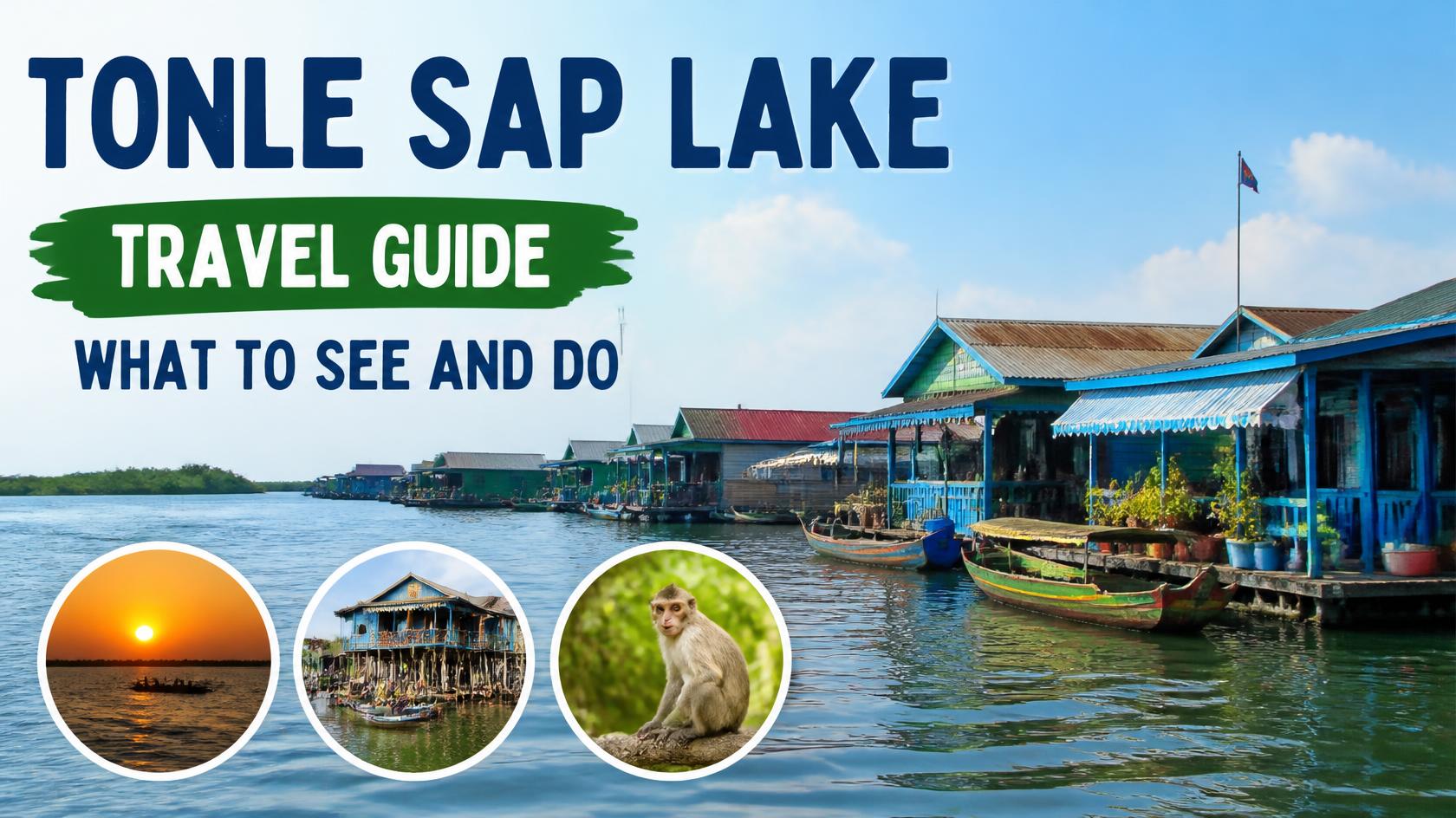

Tonle Sap Lake is one of Cambodia’s most remarkable natural destinations. Known as the Great Lake of Cambodia, this enormous freshwater ecosystem is famous for its floating communities, towering stilt houses, seasonally flooded forests, traditional fishing livelihoods, and extraordinary biodiversity.
Located in central Cambodia, south of Siem Reap, Tonle Sap is the largest freshwater lake in Southeast Asia. Its waters rise and fall dramatically throughout the year, transforming the surrounding landscape and shaping the lives of communities that depend on the lake.
For travelers visiting Siem Reap and Angkor Wat, a trip to Tonle Sap provides an opportunity to discover another essential part of Cambodian life. Instead of ancient stone temples, visitors encounter waterways, fishing boats, lakeside villages, wetlands, and landscapes that change with the seasons.
Popular places to explore include Kampong Phluk, Kampong Khleang, Chong Kneas, and Prek Toal Bird Sanctuary. Visitors can enjoy boat excursions, discover traditional settlements, observe waterbirds, and learn about the connection between Cambodia’s people and its natural environment.
This complete Tonle Sap Lake travel guide explains what to see and do, which villages to visit, the best time to go, how to get there from Siem Reap, and how to enjoy the lake responsibly.
Tonle Sap Lake at a Glance
| Travel Information | Details |
|---|---|
| Location | Central Cambodia, south of Siem Reap |
| Known For | Floating villages, stilt houses, fishing communities, wetlands, and wildlife |
| Ecological Status | Part of the UNESCO-recognized Tonle Sap Biosphere Reserve |
| Best Starting Point | Siem Reap for the northern lake communities |
| Suggested Visit | Half a day for a village excursion; a full day for specialist birdwatching |
| High-Water Experience | Flooded forests, boat-accessible waterways, and stilt houses above water |
| Low-Water Experience | Exposed tall stilts, village roads, and changing lakeside livelihoods |
| Recommended Activities | Community boat tours, photography, wildlife watching, and cultural learning |
What Makes Tonle Sap Lake So Special?
Tonle Sap is not an ordinary lake. It is part of a unique river and floodplain system connected to the Mekong River through the Tonle Sap River.
During the rainy season, rising water in the Mekong causes the Tonle Sap River to reverse its flow, sending water back toward the lake. This natural process dramatically increases the lake’s water level and surface area.
When the Mekong’s water level falls, the river reverses again, allowing water to drain from Tonle Sap Lake toward the Mekong.
According to UNESCO, the lake can expand to several times its dry-season size. This annual flood pulse creates extensive wetlands, flooded forests, and productive habitats for fish and waterbirds.
The lake also plays a central role in Cambodia’s economy and food security. Fishing, aquaculture, agriculture, boat transportation, and seasonal activities support communities throughout the lake basin.
For visitors, the changing water levels mean that Tonle Sap can look completely different depending on when you visit. A village surrounded by deep water in October may have dry roads and houses standing high above the ground in March or April.
Best Places to Visit Around Tonle Sap Lake
1. Kampong Phluk – Best for Stilt Houses and Flooded Forests
Kampong Phluk, also spelled Kompong Phluk, is one of the most popular destinations for travelers visiting Tonle Sap Lake from Siem Reap.
The community is known for its wooden houses built on tall stilts, designed to accommodate the dramatic changes in water level throughout the year.
During the high-water season, boats travel along waterways beside elevated houses, giving visitors an impressive view of how buildings have been adapted to seasonal flooding.
During the dry season, the water recedes and the tall supporting posts beneath the houses become clearly visible. Visitors may see roads and ground-level village activities that are underwater during wetter months.
Kampong Phluk is also associated with nearby seasonally flooded forest, where small boats may travel among partially submerged trees when water levels are sufficiently high.
Things to Do in Kampong Phluk
- Take a boat tour along the village waterways.
- Observe traditional stilt-house architecture from public routes.
- Experience the flooded forest on a locally operated small-boat excursion when conditions allow.
- Learn about fishing, river transport, and daily life through a knowledgeable local guide.
- Enjoy views toward the open lake during suitable weather and water conditions.
Getting there: Kampong Phluk is southeast of Siem Reap. The road journey to the village or relevant departure point commonly takes around one hour, but actual travel time depends on road conditions and the season.
Best for: First-time visitors, families, photographers, and travelers wanting an accessible introduction to the lake.
Important: The flooded forest excursion is seasonal. During low-water periods, boats may not be able to enter the forest.
2. Kampong Khleang – Best for an Extensive Lakeside Community
Kampong Khleang, also written Kompong Khleang, is another outstanding place to explore life around Tonle Sap Lake.
Located approximately 50–55 kilometers from Siem Reap, Kampong Khleang is a large, established community where residents have adapted their homes and livelihoods to the lake’s changing seasonal conditions.
The settlement is particularly striking during the dry season, when tall wooden houses rise above exposed ground on supporting posts that can reach several meters high.
During the high-water months, the surrounding landscape changes dramatically, and boats become an important way of traveling through certain parts of the community.
Kampong Khleang is often preferred by travelers looking for a longer and more community-focused excursion rather than a quick sightseeing trip.
Things to Do in Kampong Khleang
- Explore the village through a locally guided tour.
- Observe traditional houses designed for seasonal flooding.
- Learn about fishing, fish processing, and local livelihoods.
- Visit appropriate public community areas with local permission.
- Take a boat ride to the open lake when water conditions permit.
- Learn about local initiatives supporting education and community development.
Responsible operators such as Community First offer tours that involve local guides, community boat operators, and educational initiatives.
Getting there: Allow approximately one to one and a half hours for the drive from Siem Reap, depending on your route and road conditions, plus time for the village and any boat excursion.
Best for: Culture-focused travelers, photographers, responsible tourism, and visitors with at least half a day available.
Travel tip: The itinerary changes by season. In low water, operators may combine walking with boat travel rather than traveling by boat through all sections of the village.
3. Chong Kneas – Best for a Convenient Short Excursion
Chong Kneas is one of the closest and most established boat-tour departure areas for Tonle Sap Lake from Siem Reap.
Located roughly 15 kilometers south of the city, the area has long been associated with floating communities, fishing activities, and tourism boats operating on the lake.
Because of its proximity to Siem Reap, Chong Kneas can be convenient for travelers who have limited time or prefer a shorter road journey.
However, parts of the tourism operation are highly commercialized. Visitors may encounter organized stops at floating shops, tourist facilities, or other paid attractions.
For this reason, it is especially important to clarify the tour route, boat price, included activities, and any additional stops before booking.
Things to Consider
- The road journey is generally shorter than the journey to Kampong Khleang.
- Boat-tour operators and routes vary.
- Some experiences can feel more commercialized than other village excursions.
- Travelers should avoid pressure to purchase unnecessary goods or donations.
Best for: Visitors with limited time who have carefully selected a transparent and responsible operator.
Our recommendation: If you have enough time, consider comparing Chong Kneas with Kampong Phluk or Kampong Khleang before booking.
4. Prek Toal Bird Sanctuary – Best for Wildlife and Birdwatching
Prek Toal Bird Sanctuary is one of the most important wildlife destinations within the Tonle Sap ecosystem.
Located in the northwestern part of the lake, within Battambang Province, Prek Toal is known for its seasonally flooded forests and breeding populations of large waterbirds.
The protected area supports species such as painted storks, spot-billed pelicans, greater adjutants, lesser adjutants, and other wetland birds.
Prek Toal is particularly rewarding for travelers interested in conservation, wildlife photography, ecology, and birdwatching.
Unlike a standard village sightseeing tour, a visit to the bird sanctuary requires more planning. Visitors may need to travel by motorboat, use smaller boats along forest waterways, and work with local conservation guides or rangers.
Best Time for Birdwatching
The dry-season birdwatching period, particularly from around December to March, is often favorable for observing waterbird colonies. Conditions vary by year, and receding water may eventually make some observation areas more difficult to reach.
Travelers seeking specific bird species should contact a specialist birdwatching or conservation operator before arranging a trip.
Best for: Birdwatchers, wildlife photographers, conservation enthusiasts, and travelers interested in protected wetlands.
Travel tip: Plan a full day and choose an operator that follows wildlife-protection rules and keeps an appropriate distance from nesting birds.
5. Phnom Krom – Best for Views Over the Tonle Sap Landscape
Phnom Krom is a small hill southwest of Siem Reap that offers views across the surrounding countryside toward Tonle Sap Lake.
The hill is also home to an ancient temple associated with the Angkorian period, making it an interesting destination for travelers who enjoy both landscape photography and Khmer history.
According to Cambodia’s Ministry of Tourism, Phnom Krom is particularly attractive during sunrise and sunset, when the changing light creates scenic views over the surrounding plains and lake.
Unlike the floating-village destinations, Phnom Krom can be appreciated from land and does not necessarily require a boat excursion.
Best for: Landscape photography, temple enthusiasts, and travelers looking for an additional activity near Siem Reap.
Travel tip: Check current heritage-site access, opening hours, and ticket requirements before visiting the temple area.
Best Things to Do at Tonle Sap Lake
Take a Traditional Boat Tour
A boat excursion is one of the most popular ways to experience Tonle Sap Lake.
Depending on your destination, tours may travel through village waterways, past stilt houses, toward floating communities, or out onto the open lake.
Boat tours offer a closer look at how transportation, fishing, and everyday activities adapt to seasonal water levels.
When selecting a boat tour, choose operators who provide properly maintained vessels, suitable life jackets, clear prices, and experienced local boat drivers.
Explore a Seasonally Flooded Forest
The flooded forests surrounding Tonle Sap are among its most distinctive ecological features.
These forests provide important habitat for fish and other wildlife, help protect the floodplain, and contribute to the health of the wider ecosystem.
At Kampong Phluk, visitors may have the opportunity to take a smaller boat through partially submerged trees when water levels allow.
Moving quietly through a flooded forest can be a memorable experience, particularly for nature photographers.
However, this activity is not available under all conditions. Low water, strong currents, weather, or access restrictions may prevent boat trips.
Learn About Life in Floating and Stilt-House Communities
Tonle Sap is home to communities whose livelihoods are closely connected to fishing, aquaculture, trade, and seasonal agriculture.
Some families live in elevated houses fixed to the floodplain, while others live in floating structures that can be moved as water levels change.
These communities are not museums or staged attractions. They are places where residents work, attend school, raise families, celebrate religious traditions, and carry out everyday activities.
Travelers can learn more through community-led excursions and respectful conversations arranged by local guides.
Enjoy a Sunset on the Lake
Sunset is a popular time for boat excursions on Tonle Sap Lake.
When the weather is clear, the wide horizon and reflections on the water can create beautiful photography conditions.
However, sunsets are weather-dependent, and afternoon storms or clouds may affect visibility.
If planning an evening excursion, choose a reliable operator and make sure the return journey is arranged safely before darkness.
Go Birdwatching
Tonle Sap’s wetland ecosystem supports a remarkable diversity of birdlife.
While specialist birdwatching trips commonly focus on Prek Toal, visitors may also see waterbirds around lake channels, flooded vegetation, and quieter wetland areas.
Birdwatchers should bring binoculars and select guides familiar with local conservation rules.
Never approach nesting areas too closely or encourage boat operators to disturb wildlife for photographs.
Discover the Importance of Cambodia’s Inland Fisheries
Tonle Sap plays an essential role in Cambodia’s food supply and rural livelihoods.
Fishing communities depend on the lake’s seasonal flood cycle, which creates breeding and feeding habitats for many freshwater fish species.
During suitable guided experiences, travelers can learn about traditional fishing methods, fish processing, and the relationship between fisheries and floodplain ecosystems.
Understanding these livelihoods offers valuable insight into why protecting Tonle Sap is important for Cambodia’s environmental and economic future.
Floating Villages vs. Stilt Villages: What Is the Difference?
Visitors often use the term floating village to describe all settlements around Tonle Sap Lake, but there is an important distinction.
| Settlement Type | Characteristics |
|---|---|
| Floating Villages | Homes and other structures rest on floating platforms or boats and may move as water levels change. |
| Stilt Villages | Homes are built on tall fixed supports above the floodplain and remain in place as water rises and falls. |
Kampong Phluk is especially well known for its tall stilt houses, while some communities farther out on the lake live in movable floating structures.
Kampong Khleang also includes extensive stilt-house areas and provides access to floating settlements.
Understanding this difference can help you choose the kind of excursion you are most interested in.
Kampong Phluk vs. Kampong Khleang: Which Should You Visit?
| Feature | Kampong Phluk | Kampong Khleang |
|---|---|---|
| Distance from Siem Reap | Generally closer | Approximately 50–55 km |
| Main attraction | Stilt houses and seasonal flooded forest | Extensive village landscape and community life |
| Typical excursion | Half-day trip | Half-day to longer excursion |
| High-water experience | Village waterways and flooded forest | Boat travel through parts of the community |
| Low-water experience | Exposed house stilts and village roads | Extensive stilt structures and village walking routes |
| Best for | First-time visitors and nature sightseeing | Travelers seeking a more in-depth community excursion |
Choose Kampong Phluk if you have limited time and are especially interested in stilt houses or the seasonal flooded forest.
Choose Kampong Khleang if you are willing to travel farther for a larger community experience with a knowledgeable local guide.
Best Time to Visit Tonle Sap Lake
There is no single perfect month to visit Tonle Sap. The best time depends on what you want to see.
June to October – Rising Water and Green Landscapes
During much of the rainy season, water levels generally rise as rainfall and the Mekong flood pulse replenish the lake.
Flooded vegetation becomes more prominent, and boat access improves in certain channels and forests as water levels increase.
However, heavy rain and thunderstorms can disrupt excursions and create dangerous boating conditions.
October to December – High Water and Changing Scenery
The period around the end of the rainy season often offers dramatic high-water landscapes.
Visitors may see villages surrounded by water and have good opportunities for flooded-forest excursions, depending on the year’s flood conditions.
Because water levels vary between years, confirm the current situation before booking.
January to April – Lower Water and Exposed Stilt Houses
As the dry season progresses, lake levels generally decline.
This reveals the remarkable height of houses built on stilts and changes the way people travel around villages.
Some boat routes may become difficult or unavailable, but walking routes and other community experiences may become possible.
The period from roughly December to March can also be attractive for birdwatching at Prek Toal, subject to nesting activity and access conditions.
Seasonal Comparison
| Season | What You May Experience | Things to Consider |
|---|---|---|
| Rainy season | Rising water, green scenery, expanding wetlands | Rain, storms, changing access |
| High-water period | Flooded forest, waterways beside stilt houses | Boat availability and conditions vary |
| Early dry season | Declining water, pleasant weather, birdwatching opportunities | Some waterways become shallower |
| Late dry season | Tall exposed stilts, village roads, fishing activities | Low water and limited boat routes |
Our recommendation: For flooded forests and high-water scenery, consider the late rainy season and early dry season. For birdwatching, consult specialist operators about December-to-March conditions. For seeing the full height of stilt houses, the lower-water months can be especially interesting.
How to Get to Tonle Sap Lake from Siem Reap
Siem Reap is the most convenient base for visiting the northern side of Tonle Sap Lake.
However, there is no single departure point for every lake excursion. Your road route and boat dock depend on which community or protected area you plan to visit.
Step 1: Choose Your Destination
Decide whether you want to visit Kampong Phluk, Kampong Khleang, Chong Kneas, or Prek Toal.
These are different destinations with different routes, experiences, and time requirements.
Step 2: Arrange Road Transportation
Travelers commonly use:
- Private cars: Comfortable for families and longer trips.
- Tuk-tuks: Practical for some village routes, depending on the distance and road conditions.
- Organized tours: Convenient when transportation and boat arrangements are included.
Confirm the destination, pickup point, waiting time, and return journey before departure.
Step 3: Confirm Your Boat Arrangements
Many lake excursions involve traveling by road to a boat departure point and continuing by water.
The departure location may change with the season as water levels rise or fall.
Check whether your tour includes the boat fare, life jackets, local guide, community fees, and any additional activities.
Tonle Sap Boat Tour Prices and Costs
There is no single universal ticket price for visiting Tonle Sap Lake.
Costs depend on the destination, tour operator, group size, boat type, season, transportation distance, and activities included.
For example, a short excursion to a nearby village can have a very different total price from a full-day trip to Prek Toal Bird Sanctuary.
When comparing tours, ask for an itemized total covering:
- Round-trip transportation from Siem Reap.
- Boat transportation and the length of the boat ride.
- Local guide services.
- Community or conservation fees, if applicable.
- Additional small-boat excursions through flooded forests.
- Meals, refreshments, and any optional stops.
A responsible operator should explain clearly what you are paying for and where community-related charges are directed.
Important: An Angkor temple pass does not replace the separate transportation or tour arrangements needed for Tonle Sap excursions.
Suggested Tonle Sap Lake Itineraries
Half-Day Itinerary: Kampong Phluk
This is a good option for first-time visitors who want a manageable excursion from Siem Reap.
- Morning or early afternoon: Depart Siem Reap by prearranged transport.
- Arrival: Meet the local boat operator and confirm safety arrangements.
- Village excursion: Explore waterways and observe stilt-house architecture.
- Seasonal activity: Take a flooded-forest boat excursion if available and permitted.
- Return: Travel back to Siem Reap with your driver or tour group.
Allow approximately four to five hours overall, depending on the route, water level, and tour arrangements.
Half-Day to Longer Excursion: Kampong Khleang
Travelers seeking a more extensive community experience can consider Kampong Khleang.
- Travel from Siem Reap to the community.
- Meet a local guide and learn about the settlement.
- Explore appropriate village areas on foot or by boat, depending on the season.
- Learn about local livelihoods, fishing, and seasonal flooding.
- Take a lake excursion if water conditions permit.
- Return to Siem Reap, with sunset included only if the schedule and weather allow.
A community tour may take around five to six hours in total, although private itineraries can be longer or shorter.
Full-Day Itinerary: Prek Toal Birdwatching
For a nature-focused adventure, arrange a specialist excursion to Prek Toal.
- Depart early with an experienced operator.
- Travel to the appropriate boat departure point.
- Continue by boat toward the protected wetland area.
- Explore approved birdwatching locations with a knowledgeable guide.
- Observe birds from a respectful distance.
- Return before conditions become unsuitable for safe navigation.
This itinerary requires advance planning and may need adjustment based on nesting seasons, conservation rules, and water access.
Responsible Tourism: How to Visit Tonle Sap Respectfully
Responsible tourism is especially important around Tonle Sap because its villages are real communities facing environmental and economic challenges.
UNESCO has highlighted issues affecting the lake basin, including pressure on fisheries, inadequate waste management in some areas, limited access to essential services, and the need for sustainable livelihoods.
Travelers can help reduce negative impacts by making thoughtful choices.
Choose Community-Benefiting Tours
Look for guides and boat services that employ residents, explain their pricing, and make clear how tourism supports local communities.
A community-based operator should respect village activities and avoid treating residents as tourist exhibits.
Respect People’s Privacy
Ask permission before photographing residents, particularly children or people inside their homes.
Do not enter private homes, schools, religious buildings, or working areas without appropriate permission.
Avoid Exploitative Tourist Stops
Be cautious about operators who pressure visitors to buy overpriced goods or make donations that are not clearly explained.
If you want to support education or community development, consider donating through transparent, reputable organizations rather than responding to pressure during a boat tour.
Protect the Environment
Do not throw rubbish into the lake, disturb nesting birds, damage flooded vegetation, or purchase wildlife products.
Choose operators who follow conservation rules and use established routes.
Safety Tips for Visiting Tonle Sap Lake
Boat travel is an important part of many Tonle Sap excursions, and basic safety precautions should never be overlooked.
- Wear a life jacket: Ensure that every passenger, including children, has a properly fitting life jacket.
- Check the weather: Avoid boat trips during thunderstorms, strong winds, or other dangerous conditions.
- Use reputable operators: Confirm that the boat is in suitable condition and operated by an experienced driver.
- Avoid overloaded boats: Do not board if the vessel appears overcrowded or unsafe.
- Protect electronics: Use a waterproof pouch for your phone and camera.
- Bring drinking water: Heat and sun exposure can be significant on the open lake.
- Be cautious around slippery docks: Wet wooden platforms and boat edges can be hazardous.
- Supervise children closely: Many docks and village walkways are directly beside deep water.
- Do not swim: Swimming should not be assumed safe because of currents, boat traffic, water quality, and other hazards.
- Arrange your return: Make sure transportation back to Siem Reap is confirmed before beginning the excursion.
What to Bring on a Tonle Sap Lake Tour
- Lightweight, comfortable clothing.
- Hat and sunscreen.
- Drinking water.
- Comfortable sandals or shoes with good grip.
- Light rain jacket during wetter months.
- Waterproof bag or phone pouch.
- Insect repellent.
- Cash for legitimate local purchases and agreed tour costs.
- Binoculars for birdwatching excursions.
- Camera for scenery and wildlife, used respectfully.
Where to Stay When Visiting Tonle Sap Lake
For most international visitors, Siem Reap is the best place to stay when planning a Tonle Sap excursion.
Siem Reap provides a wide range of hotels, guesthouses, restaurants, and transportation services, making it easy to combine lake visits with Angkor Wat and other attractions.
Useful accommodation areas include:
- Old Market and Pub Street: Convenient for restaurants, shopping, and nightlife.
- Wat Bo: Popular for boutique hotels, cafés, and comfortable stays.
- Wat Damnak: Suitable for couples and quieter boutique accommodation.
- Old French Quarter: Good for central hotels and convenient sightseeing.
Specialist nature travelers may also investigate approved community accommodation or research-station stays near Prek Toal where available, but these require advance arrangements.
Frequently Asked Questions About Tonle Sap Lake
Is Tonle Sap Lake worth visiting?
Yes. Tonle Sap offers an opportunity to experience Cambodia’s largest freshwater ecosystem, learn about lakeside communities, explore seasonal flooded forests, and discover important wildlife habitats.
How far is Tonle Sap Lake from Siem Reap?
The distance depends on your destination. Chong Kneas is roughly 15 kilometers south of Siem Reap, while Kampong Phluk requires a longer journey and Kampong Khleang is approximately 50–55 kilometers away.
What is the best floating village to visit near Siem Reap?
Kampong Phluk is a popular choice for first-time visitors interested in stilt houses and flooded forests. Kampong Khleang is ideal for travelers seeking a larger community experience and who do not mind traveling farther.
What is the difference between Kampong Phluk and Kampong Khleang?
Kampong Phluk is closer to Siem Reap and is known for its tall stilt houses and seasonal flooded forest. Kampong Khleang is farther away and features an extensive community, tall stilt houses, and access to floating settlements.
What is the best month to visit Tonle Sap Lake?
The best month depends on your interests. Around October to December, higher water levels can create impressive flooded landscapes. Lower-water months reveal the height of stilt houses, while birdwatching around Prek Toal can be rewarding during parts of the dry season.
Can you visit Tonle Sap Lake without a tour?
You can arrange road transportation independently to certain village departure points, but many lake experiences still require a boat operator. A responsible local guide can help explain the community and seasonal landscape.
How much does a Tonle Sap boat tour cost?
Prices vary by village, boat type, group size, tour duration, and included services. There is no universal lake ticket covering all excursions. Request a clear total price before booking.
Can you swim in Tonle Sap Lake?
Swimming is not recommended as a general tourist activity because of water quality, boat traffic, currents, and other hazards. Follow local safety guidance and choose supervised recreational activities elsewhere.
Can you see birds at Tonle Sap Lake?
Yes. Tonle Sap supports significant bird populations, and Prek Toal Bird Sanctuary is particularly well known for large waterbirds and specialist birdwatching trips.
Is Tonle Sap Lake suitable for children?
Family visits are possible, but boat safety is essential. Choose a reputable operator, ensure properly fitted life jackets are available, supervise children closely, and avoid dangerous weather conditions.
Do you need an Angkor Pass to visit Tonle Sap Lake?
No Angkor Pass is required for ordinary floating-village excursions. However, boat-tour charges and other local fees may apply. Nearby archaeological sites, such as Phnom Krom Temple, may have separate heritage-access requirements.
Can you see Tonle Sap Lake and Angkor Wat in one day?
It is possible to visit selected Angkor temples in the morning and take a short lake excursion later in the day, but the schedule can be tiring. Spending separate days at Angkor and Tonle Sap usually provides a more enjoyable experience.
Sources and References
This guide draws on official information from UNESCO, the Mekong River Commission, Cambodia’s Ministry of Tourism, conservation organizations, and community tourism operators. Boat services, water levels, access conditions, and conservation rules change, so verify important details before traveling.
- UNESCO – Tonle Sap Biosphere Reserve: Ecosystems, wildlife, ecological significance, and lake communities.
- Mekong River Commission – Geography: The Mekong system and seasonal reversal of the Tonle Sap River.
- UNESCO – The Heart of Cambodia: Tonle Sap: Conservation, fisheries, livelihoods, and environmental significance.
- Cambodia Ministry of Tourism – Tonle Sap: Official visitor information and lake communities.
- Tourism Cambodia – Kampong Phluk: Stilt-house communities, seasonal conditions, and flooded forest.
- Tourism Cambodia – Kampong Khleang: Village location, architecture, and access information.
- Cambodia Ministry of Tourism – Prek Toal Ecotourism: Birdwatching and community-based nature tourism.
- Wildlife Conservation Society – Tonle Sap Biosphere Reserve: Conservation zones, protected habitats, and biodiversity.
- Community First – Kampong Khleang: Community tourism programs and seasonal tour experiences.
- Cambodia Ministry of Tourism – Phnom Krom Temple: Historical attraction and lake viewpoints.
Conclusion: Discover the Beauty and Importance of Tonle Sap Lake
Tonle Sap Lake is one of Cambodia’s most important natural and cultural destinations. Its remarkable seasonal transformation supports wildlife, fisheries, agriculture, and communities whose ways of life have developed around the annual movement of water.
For travelers visiting Siem Reap, the lake offers a meaningful contrast to the ancient temples of Angkor. Instead of monumental stone architecture, visitors discover traditional stilt houses, floating communities, flooded forests, fishing boats, and expansive wetland landscapes.
Kampong Phluk is an excellent starting point for a first-time visit, particularly when water levels support its famous flooded-forest experience. Kampong Khleang offers a more extensive community excursion, while Prek Toal is especially rewarding for birdwatchers and conservation enthusiasts.
Whichever destination you choose, travel with respect for local residents, support responsible tourism providers, and appreciate the ecological importance of Cambodia’s Great Lake.
Continue exploring Cambodia with GoToKH.com for more destination guides, cultural experiences, nature attractions, and practical travel advice for discovering the Kingdom of Wonder.
